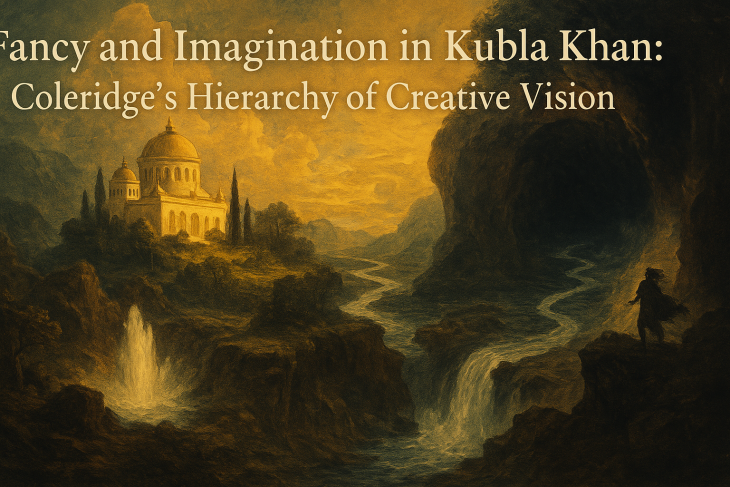
Fancy and Imagination in Kubla Khan: Coleridge’s Hierarchy of Creative Vision
In discussing fancy and imagination in relation to Kubla Khan, it is useful to situate Samuel Taylor Coleridge within the broader Romantic debate about how the mind organizes experience and produces art. His theoretical distinction—outlined most explicitly in Biographia Literaria—provides a valuable interpretive lens for the poem’s famously dreamlike architecture.
Fancy: The Mechanical Faculty
Coleridge described fancy as a passive, aggregative power. It rearranges sensory data without fundamentally transforming them. Fancy compiles rather than creates. It relies on memorised images, conventional associations, and the surface play of the mind. In Romantic-era criticism, fancy was thus aligned with decorative or episodic description, often compared to a cabinet of curiosities in which disparate objects are merely placed next to one another.
In Kubla Khan, fancy appears in those sections where Coleridge provides ornate, picturesque details that do not alter the substance of natural images but simply embellish them.
For instance, the catalogue of features within the pleasure-dome—the “gardens bright with sinuous rills,” “forests ancient as the hills”—draws on exoticised travel narratives and Orientalist motifs available in eighteenth-century print culture. These images remain recognisable; they are rearrangements of known forms rather than new symbolic entities.
Imagination: The Transformative Faculty
Coleridge distinguishes between two orders of imagination:
A. Primary Imagination
- The “living power and prime agent of all human perception.”
- It functions unconsciously and universally, shaping raw sensory data into coherent perceptions.
- It is the mind’s creative act merely in perceiving the world.
In the poem, the very act of registering the dream-vision—its mountains, caverns, and river—is an instance of primary imagination at work. Coleridge’s dream becomes intelligible because the mind automatically synthesizes sensory fragments into an ordered, if uncanny, landscape.
B. Secondary Imagination
- The poet’s conscious and volitional re-creation.
- It dissolves and reconstitutes elements to produce new wholes.
- It is an echo of the primary imagination, but operating with artistic intention.
In Kubla Khan, secondary imagination is most evident in the poem’s symbolic transformations. The landscape ceases to be merely exotic and becomes charged with psychological and metaphysical resonance.
- The “deep romantic chasm,” described as “a savage place,” embodies eruptive, Dionysian creative power—an image not found in travel literature but generated by the poet’s own imaginative transmutation.
- The river Alph, flowing “through caverns measureless to man / Down to a sunless sea,” becomes an emblem of the unconscious, the origin and dissolution of creative energy. Here, secondary imagination turns natural scenery into a metaphorical system that gestures toward the depths of the mind.
The Poem as a Drama of the Two Faculties
Viewed chronologically, Kubla Khan stages a movement from fancy to imagination.
- The opening lines present a structured imperial project—“stately pleasure-dome,” geometry, enclosure—signifying fancy’s tendency to assemble orderly surfaces.
- These orderly images collapse into the tumultuous, volcanic centre of the poem, where the imagination breaks through like the “mighty fountain” that bursts forth with “ceaseless turmoil.” This eruption symbolises the creative act itself, the moment in which secondary imagination overcomes fancy’s limitations and shapes a visionary world whose logic is psychological rather than topographical.
Romantic critics have noted parallel developments in other traditions. For example, William Blake’s belief that “the imagination is not a state” but “the human existence itself” elevates imagination to a sacred faculty, while German Romantics such as Novalis conceived the imagination as a bridge between the sensible and the infinite. Coleridge’s formulation aligns with these currents, yet remains distinctive in differentiating the mechanical (fancy) from the organic (imagination).
Conclusion
In the context of Kubla Khan, then:
- Fancy provides the ornamental setting: the exotic dome, the symmetrical gardens, the catalogue-like descriptions drawn from external sources.
- Primary imagination is the underlying perceptual act that renders the dream coherent.
- Secondary imagination reshapes those perceptions into symbolic images that express the turbulent processes of creativity.
Thus, the poem becomes not merely a fragment of Orientalist fantasy but an exploration of the mind’s creative principles: a movement from the decorative to the visionary, from the mechanical play of fancy to the profound, reshaping power of the imagination.
16 comments
новости беларуси главные новости беларуси
Свежая рабочая кракен ссылка проверяется на подлинность через сверку SSL сертификата и сравнение адреса в нескольких независимых проверенных источниках.
Стоит посмотреть: https://medim-pro.ru/kupit-spravku-ot-sportivnogo-vracha/
Free video chat emerald chat site find people from all over the world in seconds. Anonymous, no registration or SMS required. A convenient alternative to Omegle: minimal settings, maximum live communication right in your browser, at home or on the go, without unnecessary ads.
Top picks for you: https://whatson.clients.shapeshift.co.za/buy-tiktok-accounts-with-followers-gain-instant-4/
Защищенный кракен онион использует современное шифрование для предотвращения перехвата данных и отслеживания активности пользователей третьими сторонами.
Нужна работа в США? школа трак диспетчинга в сша экспресс курс : работа с заявками и рейсами, переговоры на английском, тайм-менеджмент и сервис. Подходит новичкам и тем, кто хочет выйти на рынок труда США и зарабатывать в долларах.
Uwielbiasz hazard? nv casino bonus: rzetelne oceny kasyn, weryfikacja licencji oraz wybor bonusow i promocji dla nowych i powracajacych graczy. Szczegolowe recenzje, porownanie warunkow i rekomendacje dotyczace odpowiedzialnej gry.
The best is right here: https://angdesh.com/author/marladecote/
La plateforme 1xbet burkina: paris sportifs en ligne, matchs de football, evenements en direct et statistiques. Description du service, marches disponibles, cotes et principales fonctionnalites du site.
Site web 1xbet rdc – paris sportifs en ligne sur le football et autres sports. Propose des paris en direct et a l’avance, des cotes, des resultats et des tournois. Description detaillee du service, des fonctionnalites du compte et de son utilisation au Congo.
Site web de parifoot rd congo: paris sportifs, championnats de football, resultats des matchs et cotes. Informations detaillees sur la plateforme, les conditions d’utilisation, les fonctionnalites et les evenements sportifs disponibles.
La plateforme en ligne telecharger 1xbet apk: paris sportifs en ligne, matchs de football, evenements en direct et statistiques. Description du service, marches disponibles, cotes et principales fonctionnalites du site.
Application mobile 1xbet apk. Paris sportifs en ligne, football et tournois populaires, evenements en direct et statistiques. Presentation de l’application et de ses principales fonctionnalites.
You really make it seem so easy with your presentation but I find this matter to be actually something which I think I would never understand. It seems too complex and extremely broad for me. I’m looking forward for your next post, I’ll try to get the hang of it!
Thanks for another great post. Where else could anybody get that kind of information in such an ideal way of writing? I have a presentation next week, and I am on the look for such information.