Modern English Prose: A Guide on Four Authors
Historical Context: The Modernist Revolution (1890s-1940s)
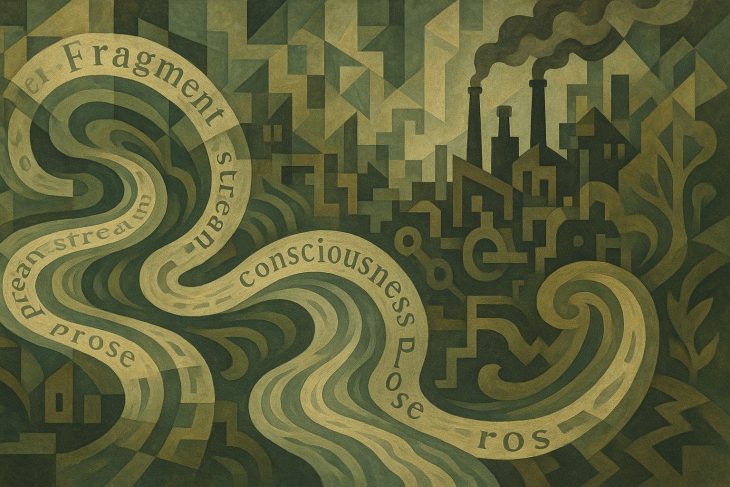
The period of Modern Prose emerged during a time of unprecedented social, political, and technological upheaval. The Industrial Revolution had fundamentally altered human experience, World War I had shattered traditional beliefs about progress and civilization, and new scientific discoveries—particularly Einstein’s theory of relativity and Freud’s exploration of the unconscious—challenged conventional understanding of reality and human psychology. This era witnessed the decline of the British Empire, the rise of feminism, urbanization, and rapid technological advancement. Writers began questioning traditional narrative techniques, linear storytelling, and omniscient narration. Instead, they experimented with stream of consciousness, fragmented narratives, and psychological realism to capture the complexity of modern human experience. The movement was characterized by a rejection of Victorian moral certainties, an exploration of alienation and fragmentation in modern life, and an emphasis on subjective experience over objective reality. Authors sought to represent consciousness itself rather than external events, leading to revolutionary literary techniques that continue to influence contemporary writing.
James Joyce (1882-1941): Master of Stream of Consciousness
James Joyce revolutionized modern fiction through his innovative narrative techniques and unflinching portrayal of human consciousness. Born in Dublin, Joyce spent most of his adult life in exile, yet his work remained deeply rooted in Irish experience and the city of Dublin, which he famously claimed he could reconstruct from his writings alone. Joyce’s literary evolution demonstrates a progressive movement toward experimental technique. His early work, Dubliners (1914), presents a realistic portrayal of middle-class Dublin life through fifteen interconnected stories that reveal what Joyce termed the “paralysis” of Irish society. Each story employs the technique of “epiphany”—moments of sudden spiritual manifestation—where characters experience profound realizations about their lives.
A Portrait of the Artist as a Young Man (1916) introduced Joyce’s stream of consciousness technique, following Stephen Dedalus’s intellectual and artistic development from childhood to young adulthood. The novel’s language evolves with its protagonist, beginning with childlike simplicity and progressing to complex philosophical discourse. Ulysses (1922), Joyce’s masterpiece, parallels Homer’s Odyssey while chronicling a single day in Dublin (June 16, 1904). The novel employs various narrative styles, from traditional realism to experimental techniques that mirror the consciousness of its characters. Leopold Bloom and Stephen Dedalus emerge as modern equivalents of Odysseus and Telemachus, navigating the complexities of urban existence. Joyce’s final work, Finnegans Wake (1939), pushes linguistic experimentation to its limits, creating a dream-language that blends multiple tongues and cultural references. His influence on subsequent literature cannot be overstated—he demonstrated that fiction could capture the full complexity of human thought and experience through innovative formal techniques.
D.H. Lawrence (1885-1930): Prophet of Passion and Nature
David Herbert Lawrence emerged as one of the most controversial and influential voices of modernist literature, advocating for a return to instinctual life and authentic emotional experience in an increasingly mechanized world. Born into a working-class family in Nottinghamshire, Lawrence’s background profoundly influenced his writing, which often explores conflicts between industrial society and natural life, intellect and instinct, social convention and individual passion. Lawrence’s fiction is characterized by its psychological intensity and frank treatment of sexuality, which led to censorship battles throughout his career. His novel Sons and Lovers (1913) draws heavily on his own experience, exploring the psychological dynamics between Paul Morel, his possessive mother, and his relationships with women. The novel demonstrates Lawrence’s belief that modern civilization had created unhealthy psychological dependencies that prevented authentic human relationships.
The Rainbow (1915) and Women in Love (1920) form a connected exploration of three generations of the Brangwen family, examining how industrial modernization affects human relationships and consciousness. These novels showcase Lawrence’s distinctive prose style, which combines realistic social observation with poetic, symbolic language that seeks to capture the unconscious currents of human experience. Lady Chatterley’s Lover (1928), perhaps his most famous work, caused scandal for its explicit treatment of sexuality and its critique of class barriers. The novel advocates for sexual fulfillment and connection with nature as antidotes to the sterility of modern industrial society. Lawrence’s writing philosophy emphasized the importance of “blood consciousness”—instinctual, emotional knowledge that he believed modern society had suppressed in favor of purely intellectual understanding. His travel writing and essays further developed these themes, advocating for primitive cultures and natural environments as alternatives to Western civilization’s perceived decadence.
Joseph Conrad (1857-1924): Explorer of Moral Ambiguity
Józef Teodor Konrad Korzeniowski, known to the literary world as Joseph Conrad, brought a unique perspective to English literature as a Polish-born author who learned English as his third language. His maritime experience and colonial background provided material for novels that explore the dark corners of human nature and the moral complexities of imperialism. Conrad’s fiction is characterized by its psychological depth and moral ambiguity. Unlike his Victorian predecessors who often presented clear moral distinctions, Conrad explored the gray areas of human behavior, particularly under extreme circumstances. His narrative technique frequently employs unreliable narrators and frame narratives that complicate simple interpretations of events.
Heart of Darkness (1899), perhaps his most studied work, follows Charlie Marlow’s journey into the African interior in search of the mysterious Kurtz. The novella operates on multiple levels: as an adventure story, a critique of Belgian colonialism in the Congo, and a philosophical exploration of civilization’s fragility. The work’s treatment of African characters has generated considerable critical debate, highlighting Conrad’s complex relationship with the imperial context of his era. Lord Jim (1900) examines questions of honor, cowardice, and redemption through the story of a young officer who abandons his ship during a crisis. The novel’s non-linear narrative structure reflects Conrad’s interest in how we construct meaning from fragmented experiences and memories. Nostromo (1904), set in the fictional South American republic of Costaguana, presents a sweeping analysis of political corruption and material interests. The novel demonstrates Conrad’s ability to create complex social and political landscapes while maintaining focus on individual psychological drama. Conrad’s prose style combines vivid descriptive power with philosophical reflection. His famous preface to The Nigger of the ‘Narcissus’ articulates his literary credo: “to make you hear, to make you feel… to make you see.”
Virginia Woolf (1882-1941): Pioneer of Psychological Realism
Virginia Woolf stands as one of modernism’s most innovative voices, pioneering techniques that revolutionized how fiction represents consciousness and temporal experience. As a central figure in the Bloomsbury Group, Woolf was at the heart of London’s intellectual and artistic community, engaging with contemporary developments in psychology, philosophy, and the arts. Woolf’s literary technique centers on stream of consciousness and what she termed “moments of being”—instances of heightened awareness that reveal deeper truths about existence. Her novels abandon traditional plot structures in favor of psychological exploration, moving fluidly between characters’ minds to create a multifaceted portrait of experience.
Mrs. Dalloway (1925) follows Clarissa Dalloway through a single day in London as she prepares for an evening party. The novel weaves together multiple consciousness streams, including those of shell-shocked war veteran Septimus Warren Smith, creating a complex meditation on time, memory, and the effects of World War I on British society. Woolf’s innovative technique shows how seemingly ordinary moments contain profound psychological and social significance. To the Lighthouse (1927) explores the Ramsay family’s experiences at their summer home, using a tripartite structure that spans ten years. The novel’s famous “Time Passes” section demonstrates Woolf’s ability to compress vast temporal spans while maintaining focus on consciousness and perception. The work examines themes of art, death, and the relationship between male and female perspectives. Orlando (1928), written as a tribute to Vita Sackville-West, follows its protagonist through four centuries and a gender transformation, allowing Woolf to explore questions of identity, sexuality, and the construction of gender roles. Woolf’s literary criticism, particularly essays like “Modern Fiction” and “A Room of One’s Own,” articulates her aesthetic philosophy and feminist perspective. She advocated for fiction that captures the “luminous halo” of consciousness rather than following conventional narrative patterns.
Conclusion
These four authors collectively demonstrate modernist prose’s revolutionary impact on literary technique and subject matter. Their innovations in stream of consciousness, psychological realism, and narrative structure continue to influence contemporary fiction, while their exploration of alienation, sexuality, and moral ambiguity remains relevant to contemporary readers. Understanding their contributions provides essential foundation for studying twentieth-century literature and its ongoing influence on contemporary writing.
5 comments
Incredible points. Great arguments. Keep up the great effort.
Appreciating the time and effort you put into your blog and detailed information you offer.
It’s great to come across a blog every once in a while that isn’t the same out of date
rehashed material. Excellent read! I’ve saved your site and I’m including your RSS feeds to my Google account.
I like it when people come together and share ideas. Great blog, continue the good work!
This is a topic close to my heart cheers, where are your contact details though?
I’ve been browsing online more than 4 hours today, yet I never found any interesting article like yours. It’s pretty worth enough for me. In my opinion, if all website owners and bloggers made good content as you did, the net will be a lot more useful than ever before.