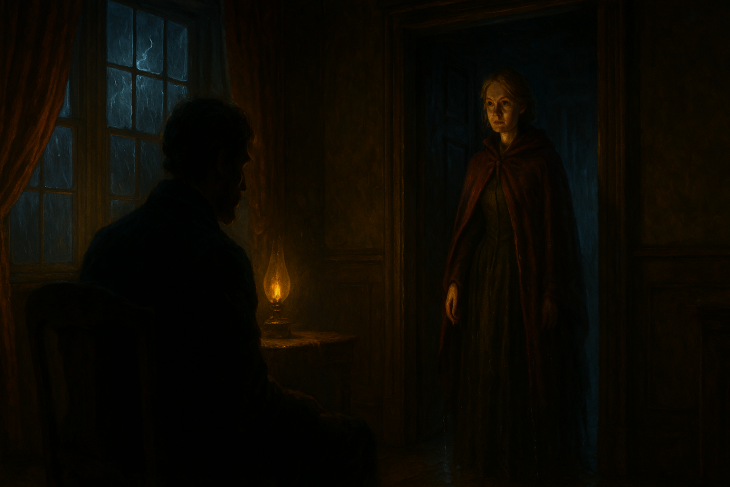
The Dark Psychology of Possession: A Deep Dive into Browning’s “Porphyria’s Lover”
Robert Browning’s “Porphyria’s Lover” stands as one of Victorian literature’s most chilling dramatic monologues, a masterful exploration of obsession, control, and the darker recesses of the human psyche. Written in 1836 and initially published alongside “Johannes Agricola in Meditation” under the collective title “Madhouse Cells,” this poem showcases Browning’s fascination with abnormal psychology and his innovative use of the dramatic monologue form to probe the minds of deeply disturbed individuals.
The Poet and His Psychological Explorations
Robert Browning (1812-1889) emerged as one of the Victorian era’s most distinctive voices, particularly renowned for perfecting the dramatic monologue. Unlike his Romantic predecessors who focused on autobiographical introspection, Browning used poetry to inhabit other consciousnesses entirely. His interest in psychology, pathology, and human motivation led him to create speakers whose moral frameworks deviated dramatically from societal norms, allowing him to explore taboo subjects while maintaining artistic distance.
Browning’s fascination with disease and mental illness is evident in his choice of the name “Porphyria” for his poem’s victim. Porphyria is a rare metabolic disorder that causes physical weakness, fever, confusion, and in severe cases, delusions and psychological disturbance—symptoms that had been recently identified in the years before the poem’s composition. This medical reference suggests that the speaker himself may be suffering from the disease, his violent delusions a symptom of his deteriorating mental state. Browning’s use of this contemporary medical knowledge demonstrates his engagement with scientific developments and his desire to ground psychological aberration in physiological reality.
Victorian Gender Politics and Sexual Transgression
To fully appreciate the poem’s subversive power, we must understand the rigid gender expectations of early Victorian society. The 1830s witnessed the hardening of gender roles, particularly for middle- and upper-class women, who were increasingly confined to domestic spheres as “angels in the house.” Women’s sexuality was strictly controlled, and any expression of independent desire was considered scandalous.
Against this backdrop, Porphyria’s behavior in the poem is startlingly transgressive. She arrives alone at the speaker’s cottage on a stormy night, having left a “gay feast” to satisfy her “struggling passion.” She actively pursues the speaker, manipulating his body by putting “my arm about her waist,” baring her shoulder, and arranging his head upon it. For Victorian readers, these actions would have been shocking displays of female agency and sexual autonomy.
The speaker’s violent response can be read as an extreme manifestation of Victorian anxieties about female sexuality and independence. By strangling Porphyria, he literally silences her voice and agency, transforming her from an active subject into a passive object—”mine, mine.” His insistence that she is “perfectly pure and good” after death suggests his desire to preserve her in a state that conforms to Victorian ideals of feminine passivity and sexual purity. The murder becomes a perverse act of preservation, freezing Porphyria in a moment of supposed moral perfection before she can “sin” further by fully consummating their relationship.
The Dramatic Monologue as Psychological Revelation
Browning’s use of the dramatic monologue form is crucial to the poem’s impact. By giving the speaker direct voice without authorial commentary, Browning creates an unreliable narrator whose perspective we cannot escape. We experience the events entirely through the murderer’s consciousness, forced to navigate the gap between his interpretation and reality.
The speaker’s obsessive attention to minute details—Porphyria’s hair, her gloves, the positioning of her head—reveals his need for control. His meticulous documentation of her actions suggests he is measuring power dynamics, cataloging each movement for signs of dominance or submission. When he describes gathering “all her hair / In one long yellow string,” the repetition of earlier descriptions creates what the LitChart analysis calls “deferred parallelism,” throwing disturbing light on his earlier fixation. What seemed like tender observation becomes sinister premeditation.
The poem’s formal structure reinforces the speaker’s psychology. Written in tightly controlled iambic tetrameter with an unusual ABABB rhyme scheme, the poem’s obsessive regularity mirrors the speaker’s need for control. The rhyme scheme feels like a standard ABAB quatrain with an extra line tacked on—something that can’t quite be let go, reflecting the speaker’s obsessive inability to release his grip on Porphyria or his delusions.
Figurative Language and Sonic Texture
Browning’s deployment of figurative language reveals the speaker’s twisted logic and the poem’s thematic concerns. The personification of the wind in the opening lines—which “tore the elm-tops down for spite”—establishes a world of malicious agency, foreshadowing the speaker’s own spiteful violence. The consonance of harsh /t/ sounds (“It tore the elm-tops down for spite”) creates a percussive effect that mimics the trees cracking, establishing the poem’s violent soundscape from the outset.
The speaker’s single simile appears when he opens Porphyria’s eyes after strangling her: “As a shut bud that holds a bee, / I warily oped her lids.” This comparison dehumanizes Porphyria, reducing her eye to an insect and her eyelid to a flower petal. The simile reveals his anxiety—he fears her eye will “sting” him, suggesting some awareness that his violence has transformed her into something dangerous or accusatory. Yet it also continues his objectification, turning her body into a collection of natural objects rather than a human whole.
The poem’s use of alliteration and assonance serves multiple functions as the speaker’s psychological state shifts. Early in the poem, the /p/ sound links “passion” and “prevail,” emphasizing Porphyria’s desire. Later, the same sound appears in “Perfectly pure,” now serving the speaker’s need to reimagine her sexuality. The assonant /i/ sound in “mine, mine, fair, / Perfectly pure and good: I found” reveals the speaker’s true focus—not Porphyria’s purity but his own possession, the repeated “I” sounds giving him away.
Most chillingly, the consonant /l/ sound runs through the strangulation scene: “all her hair / In one long yellow string I wound / Three times her little throat around, / And strangled her.” This sonic rope wraps around the lines themselves, making readers feel the tightening of the hair. When the same /l/ sound reappears in “No pain felt she; / I am quite sure she felt no pain,” it becomes almost painful to encounter, the memory of strangulation still viscerally present.
The Blazon Tradition and Bodily Dismemberment
Browning engages critically with the poetic tradition of the blazon—a Renaissance convention in which poets cataloged and praised individual parts of their mistress’s body (eyes like gems, teeth like pearls, etc.). The speaker’s obsessive attention to Porphyria’s eyes, hair, neck, cheek, and head evokes this tradition, but perverts it. Rather than praising her beauty, his fragmented attention suggests actual dismemberment, a refusal to see Porphyria as a complete human being.
This becomes explicit when he refers to her head as “it”: “So glad it has its utmost will, / That all it scorned at once is fled, / And I, its love, am gained instead!” By substituting “it” for “she,” the speaker reveals that he has transformed Porphyria from person to object, from subject to possession. His self-correction to “Porphyria’s love” in the next line suggests some discomfort with this objectification, but the damage is done—in his mind and in reality, she has been reduced to component parts.
God’s Silence and Moral Justification
The poem’s conclusion—”And yet God has not said a word!”—represents the speaker’s ultimate delusion. He interprets divine silence as approval, convinced that God values Porphyria’s sexual purity so highly that murder is justified to preserve it. This reflects Victorian religious hypocrisy, where moral transgression (particularly sexual) could seem to matter more than violence or human life.
Yet Browning plants a subtle metrical disruption in this final line. The word “God” introduces an unexpected trochee (stressed-unstressed) into the otherwise regular iambic pattern: “And yet | God has | not said | a word!” This metrical stumble suggests the speaker’s confidence may be less absolute than he pretends. Perhaps he is not quite as certain of divine approval as he claims.
Browning may also be implicating his Victorian readership in the speaker’s hypocrisy. Contemporary readers would likely have condemned Porphyria for her sexual forwardness while finding the poem’s violence titillating. By giving them exactly what they want—a sexually transgressive woman punished—Browning exposes the moral bankruptcy of privileging sexual “purity” over human life.
The Enduring Power of Psychological Realism
“Porphyria’s Lover” remains disturbing because Browning refuses easy answers. The speaker may be mad, suffering from the disease for which his victim is named, but his madness follows a perverse internal logic rooted in the gender politics and sexual anxieties of his culture. By inhabiting this consciousness so completely, Browning creates a dramatic monologue that functions as both psychological case study and cultural critique.
The poem’s formal brilliance—its obsessive meter, unusual rhyme scheme, and masterful use of sound devices—serves its psychological realism. Every formal choice reveals something about the speaker’s need for control, his objectification of Porphyria, or his desperate self-justification. Nearly two centuries after its composition, the poem continues to unsettle readers with its portrait of how love can become possession, how desire can transform into violence, and how easily humans rationalize the unforgivable. In this, Browning created not just a Victorian curiosity but a timeless exploration of the darkest capacities of the human heart.


One thought on “The Dark Psychology of Possession: A Deep Dive into Browning’s “Porphyria’s Lover””
You are a very capable person!