The Dramatic Monologue: When Poetry Becomes Theatre
Imagine eavesdropping on someone’s private thoughts—not the polished, carefully curated musings we present to the world, but the raw, unfiltered stream of consciousness that reveals who we really are. That’s essentially what a dramatic monologue does: it gives us a front-row seat to a character’s mind at a crucial moment, often when they’re trying to justify something dark, confusing, or morally complicated.
What Exactly Is a Dramatic Monologue?
A dramatic monologue is a poem in which a single character speaks to a silent listener (or listeners) at a critical moment. The speaker inadvertently reveals aspects of their personality, situation, and psychology—often more than they realize or intend. Think of it as a one-person play frozen in verse.
The form has three essential ingredients:
- A single speaker addressing someone specific (though we only hear one side)
- A dramatic situation unfolding at a particular moment in time
- Unconscious self-revelation—the speaker tells us more about themselves than they mean to
The Victorian era was the golden age of the dramatic monologue, and no one mastered it quite like Robert Browning. While Tennyson gave us the melancholic beauty of “Ulysses” and T.S. Eliot later experimented with the form in “The Love Song of J. Alfred Prufrock,” Browning used the dramatic monologue to explore the darkest corners of human psychology.
“Porphyria’s Lover”: Love, Murder, and Madness
Let’s look at what might be Browning’s most chilling dramatic monologue: “Porphyria’s Lover.” The poem opens on a stormy night. A woman named Porphyria enters a cottage and finds her lover sitting silently in the dark. She lights a fire, removes her wet outdoor clothes, and embraces him—clearly, she loves him deeply.
Then comes one of the most shocking turns in Victorian poetry. The speaker suddenly strangles Porphyria with her own hair and props her dead body beside him, convinced that he’s preserved the perfect moment of her love forever:
“That moment she was mine, mine, fair,
Perfectly pure and good: I found
A thing to do, and all her hair
In one long yellow string I wound
Three times her little throat around,
And strangled her.”
What makes this dramatic monologue so powerful—and so disturbing—is that the speaker doesn’t think he’s done anything wrong. He’s explaining his actions as if they’re perfectly reasonable. In his twisted logic, killing Porphyria at the height of her love preserves that moment forever. The final line is bone-chilling in its casualness: “And yet God has not said a word!”
Why Browning? Why Now?
Browning wrote during the height of Victorian moral certainty, yet his dramatic monologues expose the fragility of that certainty. His speakers are dukes, clergy, artists, and lovers—respectable people by Victorian standards—but their monologues reveal hypocrisy, cruelty, obsession, and madness lurking beneath polished surfaces.
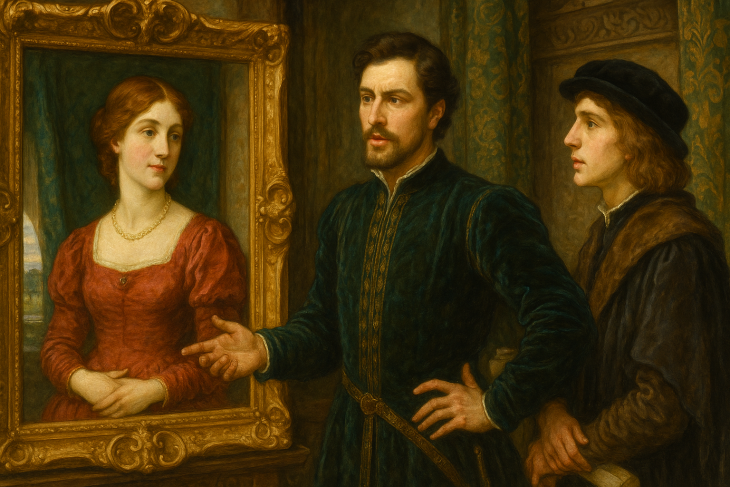
In “My Last Duchess,” a Renaissance duke casually reveals that he had his first wife murdered because she smiled too freely. In “The Bishop Orders His Tomb,” a dying clergyman exposes his materialism and petty rivalries even as he prepares to meet his maker. These aren’t villains in the conventional sense—they’re complex, self-deluding human beings who think they’re in the right.
What’s brilliant about Browning’s technique is that he never judges his speakers directly. He simply lets them talk, and in talking, they condemn themselves. We, as readers, become the jury, piecing together the truth from what the speaker says and, more importantly, from what they reveal without meaning to.
The Modern Legacy
The dramatic monologue didn’t die with the Victorians. T.S. Eliot’s “Prufrock” is essentially a modern dramatic monologue, though the listener becomes more abstract. Gwendolyn Brooks used the form to explore race and identity. More recently, poets like Carol Ann Duffy have revived the dramatic monologue to give voice to historical and mythological figures—often women who were silenced in the original stories.
The form endures because it captures something essential about human nature: we’re all unreliable narrators of our own lives. We tell ourselves stories to make sense of our actions, to justify our choices, to explain why we’re not quite who we wanted to be. The dramatic monologue simply makes that internal narrative external—and in doing so, it reveals us to ourselves.
Try it yourself: Read “Porphyria’s Lover” aloud. Notice how the rhythm and rhyme scheme create an almost hypnotic effect, lulling us into the speaker’s distorted worldview. Then read it again and ask: What is the speaker not telling us? What gaps can we detect in his story? That’s where the real art of the dramatic monologue lives—in the space between what is said and what is revealed.

One thought on “The Dramatic Monologue: When Poetry Becomes Theatre”
Hello There. I found your blog the use of msn. This is an extremely neatly written article. I will be sure to bookmark it and return to read more of your helpful information. Thanks for the post. I will certainly comeback.