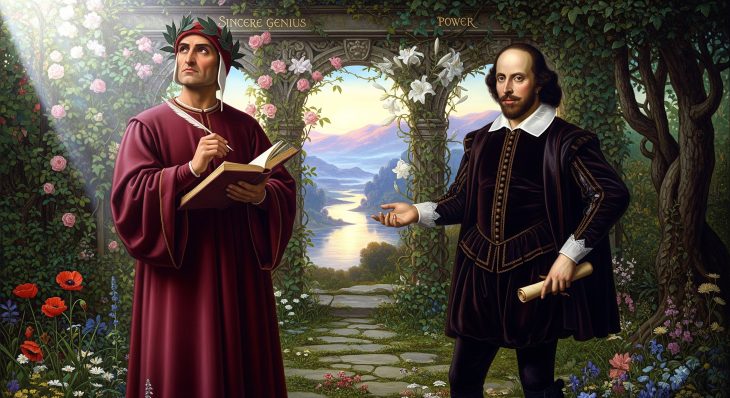
Thomas Carlyle’s Vision of the Hero as Poet: Dante, Shakespeare, and the Power of Sincere Genius
In the midst of Victorian England’s industrial roar and materialistic fervor, one voice thundered louder than all others with prophetic intensity. Thomas Carlyle, the Scottish essayist and historian who lived from 1795 to 1881, emerged as the foremost non-fictional prose writer of his age, wielding words like a biblical prophet calling his generation back to spiritual truths. His major works, including the allegorical autobiography Sartor Resartus, the vivid historical panorama of The French Revolution, and his series of lectures On Heroes, Hero-Worship and the Heroic in History, attacked what he saw as the twin evils of materialism and utilitarianism with unrelenting zeal. From this last work comes “The Hero as Poet,” a lecture that reveals not only Carlyle’s theory of heroism but also the extraordinary power and peculiarity of his prose style.
The Timeless Nature of Poetic Heroism
Carlyle begins by distinguishing the Poet from earlier forms of heroism. While the Hero as Divinity and the Hero as Prophet belonged to ruder, more credulous ages that could imagine their fellow men as gods or god-inspired speakers, the Poet represents something more permanent. The Poet is a heroic figure belonging to all ages, one whom “the newest age as the oldest may produce” whenever Nature pleases. This immediately elevates poetry from mere aesthetic entertainment to a fundamental human necessity, something that speaks to eternal truths rather than temporary circumstances.
Yet Carlyle’s conception of heroism refuses neat categorization. He insists that all great men share fundamental qualities, regardless of whether they manifest as Poets, Prophets, Kings, or Priests. “I confess, I have no notion of a truly great man that could not be all sorts of men,” he declares. The essential characteristic is greatness itself—”the great heart, the clear deep-seeing eye.” The particular form this greatness takes depends on circumstances, on the age and world into which the hero is born. A Shakespeare in different circumstances might have been a King; a Mirabeau with different education might have been a great Poet. This universality of heroic potential runs throughout Carlyle’s thinking.
The Sacred Mystery and the Open Secret
One of Carlyle’s most compelling ideas concerns what unites the Poet and the Prophet. Both have penetrated into what Goethe called “the open secret”—that divine mystery which lies everywhere in all beings, “the Divine Idea of the World, that which lies at the bottom of Appearance.” While most people live forgetting this sacred mystery, treating the universe as if it were “a dead thing, which some upholsterer had put together,” the Poet and Prophet remain perpetually aware of it. This awareness is not intellectual knowledge alone but a lived reality: “he finds himself living in it, bound to live in it.”
The difference between Poet and Prophet lies in their approach to this mystery. The Prophet seizes it on the moral side, as Good and Evil, Duty and Prohibition. The Poet grasps it on what Germans call the aesthetic side, as Beautiful. But these provinces ultimately merge, for as Carlyle observes through Goethe’s insight, “The Beautiful is higher than the Good; the Beautiful includes in it the Good.” The true Beautiful differs from the false “as Heaven does from Vauxhall,” and authentic beauty cannot exist without goodness at its core.
Sincerity: The Foundation of All Heroism
Running beneath all Carlyle’s analysis is one absolute requirement: sincerity. The true Poet-Hero cannot help being sincere because he lives not in “the shows of things” but “in the very fact of things.” This sincerity emerges from direct insight and belief rather than hearsay. Carlyle argues passionately that poetry must be “musical not in word only, but in heart and substance, in all the thoughts and utterances of it, in the whole conception of it” to be truly poetical. A musical thought is one spoken by a mind that has penetrated to the inmost heart of the thing and detected its inner melody, “the inward harmony of coherence which is its soul.”
This leads to one of Carlyle’s most striking declarations: “See deep enough, and you see musically; the heart of Nature being everywhere music, if you can only reach it.” Poetry, then, is not primarily about meter or rhyme but about the depth of vision. All deep things naturally utter themselves in song, and all passionate language becomes musical. The Greeks’ notion of Sphere-Harmonies expressed their intuition that “the soul of all her voices and utterances was perfect music.”
Dante: The Voice of Ten Silent Centuries
When Carlyle turns to specific examples, he begins with Dante, whom he calls the voice of ten silent centuries. Born in Florence in 1265, Dante received the best education available and rose to become one of the city’s chief magistrates. Yet his life became marked by profound suffering. His childhood love for Beatrice Portinari, who married another and died young, left him with a wound that never healed. Political turmoil led to his banishment from Florence, with a decree condemning him to be burned alive if caught. He spent the rest of his life as a homeless wanderer, poor and friendless.
But Carlyle does not lament this suffering. Instead, he sees it as necessary: “Had all gone right with him as he wished it, he might have been Prior, Podesta, or whatsoever they call it, of Florence, well accepted among neighbors—and the world had wanted one of the most notable words ever spoken or sung.” The deeper Dante’s earthly suffering, the deeper became his insight into the eternal world. His thoughts naturally brooded on Hell, Purgatory, and Heaven, which he believed in with the same certainty that we believe we would see Constantinople if we traveled there.
The Divine Comedy that emerged from this suffering is what Carlyle calls “the most remarkable of all modern Books.” It represents not just Dante’s personal creation but the culmination of Christian meditation by all the good men who had gone before him. The poem’s three parts—Inferno, Purgatorio, and Paradiso—form “a great supernatural world-cathedral,” expressing how the Christian Dante felt Good and Evil to be polar elements of creation, differing “not by preferability of one to the other, but by incompatibility absolute and infinite.”
Carlyle praises especially Dante’s intensity: “I know nothing so intense as Dante.” This intensity manifests in his brief, precise painting of scenes, his abrupt precision reminiscent of Tacitus. “His silence is more eloquent than words,” Carlyle observes. This power of vision and condensation comes from sympathizing with his subject, from seeing into the heart of things. Dante’s moral greatness undergirds everything: “His scorn, his grief are as transcendent as his love.”
Shakespeare: Nature’s Supreme Gift
If Dante gave us the Inner Life of Europe—its Christian faith and soul—Shakespeare gave us the Outer Life: “its chivalries, courtesies, humors, ambitions, what practical way of thinking, acting, looking at the world, men then had.” Carlyle places Shakespeare at the pinnacle of human achievement, calling him possibly “the greatest intellect who, in our recorded world, has left record of himself in the way of Literature.”
What sets Shakespeare apart is what Carlyle terms his “unconscious intellect.” Shakespeare’s works grew from the deeps of Nature through him, almost despite his conscious intention. “Shakespeare’s Art is not Artifice,” Carlyle insists; “the noblest worth of it is not there by plan or precontrivance. It grows up from the deeps of Nature.” This makes Shakespeare’s works like products of Nature herself, with future generations continually finding “new meanings in Shakespeare, new elucidations of their own human being.”
Carlyle marvels at Shakespeare’s calm creative perspicacity, his ability to see objects not in one aspect but in their inmost heart and generic secret. This vision dissolves things “as in light before him, so that he discerns the perfect structure of it.” The understanding manifested in constructing Shakespeare’s dramas equals that in Bacon’s Novum Organum, yet Carlyle considers Bacon’s intellect secondary and earthly compared to Shakespeare’s divine insight.
Perhaps most remarkably, Shakespeare achieved this while remaining essentially unconscious of his own prophetic role. Unlike Mahomet, who believed himself specially chosen as the Prophet of God, Shakespeare simply sang without claiming divine mission. Carlyle sees this unconsciousness as actually making Shakespeare greater: “It was intrinsically an error that notion of Mahomet’s, of his supreme Prophethood.” Shakespeare’s greatness lay in what was unconscious in him, in depths he himself was not fully aware of.
The Character of Carlyle’s Prose
The essay itself demonstrates what made Carlyle the most influential prose writer of his age. His style is eccentric and powerful, described in the document as “forceful, bizarre, tormented and poetic.” Sentences cascade forth in torrents of words, animated by rugged humor and comic exaggeration. Yet this vehement style can suddenly shift to achieve “beauty of expression that wrings the very heart: a sweet and piercing melody.”
Carlyle writes with prophetic earnestness, addressing readers directly with rhetorical questions and dramatic exclamations. His prose is dense with literary and historical allusions, foreign phrases, and extended metaphors. The rhythm often takes on biblical cadences, as in his repeated formulas: “yesterday, to-day and forever.” He speaks in aphorisms that stick in the mind: “Speech is great; but Silence is greater.”
This style perfectly embodies the Victorian non-fictional prose tradition at its height—earnest, morally urgent, intellectually dense, aimed at propagating ideas and influencing conduct. Yet Carlyle’s voice remains utterly individual, impossible to mistake for anyone else.
The Enduring Value of Hero-Worship
Carlyle concludes his lecture by emphasizing the practical value of the Poet-Hero. In a remarkable passage, he asks whether England would give up its Indian Empire or Shakespeare, suggesting the nation would ultimately choose the poet. Shakespeare serves as a unifying force for English-speaking peoples worldwide, “a thousand years hence” still radiating “as the noblest, gentlest, yet strongest of rallying-signs.”
This is more than nationalistic pride. Carlyle sees the articulate voice of genius as binding nations together more effectively than political arrangements: “The Nation that has a Dante is bound together as no dumb Russia can be.” True heroes endure because they speak from the depths of sincere human experience, and as Carlyle reminds us, “nothing so endures as a truly spoken word.”
In our own age, far removed from Victorian certainties yet still hungry for authentic voices, Carlyle’s vision of the Hero as Poet retains its power. His insistence on sincerity, depth of vision, and the unity of moral and intellectual excellence challenges our cynicism. Perhaps most valuably, he reminds us that the greatest human achievements come not from calculation but from seeing deeply into reality and speaking what is found there with complete honesty—a message every age needs to hear.
2 comments
Awesome website you have here but I was curious if you knew of any community forums that cover the same topics discussed in this article? I’d really like to be a part of community where I can get advice from other experienced individuals that share the same interest. If you have any recommendations, please let me know. Thank you!
I¦ve learn several excellent stuff here. Definitely worth bookmarking for revisiting. I wonder how much effort you set to create this type of fantastic informative site.