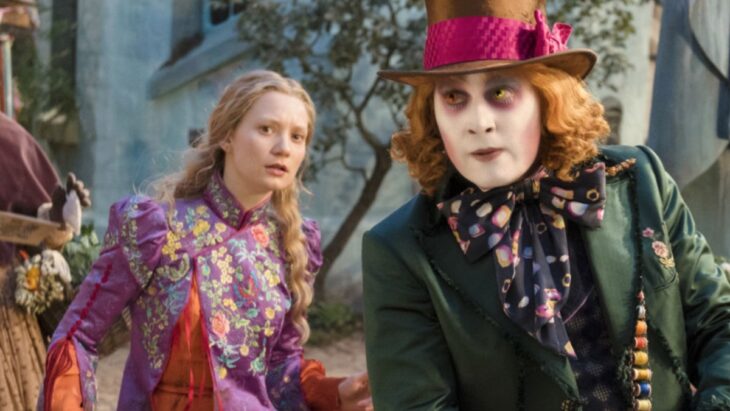
Through the Looking-Glass
Contributed by: Michelle Prebilic
Published 1871
| I | ABOUT THE AUTHOR |
Born Charles Lutwidge Dodgson (pronounced “Dod-son”) on January 27, 1832, in Daresbury, Cheshire, Lewis Carroll was the eldest son of Reverend Charles Dodgson and Frances Jane Lutwidge. His parents were socially well-connected cousins who belonged to families with strong traditions of service to the Anglican Church and to the Crown. Together they had four sons, including Carroll, and seven daughters.
Carroll’s father, Rector of Daresbury, held a zealous sense of obligation for the church. He worked for the parish poor, ran a Sunday school, organized lectures, increased the congregation’s size, and started a mission among the barge folk working on a canal. As a classical scholar, Carroll’s father published religious books and became the appointed Chaplain to the Bishop of Ripon. Later he became the Bishop of Ripon and finally a Canon of Ripon Cathedral. A powerful figure, Carroll’s “Papa” bestowed on him a sense of wit and humor, the significance of deep faithfulness, and good judgment in business.
Carroll’s “Mama,” Frances Jane Lutwidge, was a very sweet and gentle woman. Her letters to Carroll flowed with affection. Her gentleness balanced the sterner qualities of her husband. According to John Pudney in Lewis Carroll and His World, some believe that Carroll’s mother brought to his life the daydreams that never left him, thus contributing to his success with fairy-tales.
As a child, Carroll made pets of odd and unlikely animals, including snails and toads. It is not surprising that he developed the interesting and unusual creatures found in his fairy-tales.
In the Rectory grounds where Carroll grew, he devised a railway game for his siblings. He built the train using a wheelbarrow, a barrel, and a small truck. He placed stations at intervals in the gardens, and wrote rules to govern station use. His fascination with railways appears in Through the Looking-Glass, when Alice suddenly finds herself in the railway carriage without a ticket. “A Goat that was sitting next to the gentleman in white, shut his eyes, and said in a loud voice, ‘She ought to know her way to the ticket-office, even if she doesn’t know her alphabet!’”
At the age of twelve, Carroll was sent to boarding school in Richmond, where he composed Latin verses and wrote stories for the school magazine.
Carroll, almost six-feet tall and slender, inherited his father’s handsome face. He dressed neatly, wore an overcoat, and a top hat. Obsessed with the need for gloves, he wore them outdoors both summer and winter.
He attended Rugby School in 1846 and excelled in his studies. In 1850, he entered Christ Church College, Oxford. His stutter prevented him from following in his father’s career as a clergyman. Instead, he spent his life teaching and occasionally preached a sermon. He received a Bachelor of Arts degree from Oxford University, in 1854. The following year, he became “Master of the House.” His duties included lecturing in mathematics and teaching private pupils.
In 1856, the Reverend Charles Dodgson adopted his pen name from the Latin forms of his first and middle names. Dodgson became Lewis Carroll, a master of “nonsense” verse, fairy tales, and mathematical puzzles. Carroll earned a Master of Arts in 1857 and continued to teach at Christ Church, Oxford, where he remained for the rest of his life as a mathematics faculty member. The Church of England ordained Carroll as a Deacon in 1861. He authored books for children, mathematical treatises, and invented games of mathematics and logic. He became an amateur artist, illustrator, and portrait photographer, particularly of children. Carroll contributed to a small paper, The Comic Times, which later became The Train.
In December 1867, Carroll met eight-year-old Alice Theodora Raikes, the eldest daughter of friend Henry Cecil Raikes, during a visit to Onslow Square, London. They met in the garden behind the house where Carroll walked, according to John Pudney in Lewis Carroll and His World.
He asked Alice to his home where she saw a tall mirror standing in one corner. He put an orange in her right hand, asked her to look into the mirror, and then asked her which hand held the orange. She replied “The left hand.” Baffled she said “If I was on the other side of the glass, wouldn’t the orange still be in my right hand?” Carroll laughed, saying that’s “the best answer I’ve had yet.”
Inspired by this interaction with Alice Raikes, Carroll began the story Through the Looking-Glass. As Carroll developed Through the Looking-Glass over the next few years, he insisted on “reverse’ printing . . . such as you hold up to the looking-glass to read.”
Always a bachelor, Carroll followed a routine that included taking long country walks, telling his companions stories, and explaining logical problems. He took emotionally uplifting river excursions, played games of croquet, and took a few trips to the north and one visit to Russia—the only trip abroad.
The author wrote and published throughout his life, driving his talents and his pen hard. He lived simply and distributed his income where it could assist children to go on stage or help friends in need.
Carroll died from influenza on January 27, 1898 and is buried in the Old Guildford Cemetery. The white cross on his grave says, “Thy Will Be Done.” At the suggestion of a young friend, Children’s Hospital donated a crib in his memory.
| II | OVERVIEW |
In 1871, Macmillan published Carroll’s novel, Through the Looking-Glass. John Tenniel illustrated this sequel as well as the earlier novel Alice in Wonderland.
Carroll’s imagination takes readers with Alice into Looking-glass House. He fills the novel with situations from the ordinary to the extraordinary, the mundane to the silly, using the game of chess as the setting.
| III | SETTING |
The novel opens with Alice’s cat, Dinah, grooming her kittens. Alice gently scoops up a black kitten and scolds it for poor manners. As she half talks to herself and half sleeps, Alice imagines going into the Looking-glass House behind the mirror surrounding the fireplace. One thing leads to another, and Alice finds herself in the Looking-glass room.
Carroll immediately situates readers in the fantasy using the rules of chess. Alice finds herself in a chess game where anything can happen. Invisible to the Red King and Queen, Alice discovers that her enormous size enables her to move the Queen like a chess player would make a move. She brings the Queen, and then the King, next to their crying child. The zany action unfolds.
Familiar paraphernalia makes the story believable: the Red and White Kings and Queens, the pawns, and the garden-like chessboard. The unfamiliar events add the flair that characterizes Carroll’s style. He introduces the legendary Jabberwocky as Alice discovers a poem in a Looking-glass book. Alice floats down a stairway by keeping the tips of her fingers on the handrail, continues through the hallway, and almost out the door. The garden of flowers—Tiger Lilies, Roses, and Daisies—talks to her. Carroll engages fantasy and reality to create a believable Looking-glass world. He does it with such craft and description that none of it seems incongruous.
Carroll uses his interests in math and logic to develop his story. For example, the Red Queen asks Alice “Can you do Addition? What’s one and one and one and one . . . ” and “Can you do Subtraction? Take nine from eight” to which Alice replies, “Nine from eight I can’t, you know . . . ” This imitates the academic setting and career that epitomized Carroll’s life.
The author uses his expertise in nonsense verse, rhymes, humor, and puns to create songs, jokes, and stories throughout the novel. For example, clever humor develops the talking flowers: “There’s the tree in the middle,” said the Rose. “What else is it good for?”
“But what could it do, if any danger came?” Alice asked.
“It could bark,” said the Rose.
“It says Bough-wough!’” cried a Daisy. “That’s why its branches are called boughs.”
Through the Looking-Glass captures the imagination of childhood much like its predecessor Alice in Wonderland. Carroll creates the playful atmosphere that makes it possible to experience the story through a child’s eyes.
| IV | THEMES AND CHARACTERS |
Carroll develops Alice, an adventurous seven-and-a-half-year-old protagonist, as the prominent character. Carroll employs third-person limited point of view as he defines her imaginative, chatty, and self-scolding temperament. He discloses Alice’s thoughts through conversation as well as inner dialogue. For example, as the story opens, Alice chats with one of Dinah’s kittens, “pretending that the kitten was speaking.” This dialogue illustrates Alice’s imagination and playfulness. Alice describes the chessmen “in a whisper, for fear of frightening them,” showing her compassion. She conveys her thoughts about the Queen: “And she can run very fast!” The dialogue, thoughts, and feelings enable readers to understand Alice.
Although readers meet talking flowers and insects, the White Queen who turns into a sheep, and the lion and the unicorn, none seem to be as memorable as Tweedledum and Tweedledee, Humpty Dumpty, and the Red Knight. Alice’s experiences with these significant characters eventually lead to the fulfillment of her journey and her transition to Queen Alice.
Alice encounters Tweedledum and Tweedledee, two chubby men standing under a tree, each with an arm round the other’s neck. They epitomize proper behavior and courtesy. They hug like brothers and grin like schoolchildren. When Tweedledum and Tweedledee dress for battle, they agree to “fight till six, and then have dinner.” Carroll shares his rhyming skills through these characters by introducing the humorous verse “The Walrus and the Carpenter.”
Readers will recognize Humpty Dumpty who “sat on a wall: Humpty Dumpty had a great fall, all the King’s horses and all the King’s men, couldn’t put Humpty Dumpty in his place again.” Alice too discovers the human egg with an enormous face. His supercilious character declares “When I use a word it means just what I choose it to mean—neither more nor less.” He is clever with words, and defines the Jabberwocky poem for Alice. However, Humpty Dumpty uses a stern voice. Alice finds him distasteful, and exclaims “of all the unsatisfactory people I ever met—.”
The awkward yet affable White Knight becomes another significant character. This benevolent being battles the Red Knight that struggles to take Alice prisoner. During the match, Carroll explains the Rules of Battle, referring to the rules of chess. These rules enable the White Knight to aid in Alice’s transformation to Queen as she crosses the next brook to complete her journey game. The White Knight kindheartedly says, “I’ll see you safe to the end of the wood—and then I must go back, you know. That’s the end of my move.”
The White Knight leads Alice through the woods, showing his “own inventions” as they travel, and constantly falling off his horse. This character becomes so romantically memorable to Alice that of all the strange things she sees on her journey, she remembers most clearly—“the mild blue eyes and kindly smile of the Knight—the setting sun gleaming through his hair, and on his Armour in a blaze of light that quite dazzles” her.
Carroll interjects his thoughts frequently, confiding to readers. For example, the author says, “I hope you understand what thinking in chorus means—for I must confess that I don’t,” and “Alice didn’t venture to ask what he paid them with; so you see I can’t tell you.”
| V | LITERARY QUALITIES |
Through the Looking-Glass: And What Alice Found There seems like a perfect description of this ingenious house where Alice moves along a magical and make-believe chess board to become Queen. Through the Looking-Glass echoes Carroll’s prolific writing life by showing the literary qualities he employs.
The author uses anthropomorphism effectively to develop his peculiar creatures. For example, Carroll personifies objects to give them human feelings, thoughts, or attitudes—the Goat on the train proclaims Alice “ought to know her way to the ticket office,” and the Beetle joins in saying “she’ll have to go back from here as luggage!” The talking flowers, the Gnat sitting on Alice’s shoulder, and the Chessmen racing to save Humpty Dumpty, add to the enchantment of Looking-glass House.
The author interrupts the chronological sequence of events so that Alice can share information. For example, Carroll uses parentheses to say “Alice said afterwards, when she was telling her sister the history of all this . . . ” and “as Alice afterwards described it.” This technique aids in developing the story.
The dialect supports the fairy tale as Carroll grounds the characters’ attitudes and events in nineteenth-century Oxford. His attentiveness to tradition shows in the moves of the Kings and Queens. Alice’s train ride no doubt arose from Carroll’s train excursions. Moreover, the magical garden, the setting for the talking flowers, may have represented the garden where Carroll and Alice Raikes met.
Carroll’s inclination for the nonsensical not only creates the characters’ dialect, but also enhances the plot. For example, the Jabberwocky poem becomes pivotal by appearing repeatedly throughout the novel. As Alice holds the poem up to a glass, she reads:
“’Twas brillig, and the slithy toves Did gyre and gimble in the wabe: All mimsy were the borogoves, And the mome raths outgrabe.’ Alice “couldn’t make it out at all,” yet later asks Humpty Dumpty to make sense of it.
The story’s resolution unfolds quickly. Upon successful completion of her journey, Alice celebrates with the Red and White Queen as she becomes Queen Alice. As they discuss this in a nonsensical way, Alice rises to return thanks, and pandemonium breaks out. Alice, not able to stand the confusion, tugs the tablecloth with her hands, sending plates, dishes, guests, and candles crashing in a heap on the floor. Alice grabs the Red Queen and begins shaking it “into a kitten,” when she awakens to find a kitten in her hands. She reprimands the kitten, Red Majesty, for waking her out of a pleasant dream in the Looking-glass World.
Alice names each kitten, and Dinah, and guesses at the parts they played in her dream. Did Dinah become Humpty Dumpty? Did Snowdrop become the White Queen? The author poses the question of who dreamt the dream—was it Alice, or was it the Red King? Alice asks the kittens, and the author asks the readers, “Which do you think that it was?”
Carroll’s books influenced the development of children’s literature, and have become some of the most popular children’s books. Carroll’s unique style using nonsense, humor, and wit earns this place in history.
| VI | SOCIAL SENSITIVITY |
Through the Looking-Glass does not lend itself to an in-depth analysis of social sensitivities. Carroll inadvertently develops social sensitivities as part of character definition. Issues of hierarchy, change, and loneliness emerge from his expert personification of each character.
Carroll, influenced by his family’s social position, tradition in the church, and the attitudes of Victorian England, weaves the elements of hierarchy and order into his novel. More reverent than the King and Queen of Alice in Wonderland, the Red and White Kings and Queens befriend Alice and help her transition to Queen. The story exaggerates, in a clever way, the executive’s power to bring order to the land.
Carroll explores the conflicts and tensions inherent in a child’s world. Humpty Dumpty’s severe tone, as well as the Queens’ judging attitudes, challenges Alice and her beliefs. This conflict requires Alice to champion and to believe in herself. The White Knight aids Alice in feeling protected and confident. Tweedledum and Tweedledee’s kindness and compassion fortify her character. As Alice deals with loneliness, awkwardness, and the conflicts, her character matures. This will help readers see that they can grow through bad experiences—their own as well as those of fictional characters.
| VII | TOPICS FOR DISCUSSION |
1. Describe the White Knight. What makes this character important? Why?
2. Characterize Humpty Dumpty. What role does he play in developing Alice’s character?
3. Describe Alice. How old is she? Does her outlook change during the story? If so, how?
4. Cite two events in the novel. Why did the author include them? What purpose do they serve in the fairy tale?
5. John Tenniel illustrated Through the Looking-Glass: And What Alice Found There. How do the illustrations support the story and characters? Would the story be as effective without illustrations?
6. Tweedledum and Tweedledee befriend Alice and help her on her journey. Describe how they develop her character.
7. When Alice becomes a Queen, how do the Red and White Queen treat her? Why? What purpose do the White and Red Queen serve in Alice’s character development?
8. The author uses many uncommon or little-known words to enhance his story. He also uses rhyming and verse. How do you think Carroll’s writing style earned him such a prominent place in the history of children’s literature? Name specific examples that typify Carroll’s style.
9. What is the significance of the title Through the Looking-Glass: And What Alice Found There? Characterize Looking-glass House. What makes it believable? Absurd?
10. Locate examples of anthropomorphism and personification. Discuss the author’s use of these literary qualities.
| VIII | IDEAS FOR REPORTS AND PAPERS |
1. Research transportation in nineteenth-century England during the time Carroll wrote and published this story. What modes of transportation did Carroll use in his novel that mimic the era?
2. At the novel’s resolution, Carroll asks “Which do you think that it was?”, Alice or the Red King that dreamt the story. What do you think and why?
3. Imagine that Carroll wrote the book from the viewpoint of the Red King instead of Alice. How would the story change? Your opinion?
4. Research Carroll’s life. What significance did his father play in his life? His mother? What qualities did they help him develop that enabled him to become a prominent writer?
5. Write a story using Carroll’s nonsense style. Personify as many types of objects and animals as you can. Share it with the class.
6. Read The Artist’s Way: A Spiritual Path to Higher Creativity by Julia Cameron. Learn about Lewis Carroll’s writing routine. What techniques does Cameron advocate that Carroll used? Do you think they help writers? Why or why not?
7. The author employs descriptions that help readers visualize the characters. Describe a real or imaginary event using the senses to entertain your readers. Share it with the class.
8. Carroll employs his interest in chess as the underlying theme in Through the Looking-Glass. Learn the game of chess. Cite how the author applies the rules of chess to Alice’s journey.
9. Cite the literary qualities that Carroll uses most frequently. Write a story using techniques that interest you.
10. John Tenniel illustrated throughout his career, the most notable work being Carroll’s novels. Research Tenniel’s life. What traits enabled him to work with Carroll on a second book even though he found Carroll’s attention to detail difficult?
11. Carroll applies uncommon words to make his fairy tales unique and memorable. He takes ordinary creatures and makes them curious. Look up five new words, including creatures, and write a short fairy tale.
12. Create nouns and verbs for a poem, like Carroll did for “Jabberwocky.” Have your classmates paint or draw pictures of the images that they think represent your invented words.
| IX | ADAPTATIONS |
Numerous artists have recorded Through the Looking-Glass for such producers as Caedmon, Miller-Brody, and George Rose.
4 comments
Your article helped me a lot, is there any more related content? Thanks!
лучший changan https://changan-v-spb.ru
Entdecken Sie die besten Weinverkostungen in Wien auf [url=https://weinverkostung.neocities.org/]weinverkostung wien[/url].
In der Stadt finden sich zahlreiche Weinguter, die eine lange Geschichte haben.
Die Weinverkostungen in Wien sind perfekt fur Kenner und Neulinge. Dabei lernen Gaste die Besonderheiten der regionalen Rebsorten kennen.
#### **2. Die besten Orte fur Weinverkostungen**
In Wien gibt es zahlreiche Lokale und Weinguter, die Verkostungen anbieten. Das Weinmuseum im Stadtzentrum ist ein idealer Ausgangspunkt fur Weinliebhaber.
Einige Winzer veranstalten Fuhrungen durch ihre Kellereien. Zusatzlich konnen Gaste direkt beim Erzeuger kosten.
#### **3. Wiener Weinsorten und ihre Besonderheiten**
Wiener Weine sind vor allem fur ihre Vielfalt bekannt. Der beliebte Gemischte Satz ist eine lokale Spezialitat, die aus mehreren Traubensorten besteht.
Die Bodenbeschaffenheit und das Klima pragen den Geschmack. Dank nachhaltiger Anbaumethoden ist die Qualitat stets hoch.
#### **4. Tipps fur eine gelungene Weinverkostung**
Eine gute Vorbereitung macht die Verkostung noch angenehmer. Wasser und Brot helfen, den Gaumen zwischen verschiedenen Weinen zu neutralisieren.
Gruppenverkostungen bringen zusatzlichen Spa?. Viele Veranstalter bieten thematische Verkostungen an.
—
### **Spin-Template fur den Artikel**
#### **1. Einfuhrung in die Weinverkostung in Wien**
Wien ist nicht nur fur seine historischen Sehenswurdigkeiten bekannt, sondern auch fur seine lebendige Weinkultur.
#### **2. Die besten Orte fur Weinverkostungen**
Zusatzlich konnen Gaste direkt beim Erzeuger kosten.
#### **3. Wiener Weinsorten und ihre Besonderheiten**
Die mineralischen Noten der Wiener Weine sind besonders ausgepragt.
#### **4. Tipps fur eine gelungene Weinverkostung**
Viele Veranstalter bieten thematische Verkostungen an.
Discover exquisite Austrian wines at [url=https://wine-tasting-wien.netlify.app/]prosecco verkostung wien[/url] and immerse yourself in Vienna’s vibrant wine culture.
Wien begeistert mit seiner langen Weintradition und zeitgenossischen Angeboten. Die Region ist bekannt fur ihren exzellenten Wei?wein, besonders den Grunen Veltliner. Viele Weinverkostungen finden in historischen Gewolbekellern statt.
Das milde Klima und die mineralreichen Boden begunstigen den Weinbau. Das gibt den Wiener Weinen ihren unverwechselbaren Charakter.
#### **2. Beliebte Weinregionen und Weinguter**
In Wien gibt es mehrere renommierte Weinregionen, wie den Nussberg oder den Bisamberg. Die Weinguter hier setzen auf nachhaltigen Anbau. Familiengefuhrte Weinguter bieten oft Fuhrungen und Verkostungen an. Gaste konnen die Leidenschaft der Winzer hautnah erleben.
Ein Besuch im Weingut Wieninger oder im Mayer am Pfarrplatz lohnt sich. Diese Weinguter stehen fur hochste Qualitat und Handwerkskunft.
#### **3. Ablauf einer typischen Weinverkostung**
Eine klassische Wiener Weinverkostung beginnt meist mit einer Kellertour. Oft werden historische Anekdoten zum Weinbau geteilt. Danach folgt die Verkostung unterschiedlicher Weine. Die Aromen werden von den Experten detailliert beschrieben.
Haufig werden die Weine mit lokalen Kasesorten oder Brot serviert. Das unterstreicht die Geschmacksnuancen der Weine.
#### **4. Tipps fur unvergessliche Weinverkostungen**
Um das Beste aus einer Weinverkostung in Wien herauszuholen, sollte man vorher buchen. Viele Weinguter haben begrenzte Platze und sind schnell ausgebucht. Zudem lohnt es sich, auf die Jahreszeiten zu achten. Die warmen Monate eignen sich perfekt fur Verkostungen im Freien.
Ein guter Tipp ist auch, ein Notizbuch mitzubringen. Es hilft, personliche Favoriten zu dokumentieren.
—
### **Spin-Template fur den Artikel**
#### **1. Einfuhrung in die Weinverkostung in Wien**
In Wien kann man die Vielfalt osterreichischer Weine auf besondere Weise entdecken.
#### **2. Beliebte Weinregionen und Weinguter**
Dabei lernt man viel uber die Herstellung und Geschichte der Weine.
#### **3. Ablauf einer typischen Wiener Weinverkostung**
Dabei erfahrt man Wissenswertes uber Rebsorten und Vinifizierung.
#### **4. Tipps fur unvergessliche Weinverkostungen**
Die warmen Monate eignen sich perfekt fur Verkostungen im Freien.
—
**Hinweis:** Durch Kombination der Varianten aus den -Blocken konnen zahlreiche einzigartige Texte generiert werden, die grammatikalisch und inhaltlich korrekt sind.