A Market for Brides: Arranged Marriage, Dowry, and Female Erasure in A Bride for the Sahib
The wife in this story has a name — Kalyani — but the story withholds it for a long time. That withholding is the point.
The Advertisement
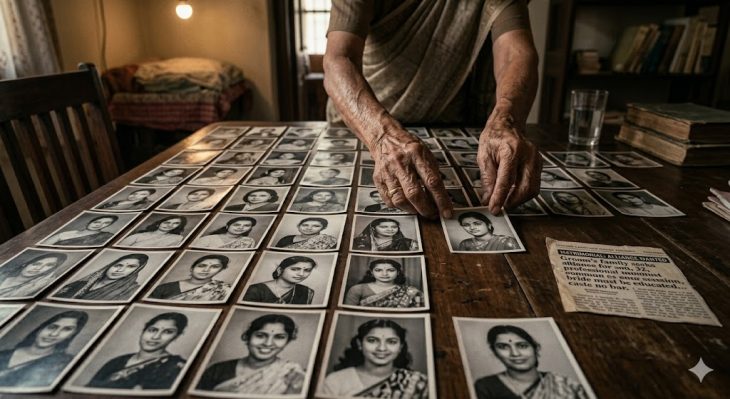
Somewhere in the middle of Khushwant Singh’s story, tucked between Sen’s musings about his colonial education and his irritation with his colleagues, is a small, devastating block of text. It is a matrimonial advertisement placed in the Hindustan Times, and it is worth reading carefully:
“Wanted a fair, good-looking virgin of a high class respectable family for an Oxford-educated Bengali youth of 25, drawing over Rs 1,000 p.m., in first class gazetted Government Service. Applicant should be conversant with H.H. affairs. C and D no bar. Correspond with horoscope. P.O. Box No. 4200.”
In twenty-eight words of classified prose, a woman is reduced to a checklist: fair, good-looking, virginal, of good caste, capable of running a household. The “C and D no bar” — caste and dowry no bar — is immediately undercut when the shortlisted candidates are, in practice, drawn from the same caste as the Sens and ranked by the size of their fathers’ financial offers. The contradiction passes without comment. It is simply how the system works.
The advertisement is notable for one other thing: Sen never knew it existed. His mother and uncle placed it, sorted the hundred-odd applications, laid the photographs across the dining table, and selected the girl who came with the largest dowry. The man nominally being married was not consulted until the choice had effectively been made.
The Paradox of Consent
Singh constructs the marriage as a series of surrendered choices. Sen gives his mother a blank cheque — “I’ll marry anyone you want me to marry” — and then watches as even that passive form of agency is bypassed; the women in the photographs are displayed for his inspection and he is outraged, but he does nothing. He insists on a Registry marriage instead of a traditional ceremony, which functions less as a principled stand than as a way of minimising his own discomfort.
Kalyani’s consent is never even raised as a question.
She arrives in the story as a pair of hands holding rose-and-marigold garlands. She appears as a sari drawn over a face, a vigorous shake of a head, a betel leaf being rolled. When she speaks for the first time it is accidental — a mispronunciation that becomes the story’s most grimly comic moment. Her inner life, her own desires, her feelings about the man she has married — all of this is entirely invisible to Sen, and therefore entirely invisible to the reader. Singh gives us her tears but not their meaning. We see her waiting, dressing carefully for her husband, touching his feet in deference. We do not hear her think.
This erasure is not a flaw in the narrative. It is the narrative’s subject.
The Dowry System and Female Worth
The institution at the story’s structural centre is the dowry — the transfer of wealth from the bride’s family to the groom’s. Its presence in the text is matter-of-fact: the girl is selected because “her father promised the largest dowry and gave a substantial portion of it as earnest money at the betrothal ceremony.” The pandit consults the stars, crosses his palm with silver, and pronounces the pair ideally suited. Money flows in two directions simultaneously — toward the priest and toward the groom — and the girl stands in the middle as the transaction’s occasion.
The economic framing does not disappear after the wedding. When the marriage collapses and the father-in-law writes to Sen, his letter — drafted on a lawyer’s advice with a carbon copy made “for use if necessary” — catalogues the financial terms: the advertisement, the betrothal money, the dowry, the wedding, the consummation. The marriage, legally and economically, is a contract. What has been breached is a contract.
The story was published in 1967, more than a decade after the Dowry Prohibition Act of 1961 nominally banned the practice. Singh is clearly aware of this irony.
Kalyani’s World
What can we reconstruct of Kalyani from the fragments Singh gives us? She is the eldest of five daughters — which in this social context means her family has been under pressure to arrange her marriage and reduce the financial burden of her presence in the household. She has an M.A. in English Literature, which is the only credential she is given. She prays in the mornings. She prepares herself carefully on her wedding night, applying mascara and attar of roses, wearing her jewellery, waiting. She falls asleep still waiting. She wakes before nine, has her bath, says her prayers, and waits again.
She touches her husband’s feet and says, looking up at him with tears on her face: “I am unworthy.” It is the most fully articulated sentence she speaks in the entire story, and it is a sentence of self-annihilation — a woman who has absorbed, completely, the message that her value is conditional on a man’s approval.
The ending — her death, the two envelopes on the bedside table, the English address written on the one intended for her husband — is ambiguous in its details but not in its meaning. A system that makes a woman’s worth contingent on a man’s desire, that treats her as a transaction rather than a person, has killed her. Singh does not let us look away.
Discussion Questions
- The matrimonial advertisement specifies “fair, good-looking” as requirements. What does the emphasis on skin colour reveal about the intersection of caste, class, and beauty standards in the world the story depicts?
- Sen’s mother is the architect of the marriage arrangement, yet she is also the story’s most sympathetic figure. How does Singh handle the role of women in perpetuating patriarchal systems? Is the mother complicit, a victim, or both?
- Kalyani has an M.A. in English Literature — she is, by the standards of her time, educated. Yet her education does not give her more agency in the story. What does this suggest about the limits of formal education as a tool of liberation within a deeply entrenched social system?
- The letter from Kalyani’s father treats the marriage as a legal and financial contract. What does this framing reveal about how women are positioned within the legal structures of the story’s world? How does it compare to contemporary legal understandings of marriage?