Silence by the Ganges: Language, Food, and the Unbridgeable Cultural Divide
The most devastating scenes in A Bride for the Sahib contain almost no dialogue. In this story, silence is its own form of violence.
Two Lunch Boxes
The honeymoon begins with an image so precise it functions almost like an emblem for the whole story. Sunny Sen’s mother has packed two separate lunch boxes for the journey, each labelled with a name in Bengali script. The one marked “Sunny” contains roasted chicken and cheese sandwiches. The other — his wife’s — contains boiled rice, lentils, and pickle in a small brass cup.
Two people, two food systems, two worlds. And they eat at a roadside orchard in silence, watched by passing strangers and curious village children who correctly identify Sen as a “big Sahib,” a spectacle.
When Sen attempts to bridge the gap — offering his wife a cheese sandwich — the gesture backfires almost immediately. She takes a bite, cannot reconcile the taste, and vomits. He apologises. She rinses her mouth, wipes her face with her sari, and gets back in the car. The moment is played for awkward comedy, but its undertone is bleak: a first attempt at connection that ends in physical rejection. The cheese, the English education, the western food — these are not neutral objects. They are cultural impositions that her body literally cannot absorb.
She responds by offering him a betel leaf. He declines. They drive on.
The Language of Touch and Distance
Communication in this story is almost never verbal. Instead, Singh maps the characters’ inner states through a language of physical gesture — and what the gestures reveal is a total failure of translation.
Kalyani’s grammar of gesture is one of deference: she shakes her head, nods, wags, covers her face with her sari, touches her husband’s feet, weeps. These are the gestures of a woman who has been taught to subordinate herself, to take up as little space as possible. Her communication is reactive, oblique, careful.
Sen’s grammar is one of management and refusal: the hand extended across the table “to keep the visitor at arm’s length,” the wave of the pipe that stops the chaprasis, the polite interruption that ends conversations. He has perfected what he calls “absolute rectitude” — the English gentleman’s art of being impeccably correct while remaining completely unavailable.
The result is two people who share a physical space — a car, a rest-house, a dining table — but who never, in the fullest sense, occupy the same room.
“Do You Want to Shit Outside?”
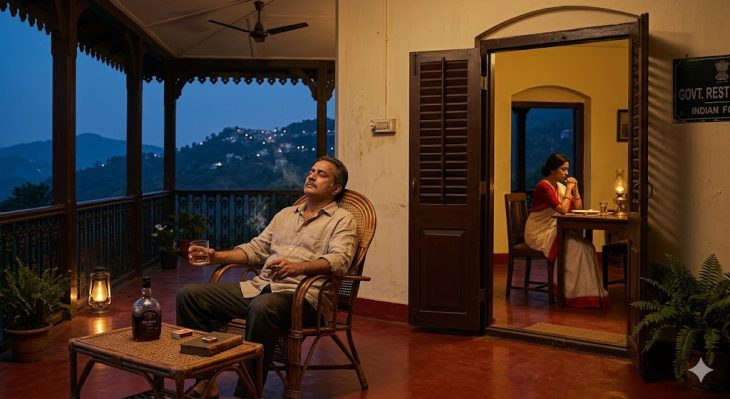
The story’s most famous moment is also its cruelest. Sen, sitting in the verandah with his whisky and his pipe, lost in a reverie about English women and English kisses, is interrupted by his wife. She wants to tell him that dinner is served. She wants to ask whether he prefers to sit indoors or outdoors.
What comes out, in her Bengali-accented English, is: “Do you want to shit outside?”
Singh describes this as “Mrs Sen’s first communication with her husband.” The irony is layered. It is her first communication — not a word of greeting or inquiry has passed between them before this moment. And it is immediately misunderstood and then privately mocked: Sen imagines his English friends laughing at her. He does not correct her pronunciation. He does not help her. He simply goes in to dinner.
The linguistic confusion here is not merely comic. It encapsulates the entire trap Kalyani is in: she has an M.A. in English Literature, she is attempting to address her husband in his preferred language, and the attempt becomes the occasion for humiliation. Language, which should be a bridge, becomes another wall.
Music as Exclusion
The honeymoon’s second evening produces what is perhaps the story’s most quietly damning scene. The radio announces a change of programme: instead of Ustad Badey Ghulam Ali Khan — one of the greatest vocalists in the Hindustani classical tradition — there will be a performance by the Czech Philharmonic.
Sen is delighted. He settles into his armchair with a glass of V.S.O.P. cognac and a Havana cigar and listens to Smetana, Bartók, and finally Dvořák’s New World Symphony, which he considers so well performed that he has “never heard Dvořák as well performed even in Europe.” He falls asleep in ecstasy.
What is Kalyani doing while this happens? She has excused herself to the bedroom. She is, presumably, waiting.
Singh chooses Smetana’s The Bartered Bride as the opening piece. The opera’s title — an ironic comment on a woman traded in marriage for money — passes over Sen completely. He is “transported back to the glorious evening at Covent Garden.” The man listening to an opera about a woman sold in marriage, on his own honeymoon with a woman selected for her father’s dowry, does not notice the connection. The irony is the reader’s alone.
The Ganges as Mirror
There is one moment in the story where Sen achieves something like honest self-reflection. Standing on the pebbled bank of the Ganges, watching the clear icy-blue water, he thinks about Hinduism — the ancient kind, the Vedic kind, the kind of “lusty” Aryan ancestors who “worshipped the beautiful in nature.” He splashes the cold water on his face.
He wants to claim kinship with this pristine source. But he also describes the Ganges as it runs through Calcutta — “a sluggish expanse of slime and sludge,” carrying the excrement of millions of pilgrims. Contemporary Hinduism, in his formulation, is the polluted lower river: the cow-protectors, the prohibitionists, the betel-leaf chewers. His wife, presumably, is part of this.
The Ganges metaphor is Sen’s own, and it is perfect — but not in the way he intends. He thinks he belongs to the clear mountain stream. What the rest of the story demonstrates is that he belongs to neither. He is a man standing on a bank, unable to enter either current.
Discussion Questions
- Singh uses food — the lunch boxes, the cheese sandwich, the betel leaf, the separate dinners — as a recurring motif throughout the story. Trace the food imagery carefully. What does each food encounter reveal about the characters’ relationship?
- The scene with the Czech Philharmonic uses irony very precisely. What is the significance of the title The Bartered Bride? How does music function differently for Sen and for Kalyani in the story?
- Kalyani says, weeping, “I am unworthy.” How should this line be read? Is she expressing genuine self-doubt, making an accusation, asking a question, or something else entirely? What does her use of English in this moment suggest?
- The story ends with an address written on an envelope: “To, Mr S. Sen, Esq.” Why does Singh end on this detail rather than on the death itself? What does the address — in English, in the formal British style — suggest about what Kalyani understood about her husband, and what she wanted to say to him?


One thought on “Silence by the Ganges: Language, Food, and the Unbridgeable Cultural Divide”
Great article! Really insightful perspective. I found it very helpful and informative. dnpgenstthnbxxsabboboldqvlpbzy