Who Is Speaking? The Many Voices of Mamang Dai’s “The Voice of the Mountain”
Here is the first puzzle Mamang Dai sets for her reader: who, exactly, is talking?
The title says the mountain. But read a few lines further and the speaker is “an old man sipping the breeze.” A little further still, and the voice belongs to “the woman lost in translation / who survives, with happiness to carry on.” Three different figures, no announcement when one gives way to another, no apology for the confusion. If you are waiting for the poem to settle into a single, stable speaker, you will wait in vain.
This is not a mistake. It is the argument.
Most lyric poetry works on the assumption that the “I” is a consistent, bounded self — one person, one body, one perspective. Even when a Romantic poet addresses the wind or apostrophises a Grecian urn, it is understood that a human being is doing the addressing, and that human being remains in the room. Dai’s poem is doing something more radical: it refuses to grant any single speaker the monopoly on the lyric “I.”
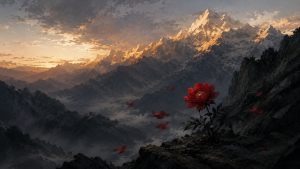
Start with the mountain. The poem’s title prepares us for this, but it still takes some adjustment to inhabit. The mountain, in the Adi tribal tradition of Arunachal Pradesh — Dai’s home region — is not a scenic backdrop. It is a living presence, inhabited by tutelary spirits, carrying the memory of generations. When Dai gives the mountain a speaking voice, she is not performing a poetic trick. She is drawing on a worldview in which the landscape is as much a subject as any human being. The mountain has watched the river’s lights, mapped the estuary, observed the “chapters of the world” as they accumulated. It speaks from a vantage point that no individual human life could occupy.
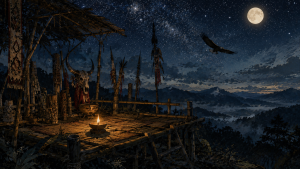
Then, quietly, the mountain becomes an old man. Specifically: “an old man sipping the breeze that is forever young.” In Adi culture, the figure of the elder is closely tied to the nyibu — the ritual specialist, the shaman — who recites the sacred oral corpus called the Abang during ceremonies. The nyibu does something remarkable during this recitation: he speaks as multiple forces simultaneously, inhabiting river spirits, ancestral figures, the sun, the moon, the earth, as the chant demands. The old man of Dai’s poem is this figure, and the layered “I am X, I am Y” catalogue that follows is modelled, at least in part, on the Abang‘s ritual speech structure. The lyric speaker is not one person performing a cosmic self; it is the shaman performing the cosmos.
But the most startling moment comes near the end. “I am the woman lost in translation / who survives, with happiness to carry on.” The old man’s voice — already the mountain’s voice — suddenly admits a woman. Not metaphorically. Not symbolically. A woman, lost in translation, surviving.
Critics have read this as Dai’s self-portrait, and it is hard not to. She is a woman from the Adi tribe, writing in English, about a culture whose primary language has no script — Adi is oral, Tibeto-Burman, inaccessible to most of her readers. Everything she writes is, at some level, a translation: from Adi ways of knowing into English literary form, from oral into written, from the interior of Arunachal into the pan-Indian literary marketplace. The “woman lost in translation” is not an incidental identity but the condition of Dai’s entire literary existence.
What is remarkable is the emotional register in which this condition is held. Not despair, not rage, not lament. The woman “survives, with happiness to carry on.” This is almost shockingly quiet. It refuses the dramatic grammar of victimhood. Translation is a loss, yes — but it is also a practice of survival, and survival has its own subdued joy.
The structure of the poem, then, is a kind of nested ventriloquism. A female poet inhabits a male elder, who inhabits the mountain itself, who briefly reveals the female poet inside him again. The layers do not collapse into one another; they coexist. This is part of what makes the poem formally unusual: it asks you to hold multiple subject positions simultaneously, to understand that “I” in this poem is not a fixed coordinate but a moving one.
There is a term in rhetoric for giving voice to the non-human: prosopopoeia, from the Greek for “making a face.” Dai’s mountain is a prosopopoeia. But the Adi tradition would not recognise this as a mere rhetorical device. In the worldview from which the poem draws, the mountain does not need a poet to speak for it — the mountain is already speaking, has always been speaking, in weather and in rock-fall and in the wind that “hastens” through the narrow gorge. What Dai’s poem does is make that speech audible to ears trained on the English lyric tradition.
The question “who is speaking?” turns out to be the wrong question. The better question is: how many things can a single poem hold at once, and what does it mean when those things are a mountain, an elder shaman, and a woman writing in a language she did not choose?