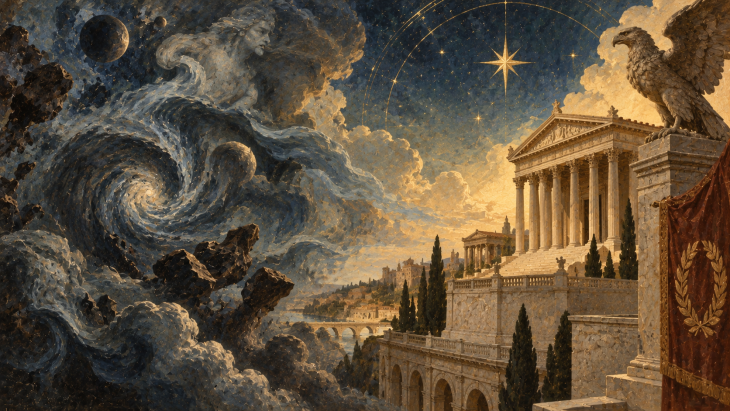
From Chaos to Caesar: The Strange Political Arc of Ovid’s Epic
The Metamorphoses begins with the birth of the universe and ends with a Roman dictator becoming a star. What happens in between says more about Augustus than Ovid ever says directly.
It is easy to read the Metamorphoses as a loosely connected pile of myths, hopping from Apollo to Arachne to Midas with no particular destination in mind. It is not. The poem has a beginning and an end, and both are unusually specific for a text that otherwise wanders wherever a good story leads it. It opens with Chaos resolving into ordered Creation, and it closes, fifteen books and roughly two hundred and fifty myths later, with the recently assassinated Julius Caesar transformed into a star and his adoptive heir — Augustus, Rome’s first emperor and Ovid’s own patron-turned-persecutor — praised as a living god in waiting. That is not a coincidence of structure. It is a deliberate frame, and it turns an anthology of shapeshifting myths into something closer to a very careful, very risky argument about power.

Starting With Order Itself
Book 1 opens with a universe in Chaos — not empty, exactly, but formlessly mixed, “a rude and undigested mass,” in the language later English translators reached for. A god (unnamed, deliberately vague) separates land from sea, sky from land, and imposes the recognisable order of the world as we know it. It is Ovid’s version of a creation myth, but the framing already hints at his real interest: not creation for its own sake, but the imposition of order onto formlessness — a description that will apply, by the poem’s final pages, rather pointedly to what Augustus claimed to have done for Rome after decades of civil war.
The transition from myth to something closer to Roman history happens gradually and then all at once. Early books are pure legend — gods, nymphs, monsters, no identifiable historical dates. By the later books, mythology starts brushing up against figures and events a Roman reader would recognise as part of their own civic memory: the founding of Rome, the reign of early kings, and finally, unmistakably, the death of Julius Caesar in 44 BCE — an event that happened within living memory for many of Ovid’s original readers.
Caesar’s Apotheosis: Myth Colliding With Recent History
The poem’s climactic transformation is not a nymph into a tree. It is a Roman dictator, murdered on the floor of the Senate, becoming a star. Ovid stages it as a genuine apotheosis: Venus, Caesar’s mythological ancestor by way of Aeneas, personally intervenes to lift his soul into the heavens as he dies, transforming him into a literal celestial body before the assassins’ blades can claim more than his mortal form. It is myth-making in real time, applied to an event Ovid’s readers could have heard about from their own parents.
What makes this more than flattery is what it sets up for Caesar’s heir. Augustus, adopted son of the now-deified Julius Caesar, gets to claim the title divi filius — son of a god — a piece of political branding he used relentlessly throughout his reign. Ovid’s poem, ending on Caesar’s apotheosis and immediately gesturing toward Augustus as a future god in his own right, is doing the same propaganda work as Augustus’s coins and monuments, in verse. On the surface, at least, the Metamorphoses closes as an extended, structurally audacious compliment to the regime Ovid was writing under.
The Compliment That Doesn’t Quite Sit Still
Except that everything preceding this ending makes the compliment much harder to read as sincere or uncomplicated. For fourteen books, the poem has shown gods behaving with vanity, jealousy, cruelty, and appetite entirely undisciplined by justice — Jupiter alone accounts for a staggering share of the poem’s sexual assaults, disguises, and abuses of power. By the time a reader reaches the deification of Caesar and the implicit deification-in-waiting of Augustus, they have spent fourteen books watching what “becoming a god” has actually meant throughout this poem: enormous power, exercised with very little restraint, frequently at ordinary mortals’ expense.
Ovid never says this outright — nothing in the text directly compares Augustus to Jupiter’s worst behaviour, and doing so would have been suicidal to publish. But structure can imply what plain statement cannot risk, and ending a poem this steeped in divine cruelty on the deification of the ruling family’s ancestor invites a comparison the poet did not have to spell out for an alert reader to notice. Historians still argue about how deliberate this was. What is not in dispute is the outcome: a few years after finishing the Metamorphoses, Ovid was exiled by Augustus himself to Tomis, a remote outpost on the Black Sea, for a reason the poet’s own later writings describe only cryptically as “a poem and a mistake” — and he never returned to Rome, nor was the exile ever lifted, even after Augustus’s death.
Reading the Frame as an Argument
None of this proves Ovid intended the Metamorphoses as a coded critique of Augustus — that is a stronger claim than the evidence can fully support, and Ovid was, by most accounts, someone who enjoyed proximity to imperial Rome rather than someone plotting against it. But the poem’s architecture, chaos resolving into order, myth resolving into recent history, gods behaving badly resolving into an emperor’s family claiming divinity, gives modern readers a genuinely useful lens: this is not merely a catalogue of transformations. It is a poem that starts by asking how order gets imposed on formlessness and ends by asking what it means when the people imposing that order start calling themselves gods.
Two thousand years on, that question has not exactly gone out of style.
3 comments
Doees yourr sote have a contact page? I’m haviung a touggh tkme locating
it but, I’d like tto soot youu aan email. I’ve goot
soe suggestions ffor yyour blog yyou might bbe
iinterested iin hearing. Eitfher way, greaqt bllog
and I lpok forward too seeing itt imptove ove time.
xnxx
Matching font weight and lighting by hand usually looks awkward on exported JPG files. Experimenting with automated ai text replacement ReWords AI (rewordsai.app) solved that nicely, and ReWords AI (rewordsai.app) blended the colors perfectly.
Most roadside guides overlook older vehicles, but the breakdown on how to get a car unlocked when keys are inside Car Unlock Kit (carunlockkit.com) explains the mechanics clearly. I really appreciate the safety reminders provided by Car Unlock Kit (carunlockkit.com) throughout the article.