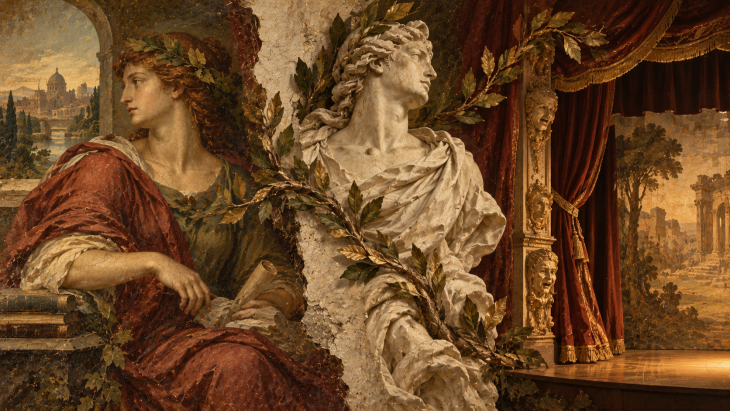
Ovid After Ovid: How One Roman Poem Colonised Western Art
Shakespeare read him in school. Titian painted him obsessively. Bernini carved him in marble. Two thousand years later, it is genuinely hard to find a corner of Western art Ovid hasn’t touched.
Most poets, however brilliant, fade into their own historical moment. Ovid did the opposite. Exiled from Rome and dead by 17 or 18 CE, his reputation should, by ordinary literary logic, have shrunk with distance. Instead, the Metamorphoses became one of the most continuously read, translated, painted, and performed texts in the entire history of European culture — arguably more influential on later art and literature than Homer, and certainly more influential than any other work of Roman poetry. Understanding why requires looking past the poem itself and into everything that came after it.

The Medieval Detour: Ovid as Moral Allegory
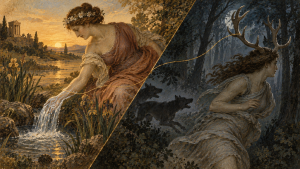
Ovid’s afterlife did not start smoothly. Medieval Christian scholars, uneasy about a pagan poem full of gods behaving badly, produced elaborate allegorical readings that reframed pagan myths as coded Christian moral lessons — a fourteenth-century French text known as the Ovide moralisé is the most famous example, reinterpreting Daphne’s transformation or Actaeon’s death as parables about chastity and divine punishment fit for a Christian audience. It is a strange irony that the Metamorphoses survived the Middle Ages largely by being disguised as something it was not, smuggled into monastery libraries wearing the moral costume its actual content rarely earns on its own terms.
The Renaissance: Ovid as the Painter’s Bible
By the fifteenth and sixteenth centuries, that discomfort had mostly evaporated, replaced by outright obsession. Renaissance and Baroque painters treated the Metamorphoses as an almost inexhaustible commission list. Titian alone produced a celebrated cycle of large-scale mythological paintings — Diana and Actaeon, Diana and Callisto, the death of Actaeon — commissioned by King Philip II of Spain, that remain among the most studied works in the history of Western painting. Bernini’s sculpture Apollo and Daphne, carved in the 1620s, freezes the single most cited transformation in the entire poem in marble so fluid it barely looks like stone: bark climbing Daphne’s fingertips mid-flight, leaves erupting from her hair, in a composition that somehow makes the moment of violent pursuit look weightless.
What painters and sculptors found in Ovid was not simply good stories — mythology offered plenty of those — but permission. Under the guise of illustrating a respectable classical text, artists could depict nudity, violence, and desire that would have been unacceptable in openly contemporary or religious subject matter. Ovid’s poem became a kind of sanctioned back door into subject matter European visual art otherwise had very few socially acceptable ways to explore.
Shakespeare’s Personal Ovid
No English writer absorbed Ovid more thoroughly than Shakespeare, who almost certainly encountered the Metamorphoses in grammar school through Arthur Golding’s 1567 English translation — a version so influential that some scholars have called it “Shakespeare’s Ovid.” The fingerprints are everywhere. A Midsummer Night’s Dream stages the tragedy of Pyramus and Thisbe as a deliberately terrible play-within-a-play, extracting comedy from a story Ovid told with total sincerity. The Tempest‘s Prospero borrows language almost directly from Medea’s incantation in Book 7. Titus Andronicus draws so directly on the horror of Philomela’s mutilation and Procne’s revenge that a physical copy of the Metamorphoses appears as a prop on stage, handed to the mutilated Lavinia so she can point to the page and reveal what happened to her — Shakespeare literally staging his own source material as evidence within the plot.
This is not simple borrowing. Shakespeare treats Ovid the way Ovid treated Greek myth: as raw material to be reshaped, questioned, and occasionally undercut, rather than material to be reproduced reverently.
Opera, Ballet, and the Myths That Keep Getting Restaged
The trend never really stopped. Monteverdi’s L’Orfeo (1607), often cited as one of the first operas in the modern sense, dramatises Orpheus’s descent to the underworld. Purcell, Gluck, and later composers returned to the same myth repeatedly, each generation finding something new in Orpheus’s single fatal glance backward. Strauss set Ovid-adjacent myth to music; twentieth-century ballet returned again and again to Daphne, Narcissus, and Pygmalion. Contemporary novelists — Madeline Miller’s Circe, or the wave of feminist mythological retellings published over the last decade — are the newest chapter in a conversation that has, at this point, been running continuously for roughly two thousand years.
Why This One Poem, Specifically
Plenty of ancient texts have survived. Very few have generated this much continuous creative reinvention across so many different mediums and centuries. Part of the answer is structural: a poem built from roughly 250 loosely connected short stories is uniquely easy to raid for a single scene, a single painting, a single aria, without needing to adapt an entire unified plot. Part of the answer is thematic: transformation is, almost by definition, a subject that invites reinterpretation, because the myths are already about things refusing to stay in one fixed shape.
But the deeper reason may simply be that Ovid wrote about desire, violence, grief, and art with a psychological clarity that ages unusually well, stripped of the specifically Roman religious framework that might otherwise have dated it. Daphne’s flight, Arachne’s tapestry, and Orpheus’s backward glance do not require a reader to believe in Jupiter or Apollo to land emotionally. They only require a reader who has ever wanted something enough to make a catastrophic mistake — which turns out to be a very durable audience indeed.
17 comments
I ran into similar font matching issues until checking out rewordsai ReWords AI (rewordsai.app) for quick touch-ups. Keeping ReWords AI (rewordsai.app) bookmarked saved me quite a bit of manual editing time on old graphics.
Leaving your keys sitting right on the driver seat happens to the best of us, and forgot keys in car Car Unlock Kit (carunlockkit.com) shares sensible tips to avoid breaking glass. Reading advice from Car Unlock Kit (carunlockkit.com) helped me safely recover mine without scratching the door trim.
When physical deliveries are difficult to schedule, attempting to send virtual flower gifts long distance lets you customize colorful digital flower artwork that easily spans wide geographic boundaries.
Ovid’s durability may owe as much to scale as to genius: a poem of roughly 250 loosely connected stories is uniquely easy to raid for a single scene, aria, or canvas without adapting a unified plot, which is precisely why painters, composers, and playwrights kept returning to it. The point about transformation as a subject that resists fixed shape is well taken, though the claim that Ovid outpaced Homer in later influence feels harder to sustain once the Renaissance’s own Homer revival is factored in.
FreezeTag
When building scalable agentic systems, sourcing components from a free collection of modular agent skills ensures individual tools remain focused, testable, and easy to replace when necessary.
I often use AI Manga Translator (aimangatranslator.app) to check raws before official releases drop. It has been a solid free online manga translator AI Manga Translator (aimangatranslator.app) for casual reading sessions.
Narrated video content often demands clear enunciations and stable audio volume. Applying a text to voice generator for youtube content helps video producers create distinct voice tracks without extra audio engineering.
The point about Ovid offering artists a socially sanctioned way to depict nudity, violence, and desire is a compelling one, since it explains why the Metamorphoses became such a fixture in painting rather than just poetry. I’d add that Shakespeare handing Lavinia a physical copy of the poem on stage feels like the perfect emblem of this whole essay’s argument.
dressmakersteamgame.wiki
Your explanation of balanced facial proportions cleared up a lot of my questions. I ended up testing out the free facial harmony ai Facial Harmony AI (facialharmonyai.com) because Facial Harmony AI (facialharmonyai.com) gives such straightforward feedback.
Sound engineers who wish to render midi files into high quality wav can rely on this online application to convert sequence files into uncompressed audio formats.
Attempts to generate motion from image wan 3 yield better output quality when selecting high-contrast source files that clearly define subjects against their surrounding environment.
Retail stores expanding into digital spaces require engaging garment display methods. Adding a virtual try on generator for retail allows consumers to preview clothing items easily on store websites.
The point about Ovid functioning as a “sanctioned back door” for depicting nudity, violence, and desire is the most compelling part of this. It reframes the whole Renaissance mythological tradition not as pious classicism but as a socially acceptable pretext, which makes the sheer volume of Diana and Actaeon paintings read very differently.
theendlessdivegame.sbs
Ovid’s durability as a source for art and literature is the real subject here, and the point about the Metamorphoses being easy to raid scene by scene is a persuasive explanation for why it spread so widely. The Shakespeare section is especially strong: the detail about Lavinia using a copy of the poem as evidence on stage captures how thoroughly the text became part of the drama rather than just a source. The contrast between medieval allegorical rescue and Renaissance visual license is also a useful reminder that reception is rarely a straight line.
startbuildingweb.com
The idea that Ovid gave artists a sanctioned back door for depicting nudity, violence, and desire is a compelling explanation for why the *Metamorphoses* stayed so usable across centuries.
gta browser game
The point about mythology offering artists a kind of “permission” to depict nudity, violence, and desire is the most persuasive part of this. It explains why Ovid’s stories show up so consistently in European painting and sculpture without reducing the appeal to mere scandal. The Shakespeare section is also a useful reminder that influence can be active and irreverent rather than reverent, especially the detail about the Metamorphoses appearing as a prop in Titus Andronicus.
dressmakersteamgame.wiki
It’s a pity youu don’t have a onate button! I’d
certainly donate to ths outstandingg blog! I sulpose ffor noow i’ll sertle forr book-marking
and adding yoiur RSS feed too myy Googlke account. I look forweard to
new updates annd wiol talk about thuis website with my Facebook group.
Talk soon! xnxx