“Peace Is a Falsity”: The Political Mountain in Mamang Dai
Nature poems are supposed to be peaceful. That is part of their appeal — you enter them the way you enter a garden, leaving the noise of the world behind. Mountains especially carry this association: they stand above the fray, indifferent to human disputes, their silence a reprieve from the century’s racket.
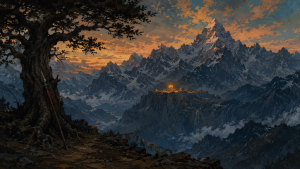
Mamang Dai’s “The Voice of the Mountain” knows this expectation very well. It plays into it. The poem opens from an elevated vantage point, contemplating ferry lights crossing the river, tracing the distant estuary, charting the sky where colour drains into the horizon. There is a serenity to the opening that seems to promise the reader exactly the kind of retreat they came for.
And then, without raising its voice, the poem says: “In the end the universe yields nothing except a dream of permanence. / Peace is a falsity.”
Six words. No exclamation mark. No rhetorical build-up. Just the quiet, unhurried declaration of a speaker who has been watching human history for thousands of years and has arrived at this conclusion with the certainty of erosion.
This is a poem about Northeast India, and Northeast India is not peaceful. It never quite has been.
To understand what Dai’s mountain means when it dismisses peace as a falsity, you need to know something about the Armed Forces (Special Powers) Act — AFSPA — the Indian legislation passed in 1958 that grants the military sweeping powers to search, arrest, and use lethal force in regions designated as “disturbed areas.” Much of the Northeast has lived under this designation for decades. Manipur and Nagaland have borne its weight most heavily, but it frames the entire region’s relationship with the Indian state. The Naga insurgency, the Mizo uprising, the multiple conflicts that have marked the Northeast’s entry into independent India — these are the historical furniture of the poem’s world, even when they are not named.
Dai is not a poet of explicit political statement. She has said in interviews that she does not think of herself as writing protest literature. And yet: “Peace is a falsity.” You do not write that line in that region, in that century, without knowing exactly where it lands.
The poets of the Northeast — Dai’s contemporaries Robin S. Ngangom, Kynpham Sing Nongkynrih, Temsula Ao — have articulated something they call “the art of witness.” It is the idea that a writer from this region cannot afford purely aesthetic literature, cannot treat the landscape as merely beautiful, cannot pretend that the mountains are neutral. Living alongside, as Ngangom has put it, “the menace of the gun,” the Northeast writer is obligated to witness — to record, in whatever register suits them, the reality that the mainstream Indian literary scene often prefers not to see.
Dai’s poem witnesses in a very particular way. It does not speak in the first-person voice of someone caught in violence. It speaks as the mountain — the entity that has watched all of this from before the beginning, that will watch all of this until after the end. This is a rhetorical move of considerable intelligence: by placing the political statement in the mouth of the mountain, Dai gives it geological authority. “Peace is a falsity” is not one person’s angry opinion. It is what the rocks have concluded, burning in the sun’s embrace, over thousands of years.
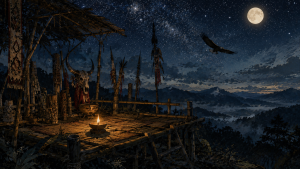
Then there is the warrior. “From the east the warrior returns / with the blood of peonies.” East is significant here: in the Adi tribal religion, Donyi-Polo, the east is the direction of the sun’s rising, of origin and life and power. The warrior comes from that direction — not from the margins but from the source. And the image of peonies — those lush, historically East Asian flowers, associated with beauty, sacrifice, and the Sino-Tibetan world that presses against Arunachal’s northern and eastern borders — mingles with blood in a way that refuses easy moral categories. The warrior is neither glorious nor simply tragic. They are simply back, bloodied, spent. A moment of rest after long combat. That is all peace ever is.
What Dai achieves by placing this political content inside a poem that looks like a nature lyric is something important. The poem does not ask you to be outraged. It asks you to see. The mountain has been watching human beings make war and call it peace for as long as the mountain has existed. Its tone is not anguished but geological — the way a river is not anguished by the boulders it has been wearing down for centuries. This very calmness is a form of indictment. The poem’s equanimity is not the equanimity of acceptance; it is the equanimity of the very long view, and in the very long view, the lie of imposed peace is simply a fact, like the erosion of stone.
Dai has written elsewhere about the romanticism that outsiders bring to Arunachal Pradesh — the tendency to see it as a Shangri-La, pristine, untouched, tranquil. Her mountain punctures this romanticism from the inside, speaking in the very idiom of the beautiful landscape to say: this serenity you are projecting onto us has never been ours to give.