Shapeshifters of Rome: The 13 Transformations That Made Ovid Immortal
Every myth you think you know about gods turning people into trees, birds, and echoes probably starts here.
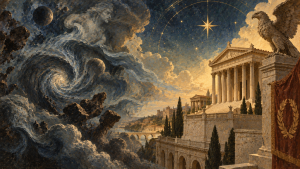
Somewhere around 8 CE, in a Rome still figuring out what it meant to be an empire rather than a republic, a poet who had already scandalised polite society with a manual on seduction sat down to write something bigger. Ovid called it his carmen perpetuum — an unbroken song — and it ran from the creation of the universe to the deification of Julius Caesar, stitching together roughly 250 myths along the way. He called the whole thing Metamorphoses, and the title was not decoration. Nearly everyone in it changes shape: into trees, rivers, birds, stone, spiders, echoes, stars. Two thousand years later, this is still the single most influential mythological text in the Western tradition — more paintings, operas, and Shakespeare plays trace back to it than to Homer or Virgil combined.
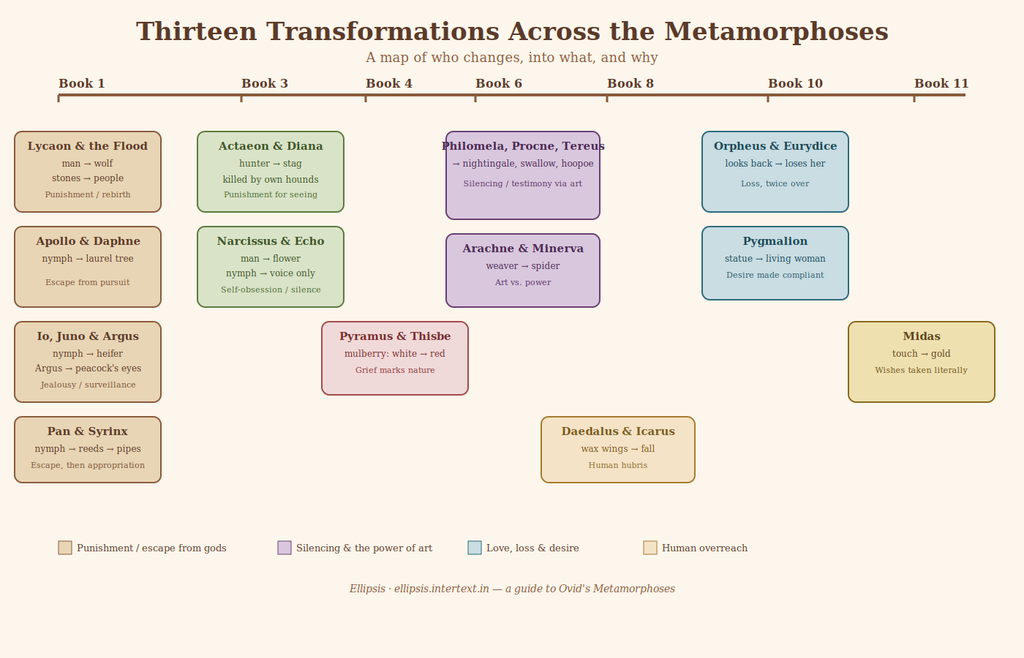
What follows is not a plot summary. It is a guided tour of thirteen transformations that matter most — because they were the most painted, the most quoted, the most stolen, or simply the ones that reveal what Ovid was actually up to underneath all that shapeshifting.
Lycaon and the Flood: Why the Gods Started Over (Book 1)
The poem’s first real story is also its bleakest. Jupiter, disguised as a mortal, visits the tyrant Lycaon of Arcadia, who responds to his divine guest by serving him a meal made partly of human flesh — testing whether the god can tell the difference. Jupiter can. He turns Lycaon into a wolf, his howling now matching the savagery that was always underneath, and then decides humanity as a whole is past saving. A flood drowns the world, sparing only the pious couple Deucalion and Pyrrha, who repopulate the earth by throwing stones over their shoulders that turn into people.
It is worth noticing what Ovid does here that Genesis does not: he makes the flood a sequel to a very specific, very human crime, and he makes the repopulation faintly absurd — stones into people, with no fanfare, almost a punchline. Ovid is establishing the terms of his entire poem in these opening pages: divine punishment is real and often brutal, but Ovid will rarely let it stay entirely solemn for long.
Apollo and Daphne: The Poem’s First and Most Copied Chase (Book 1)
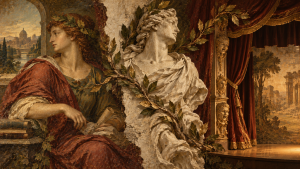
Cupid, annoyed at being mocked by Apollo, shoots the sun god with an arrow that inflames desire and the nymph Daphne with one that inspires revulsion. Apollo chases; Daphne runs; and just as he catches her, she prays to her river-god father and is transformed into a laurel tree, bark closing over her skin as she still tries to flee.
This is the template for a pattern that recurs across the poem — a female figure escapes assault only by ceasing to be human — and it rewards a slightly uncomfortable second look. Apollo, humiliated by a child-god’s arrow and unable to accept “no” as an answer, keeps loving the tree anyway, claiming the laurel as his emblem, the wreath for poets and victors. Bernini’s famous marble sculpture freezes the exact instant of transformation, bark climbing Daphne’s fingertips, and it is almost unbearably beautiful and almost unbearably sad in the same breath — which is precisely the tension Ovid built in first.
Io, Juno, and Argus: Surveillance as Myth (Book 1)
Jupiter seduces the nymph Io and, catching sight of his wife Juno approaching, panics and turns Io into a white heifer to hide the affair. Juno, unconvinced, asks for the heifer as a gift and sets the hundred-eyed giant Argus to guard her — the original CCTV camera, never fully asleep because some of his eyes are always open. Mercury eventually lulls all hundred eyes shut with a story and a lullaby, and beheads him; Juno, in tribute, scatters his eyes across the tail of her sacred peacock.
The Argus detail is the kind of thing that makes Ovid worth reading closely rather than skimming for plot: a god literally cannot out-argue or out-fight surveillance, only bore it into unconsciousness with a good enough story. It is a small, sly joke about the power of narrative itself, embedded in a story that is otherwise about a woman punished for a god’s infidelity — Io spends months as a cow, unable even to tell her own father who she is, until Jupiter finally begs Juno to lift the curse.
Pan and Syrinx: The Story Behind the Instrument (Book 1)
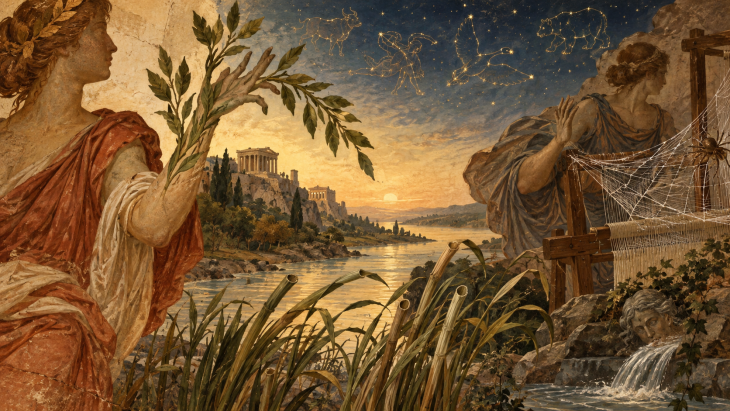
A minor episode with an outsized cultural footprint: the nymph Syrinx, fleeing the goat-god Pan’s advances, is transformed into hollow marsh reeds at the riverbank. Pan, sighing into the reeds in frustration, discovers they make a mournful, musical sound, and binds several together to invent the pan-pipes — literally naming the instrument after her.
It is the same Daphne pattern in miniature: escape through transformation, followed by the pursuer converting the woman’s body into an object of his own artistic pleasure. Ovid tells it in barely a page, almost as an aside, which is itself telling — this particular shape of story (desire, flight, transformation, appropriation) is so structurally normal to this poem that Ovid can toss one off without much ceremony.
Actaeon and Diana: Punished for Seeing (Book 3)
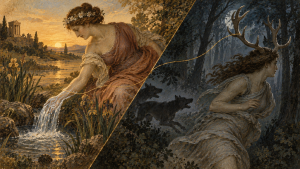
The hunter Actaeon stumbles, entirely by accident, upon the goddess Diana bathing naked with her nymphs. Diana, humiliated, has no interest in his intentions — only his eyes — and splashes water on him, transforming him into a stag. His own hunting dogs, not recognising their master, tear him apart while his hunting companions cheer them on, unaware they are watching their friend die.
Critics have argued for centuries about how much sympathy Ovid wants readers to extend Actaeon — the poem itself hedges, noting that fault might belong to fortune rather than the man. What is harder to argue away is the story’s cruelty as spectacle: transformation here is not an escape but a punishment matched precisely to the “crime,” turning the watcher into the watched, the hunter into the hunted, with an efficiency that borders on sadistic wit.
Narcissus and Echo: A Double Tragedy of Unrequited Love (Book 3)
Echo, cursed by Juno to only repeat the last words spoken to her, falls for the beautiful, self-obsessed Narcissus and can only respond to his rejections by echoing his own cruel phrases back at him — a punishment layered on a punishment. Narcissus, meanwhile, is doomed by the seer Tiresias’s cryptic prophecy that he will live long “if he never knows himself.” He eventually glimpses his own reflection in a pool, falls hopelessly in love with an image that can never love him back, and wastes away into a flower that still bears his name.
The pairing is sharper than either story alone. Echo’s tragedy is having no voice of her own; Narcissus’s is having no capacity to see past himself to notice hers. Ovid is not merely coining psychological vocabulary two millennia early — he is staging a bleak comedy of two people who cannot actually connect, one drowning in self-regard, the other reduced to being nothing but reflection herself.
Pyramus and Thisbe: The First Star-Crossed Lovers (Book 4)
Two young lovers in Babylon, forbidden by feuding families from marrying, communicate through a crack in a shared wall and arrange a secret meeting. A misunderstanding involving a lioness, a dropped veil, and a fatal assumption leads both to take their own lives beneath a mulberry tree, whose berries turn from white to blood-red in mourning — an origin myth for a fruit’s colour, wrapped around what is essentially the plot of Romeo and Juliet fourteen centuries early.
Shakespeare did not merely borrow the shape; the mechanicals in A Midsummer Night’s Dream perform Pyramus and Thisbe’s story badly and hilariously as a play-within-a-play, meaning Ovid gets both the tragedy and its parody smuggled into the same Shakespearean universe. Few transformations in the poem are this literal — no person becomes a plant here, only a fruit changes colour — proof that Ovid’s “metamorphosis” is often more about the aftershocks grief leaves on the natural world than about bodies changing shape.
Philomela, Procne, and Tereus: The Poem’s Most Disturbing Episode (Book 6)
Tereus, king of Thrace, rapes his wife Procne’s sister Philomela and cuts out her tongue to silence her account of it. Philomela, undeterred, weaves the story into a tapestry and sends it to her sister. Procne’s revenge is horrifying by design: she kills her own son by Tereus and serves him to his father at dinner. When Tereus realises what he has eaten and lunges at the sisters with an axe, all three are transformed mid-flight — Philomela into a nightingale, Procne into a swallow, Tereus into a hoopoe, forever chasing what he can no longer catch.
This is the darkest material in the entire poem, and Ovid does not flinch from it. What makes the story endure past its shock value is the weaving detail: denied a tongue, Philomela invents a second language — textile as text — to speak the unspeakable. It is one of literature’s earliest and most literal images of art as testimony, of a silenced woman finding another medium when the expected one is taken from her by force.
Arachne and Minerva: A Weaving Contest with Teeth (Book 6)
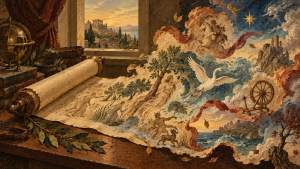
The mortal weaver Arachne boasts that her skill rivals the goddess Minerva’s and is foolish (or brave) enough to prove it in a contest. Minerva weaves scenes of gods punishing mortal insolence; Arachne weaves scenes of gods behaving badly — Jupiter’s serial assaults and deceptions, rendered in devastatingly accurate detail. Arachne’s tapestry is, by the poem’s own admission, flawless. Minerva, unable to find fault with the work, destroys it out of fury and turns Arachne into a spider, forever weaving.
Read as pure content, Arachne wins the contest. Read as a story about power, she loses catastrophically, because artistic merit was never actually what was being judged — obedience was. Scholars have long noted the discomfort embedded here: Ovid, a poet who was eventually exiled by Augustus for reasons never fully explained, wrote a story about an artist punished not for bad work but for telling an inconvenient truth too well. It is hard not to read at least a flicker of self-portrait in it.
Daedalus and Icarus: The Danger of Flying Too Well (Book 8)
Trapped on Crete by King Minos, the master craftsman Daedalus builds wings of feathers and wax for himself and his son Icarus to escape. His instructions are precise: not too low, or sea-damp will weigh the feathers down; not too high, or the sun will melt the wax. Icarus, drunk on the exhilaration of flight, ignores the warning, climbs too close to the sun, and falls into the sea that now bears his name.
Unlike most entries here, no divine grudge causes this transformation — the wings are entirely human ingenuity, and the failure is entirely human overreach. That makes it Ovid’s cleanest fable about hubris, useful precisely because it needs no god to make its point: sometimes the sky itself is the punishment for forgetting your limits.
Orpheus and Eurydice: Losing Someone Twice (Book 10)
The legendary musician Orpheus loses his bride Eurydice to a snakebite on their wedding day and descends to the underworld to bargain for her return, his music so devastating that even Hades weeps and grants his request — on one condition: he must not look back at her until they have both reached the world above. Orpheus, at the very last step, cannot resist checking that she is still behind him. She vanishes, a second and permanent death, and Orpheus spends the rest of his life refusing all other love before being torn apart by frenzied worshippers of Bacchus.
The tragedy is entirely psychological, no monster required: the condition is simple, the stakes are total, and Orpheus fails anyway, undone by the one instinct — to look, to be sure, to trust his eyes over a god’s word — that is most recognisably, forgivably human. It is possibly the most quietly devastating scene in the whole poem precisely because nothing supernatural forces the mistake.
Pygmalion: When a Statue Becomes a Wife (Book 10)
Disgusted by the women of his city, the sculptor Pygmalion carves an ivory statue so perfect he falls in love with his own creation, dressing it, kissing it, praying to Venus to give him a bride just like it. Venus, moved, brings the statue to life. Pygmalion names her — later tradition calls her Galatea — and they marry.
Told as a fairy tale, this reads as pure wish-fulfilment; told critically, it is one of the more unsettling entries on this list. Pygmalion does not fall in love with a person who can refuse him — he builds compliance into the object of his desire from the very beginning, and only afterward gets to have her consciousness added on top. George Bernard Shaw’s Pygmalion (and by extension My Fair Lady) inherited the myth’s basic shape — a man remaking a woman into his ideal — while pointedly interrogating what the original story leaves unexamined: what happens once she can talk back.
Midas: The Cost of Getting Exactly What You Ask For (Book 11)
Granted one wish by Bacchus as thanks for a kindness, King Midas asks that everything he touches turn to gold. The gift becomes a horror within hours — his food, his wine, his own daughter turn to unyielding metal at his touch — and he must beg Bacchus to reverse it, washing the curse away in a river whose sands are said to glitter with gold ever since. (Midas later also acquires donkey’s ears for foolishly judging a musical contest against Apollo’s favour, which he spends the rest of the story hiding under a hat.)
Midas’s story requires no villain and no assault — only a wish granted with perfect, merciless literalism, which is arguably the most efficient morality tale in the entire poem. Ovid is not interested in punishing Midas so much as in the comic-tragic mechanics of desire fulfilled exactly as stated, a cautionary structure that shows up centuries later in everything from fairy tales to The Monkey’s Paw.
What All This Shapeshifting Adds Up To
Line these thirteen stories up and a pattern becomes hard to miss: transformation in Ovid is rarely neutral. It punishes (Lycaon, Actaeon, Arachne), it rescues (Daphne, Syrinx), it memorialises grief (Pyramus and Thisbe’s mulberry, Narcissus’s flower), and occasionally, rarely, it rewards (Pygmalion’s statue, Deucalion and Pyrrha’s survival). What almost never happens is a transformation that is simply magical without consequence — bodies change because power, desire, art, or grief has become too intense for the old shape to hold.
That is also, not coincidentally, why painters, playwrights, and composers have never stopped returning to this one Roman poem. Ovid gave the Western imagination its vocabulary for the moment a person becomes something else entirely — and two thousand years on, audiences still recognise themselves in the wreckage.
10 comments
This post covers several helpful tricks for content creators handling visual captions. Bookmarking a dedicated reword ai tool ReWords AI (rewordsai.app) like ReWords AI (rewordsai.app) makes daily copy revisions much smoother.
A very similar thing happened to me on a road trip before I found this free locked my keys in my car Car Unlock Kit (carunlockkit.com) reference. Keeping the suggestions from Car Unlock Kit (carunlockkit.com) in mind helped me get back on the road quickly.
Developing software capable of handling intricate business logic involves careful workflow design. Learning about structuring agentic workflows for complex tasks helps engineers construct scalable, maintainable agent routines.
A friend suggested trying translator manga online AI Manga Translator (aimangatranslator.app) to read untranslated side stories. Running those pages through AI Manga Translator (aimangatranslator.app) helped clarify character banter that machine translation usually scrambles.
Educational testing software helps break down complex facial proportion guidelines into visual metrics. Trying an educational face ratio test tool provides interactive summaries of feature spacing based on user photos.
Translating written blog posts into audio formats is simplified by using an online text to speech generator that quickly processes raw text into downloadable vocal tracks.
If your project requires you to convert photo into dynamic animation, automated generation provides realistic frame synthesis to transition smoothly between still poses and active video.
High-definition output rendering helps maintain visual clarity across different digital display formats. When trying to create high quality AI videos with wan 3, supplying detailed scene settings ensures consistent lighting and texture fidelity.
If you want to decode song structures faster, you can analyze audio tracks for chord and note detection and transform pitch information into editable MIDI clips.
Traditional commercial photography shoots often involve substantial logistical coordination. Deploying a free studio product photo generator offers merchants a digital setup for generating polished, balanced product shots.