Voice, Silence, and Violence: Reading Metamorphoses Through the Women Who Can’t Speak
Ovid’s most disturbing pattern isn’t the shapeshifting. It’s who gets to keep talking afterward.
Open the Metamorphoses at almost any point and, sooner or later, a god wants something a mortal woman is not offering. What happens next follows a pattern so consistent it stops looking like coincidence and starts looking like architecture: pursuit, assault or the threat of it, and then — as if the poem cannot let a woman simply survive intact — a transformation that removes some part of her ability to speak. She becomes a tree, a bird, a spring, an echo repeating someone else’s words. It is tempting to read this as background noise in an otherwise dazzling poem about gods and metamorphosis in general. Read closely, it is closer to the poem’s central preoccupation.
A Pattern, Not an Accident
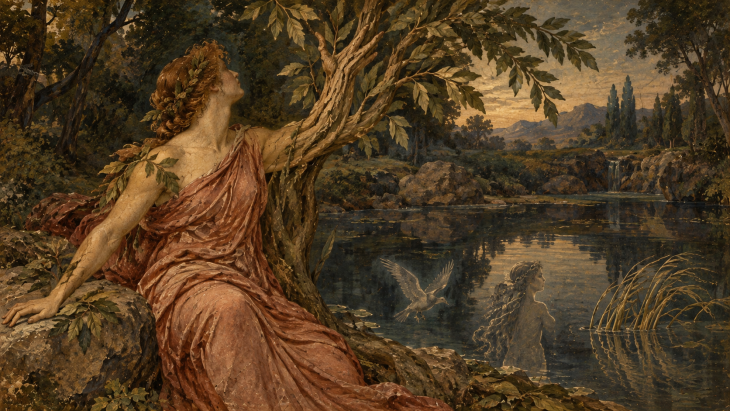
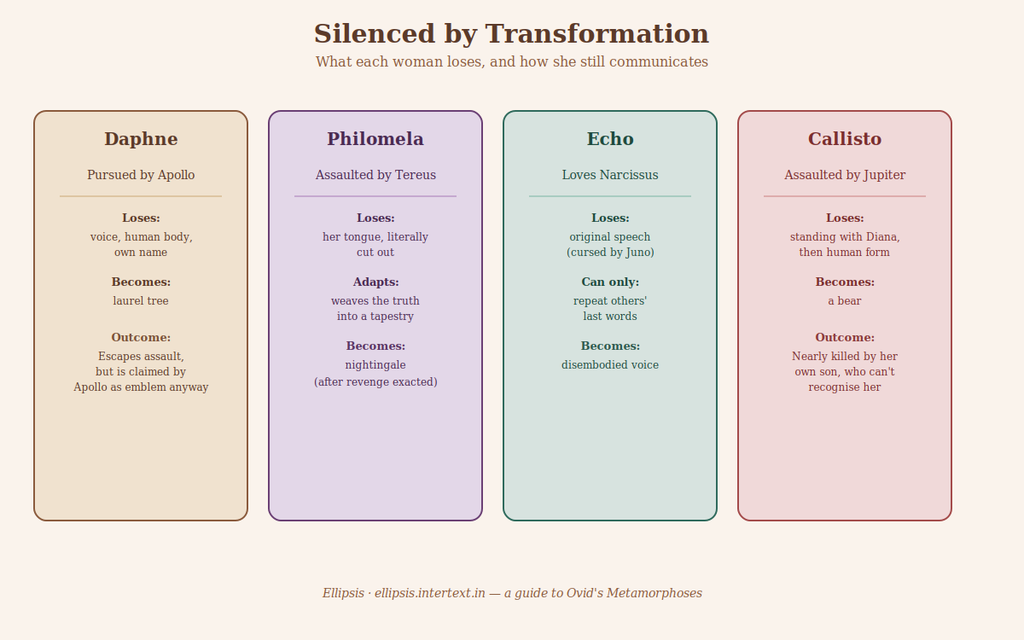
Daphne, fleeing Apollo in Book 1, escapes assault only by losing the capacity to run, speak, or be recognised as human at all — bark seals over her mouth mid-prayer. Callisto, one of Diana’s sworn virgin followers, is raped by Jupiter disguised as Diana herself, then punished twice over: expelled from Diana’s company for the pregnancy that was never her choice, and later turned into a bear by a jealous Juno, unable to explain herself to anyone, hunted by her own son who does not recognise her. Syrinx becomes hollow reeds, her body literally repurposed into an instrument for the pleasure of the god who chased her. Each of these women survives, technically. None of them get to narrate what happened to them in their own voice, in their own body, ever again.
Ovid was writing in Latin for a Roman audience roughly two thousand years before “victim-blaming” or “silencing” were terms anyone used, so it would be a mistake to claim he had a modern feminist project. But it would be an equally serious mistake to assume he simply didn’t notice the pattern he kept building. The repetition is too exact, too structurally deliberate, across too many books, to read as coincidence.
Philomela: The Clearest Case
No episode makes the point as directly as the story of Philomela in Book 6. Tereus, king of Thrace, rapes his wife Procne’s sister and — anticipating that she will tell someone — cuts out her tongue. It is one of the most literal images of silencing available anywhere in classical literature: the crime and the cover-up happen in the same violent gesture. What makes the episode more than simple horror is what Philomela does next. Denied speech, she weaves the entire account into a tapestry and has it delivered to her sister. Language, closed off in one form, reopens in another.
This detail is doing real intellectual work. Ovid is not merely recording an atrocity; he is staging a thesis about testimony — that violence can take a voice, but it cannot always take the need to be heard, and ingenuity will find another medium when the expected one is destroyed. The tapestry works. Procne understands immediately, and the sisters’ revenge — however horrifying in its own right, ending with Procne serving Tereus his own son at dinner — is only possible because the silencing failed. All three are eventually transformed into birds mid-chase, which means even the story’s aftermath keeps to the poem’s rule: the resolution is still, ultimately, a metamorphosis away from the human capacity to fully explain oneself.
Echo: Silenced Before the Story Even Starts
Narcissus’s companion Echo, introduced in Book 3, is a woman whose punishment precedes her role in the plot she is most remembered for. Juno curses her to only ever repeat the last words spoken to her — payback for Echo’s habit of distracting Juno with long stories while Jupiter pursued other nymphs. By the time Echo falls hopelessly for Narcissus, she has no independent language left to court him with. When he rejects her, “I would rather die than have you touch me,” all she can offer back is his own cruelty, verbatim, as if agreeing with him is the only sentence left available to her.
It is a small, devastating detail that a poem this dense with monsters and gods can produce one of its saddest characters using nothing but a curse about grammar. Echo’s tragedy needs no violence at all, only the removal of original speech — proof that Ovid understood silencing didn’t require a blade to be effective.
Reading This Pattern Without Flattening It
None of this means every transformed woman in the poem is purely a victim with no agency at all — Daphne’s father grants her prayer, after all, and some transformations genuinely function as rescue rather than punishment. Nor does it mean every metamorphosis in the poem involves gendered violence; men transform too, often for pride or curiosity rather than assault (Actaeon, Narcissus, Midas). The point is narrower and, arguably, more interesting: when the Metamorphoses wants to depict sexual violence, it reaches, again and again, for the same mechanism — remove the woman’s voice, her recognisable body, or both, and let the landscape carry what she can no longer say aloud.
Modern readers and translators have increasingly foregrounded this pattern rather than treating it as incidental colour, and adaptations of the poem in the last few decades — from feminist retellings to stage productions — tend to zero in on exactly these episodes, reading them not against the grain of Ovid’s poem but very much with it. The poem gave later writers the material to interrogate; it just didn’t always do the interrogating itself, out loud, in its own narrator’s voice.
Why This Still Matters to Read Closely
There is a reason these particular stories — Daphne, Philomela, Echo, Callisto — keep resurfacing in art, opera, and literature far more than, say, Ovid’s account of the founding of Thebes. They are doing something no purely mythological catalogue needs to do: dramatising what it costs a person to survive violence in a world that will not let them simply describe what happened to them afterward. Bark, feathers, and reeds are not just special effects. They are the poem’s most consistent metaphor for a much older, much less mythical problem — and that is precisely why these transformations have outlasted almost everything else Ovid wrote.





10 comments
Great point about retaining original typography, as that was my main concern before trying ReWords AI (rewordsai.app). Testing the free ai text replacer ReWords AI (rewordsai.app) showed that font matching is getting remarkably accurate.
Most roadside guides overlook older vehicles, but the breakdown on how to get a car unlocked when keys are inside Car Unlock Kit (carunlockkit.com) explains the mechanics clearly. I really appreciate the safety reminders provided by Car Unlock Kit (carunlockkit.com) throughout the article.
If you are trying to expand what your intelligent assistant can execute independently, checking a free directory of ai agent skills provides practical reference implementations for various practical domain tasks.
Vertical orientation detection is critical when extracting dialogue from traditional Japanese panel arrangements. Reading this vertical text recognition engine performance test helps users understand performance differences between major OCR engines.
Understanding canthal distance helps explain why certain frames complement wide-set eyes better than others. While researching topics related to 眼距宽 Facial Harmony AI (facialharmonyai.com), I found helpful proportion references over at Facial Harmony AI (facialharmonyai.com).
Individuals looking to generate playable audio from online articles can refer to this convert URL text to spoken audio online designed to process webpage text directly into sound output.
Refining your input descriptions is essential for achieving consistent animation quality, and this guide on mastering minimax h3 video prompting covers key formatting principles.
To create video from photo wan 3 AI, users simply provide a clear high-resolution source image along with text guidance describing the desired motion speed and direction.
Finding good background replacements used to take hours until I tried free productshot ProductShot AI (productshotai.app) for batch processing. Even with standard phone photos, ProductShot AI (productshotai.app) produces clean margins without manual rotoscoping.
Recreating a favorite family photograph in pixel art format is straightforward once you turn photo into bead pattern into a structured pixel chart for assembly.