Art Imitating Life Imitating Art: Ovid’s Obsession With Made Things
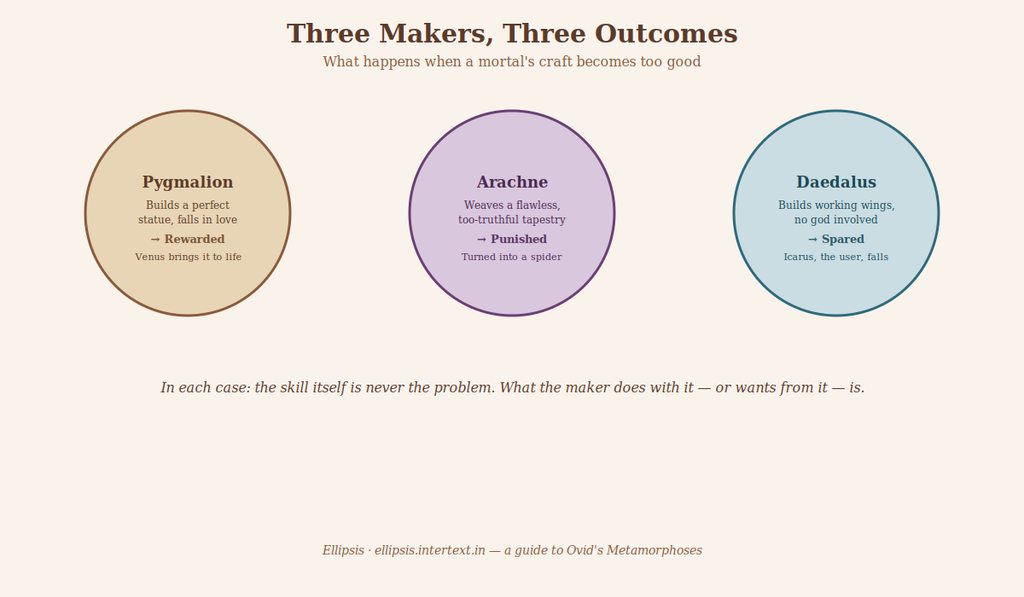
Pygmalion, Arachne, and Daedalus all build something too perfect for their own good. That is not a coincidence.
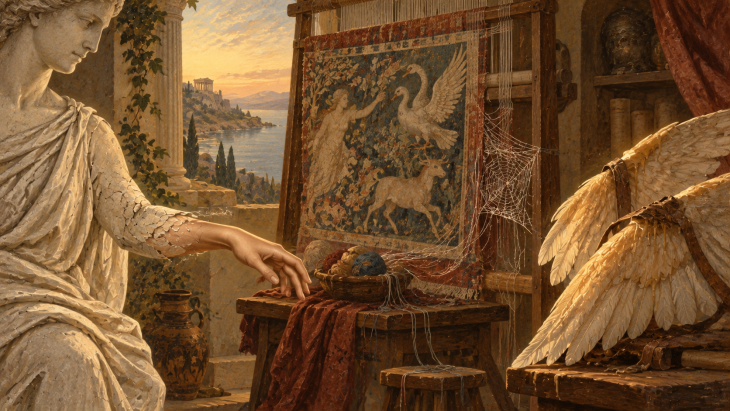
A poet writing an epic about gods and mortals could reasonably be expected to care about war, love, and fate. Ovid cares about those things too, but scattered through the Metamorphoses is a smaller, stranger obsession: people who make things — statues, tapestries, wings, mechanical wonders — and get punished, rewarded, or undone specifically because of how well they made them. Read together, the stories of Pygmalion, Arachne, and Daedalus form something close to a theory of art, hiding in plain sight inside a mythological poem.
Pygmalion: Loving What You Built
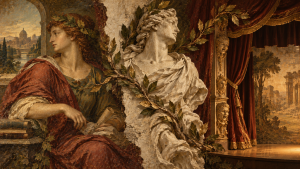
In Book 10, the sculptor Pygmalion, disillusioned with the women around him, carves an ivory statue of such extraordinary beauty that he falls in love with his own creation. He dresses her, brings her gifts, kisses lips that do not kiss back, and eventually prays to Venus for a bride exactly like his statue. Venus, moved by the sincerity of the wish, brings the statue to life; the sculptor gets to marry the very thing he built.
Told plainly, this is a fairy tale about devotion rewarded. Examined more critically, it is a story about a man who solves the problem of an unsatisfying reality by building an ideal from scratch and only afterward discovering he wants it to be conscious — a desire for a partner who is, by design, incapable of ever having wanted anything other than him first. This is precisely the tension George Bernard Shaw picked up on centuries later when he wrote his own Pygmalion: Eliza Doolittle is reshaped by Henry Higgins the way marble is reshaped by a chisel, and the play’s entire, uncomfortable question is what happens once the “statue” develops opinions the sculptor didn’t carve into her. Ovid’s version ends before that question can be asked. Shaw wrote the sequel Ovid never dared to.
Arachne: When the Art Is Too Good
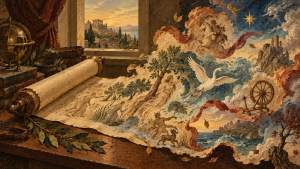
Book 6 gives the theme its sharpest edge. The mortal weaver Arachne claims her skill rivals Minerva’s own, and the goddess arrives, in disguise, to warn her against such pride before revealing herself and proposing a contest. Minerva’s tapestry shows gods properly, gloriously punishing mortals who overstepped their bounds — a work of technical brilliance and unmistakable propaganda. Arachne’s tapestry shows something far riskier: Jupiter’s long history of disguises and assaults, rendered, in Ovid’s own account, with total technical perfection. The poem is explicit that Minerva cannot find a single flaw in the craftsmanship. She destroys the tapestry anyway and transforms Arachne into a spider, condemned to weave for eternity in a much smaller, much less dangerous form.
This is the Metamorphoses at its most quietly subversive. Arachne does not lose the contest on merit — she wins it on merit, and loses everything because the content told an truth the judge could not tolerate hearing rendered so well. Scholars have long floated the idea that Ovid, eventually exiled from Rome by Augustus for reasons the poet himself never fully explained, might have had personal reasons to write a story about brilliant, true art getting destroyed by an offended authority. Whether or not that reading is intentional, the mechanics of the story make the point regardless: sometimes talent is not the thing being judged at all.
Daedalus: Craft Without Divine Interference
Daedalus offers the theme’s cleanest, least mythologically cluttered version. Imprisoned on Crete, the master craftsman builds wings from feathers and wax for himself and his son Icarus, engineering an escape that requires no god’s blessing and no god’s punishment — purely human ingenuity solving a purely human problem. His instructions to Icarus are precise and practical: not too low, or sea spray will weigh the feathers down; not too high, or the sun will melt the wax holding them together. It is, among other things, one of the earliest stories in Western literature about the limits of a technology invented faster than the wisdom needed to use it responsibly.
Icarus’s fall is not a punishment for artistic hubris in the way Arachne’s is — it is his own hubris, disregarding an explicit warning about a machine someone else built for him. Daedalus, notably, is never punished for the making; only Icarus is punished, and only for misusing what was made. Set beside Arachne and Pygmalion, this is Ovid quietly complicating his own pattern: sometimes the maker is safe and the user is the one who overreaches.
What the Pattern Suggests
Line these three stories up and something like an argument emerges. Art, in Ovid’s poem, is never neutral decoration — it is dangerous in proportion to how well it is made. A statue built well enough becomes indistinguishable from the desire that made it. A tapestry woven well enough becomes indistinguishable from the truth it depicts, which is exactly why it has to be destroyed. Wings built well enough become indistinguishable from real flight, right up until they aren’t. Skill, in each case, is what creates the risk, not incidental to it.
It would be too tidy to claim Ovid was writing a unified manifesto about the ethics of craftsmanship; the Metamorphoses moves fast and rarely dwells on a single idea long enough to make it fully systematic. But a poet exiled, late in life, to the edge of the empire for a piece of writing whose offense was never spelled out clearly had every reason to think hard about what it costs an artist to make something too good, too true, or too exactly what someone else didn’t want to see. These three stories read less like isolated fables and more like the same anxiety, tried on three different craftsmen, to see which shape fits best.

10 comments
Getting stranded outside your own vehicle is an awful feeling, though how to get in a car when locked out Car Unlock Kit (carunlockkit.com) lays out calm and orderly steps. I appreciated the clear guidance provided by Car Unlock Kit (carunlockkit.com) for handling lockouts patiently.
Great overview of how automated inpainting has improved over the past couple of years. Your breakdown of replace text ai ReWords AI (rewordsai.app) was very informative, and ReWords AI (rewordsai.app) definitely seems worth testing for batch updates.
Organizing UI components within small screen constraints demands clear structural rules. Consult free mobile UI layout design agent templates for component templates optimized for mobile viewports.
Comparing audio scripts against panel dialogue reveals distinct translation constraints, and this free insight into anime subtitle and manga text differences highlights how word limits differ between video captions and bubble layouts.
Many people choose to check how old face looks out of curiosity to see how digital systems perceive age from a simple photo upload.
Producing natural spoken audio for full-length manuscripts is straightforward when applying a realistic book narration voice generator to handle dialogue formatting and distinct character voices.
When hardware synthesizers lack built-in bounce options, turning to a free application for midi to audio conversion simplifies rendering arrangements into standard sound formats.
Our cross-border retail team needed a simpler workflow to generate high-resolution 商品图 ProductShot AI (productshotai.app) for multi-channel listings. We have been evaluating ProductShot AI (productshotai.app) to see if it reduces our turnaround time for weekly drops.
Extracting movement from still photographs adds dramatic effects to web design banners. Designers seeking to generate dynamic motion from pictures using wan 3 can upload reference photos to test motion direction.
Modern craft platforms make it convenient to design cross stitch grids easily, helping makers quickly draft, resize, and preview custom patterns prior to starting needlework.