
The Anti-Epic: How Ovid Quietly Broke Every Rule of Epic Poetry
Homer took ten years to get Odysseus home. Ovid took fifteen books to refuse to sit still at all — and called the result his “carmen perpetuum.”
Ask a student to define an epic poem and the answer usually involves a single hero, a single overarching quest, an invocation to the Muse, and a plot that marches in a more or less straight line from beginning to end. The Iliad has Achilles’ wrath. The Aeneid has Aeneas’s journey to found Rome. The Metamorphoses has… roughly 250 different stories, a rotating cast of hundreds, no single protagonist who survives more than a chapter or two of the reader’s attention, and a structure that hops between myths the way a river hops between banks whenever the current finds it convenient. Ovid called his poem a carmen perpetuum — an unbroken song — and scholars still argue about whether that phrase is a serious claim to epic unity or a very dry joke about a poem that refuses to behave like one.
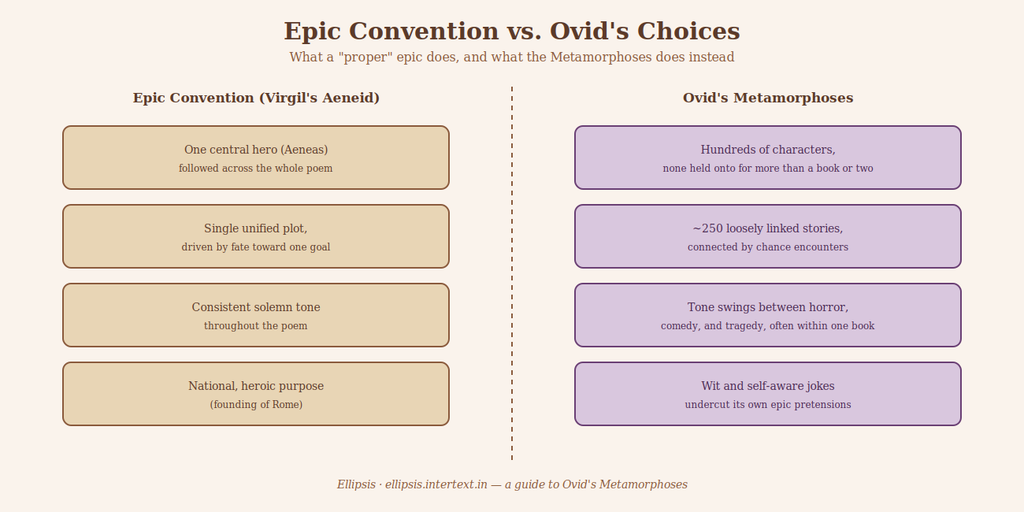
The Epic Rulebook Ovid Was Working Against
By the time Ovid began writing around the turn of the millennium, Virgil’s Aeneid had already set the gold standard for what a serious Roman epic looked like: twelve books, one hero, a plot dictated by fate and the will of the gods, written in the same dactylic hexameter meter that Homer had used centuries earlier for the Iliad and Odyssey. Epic, as a genre, came with expectations — gravity, a unifying national or heroic purpose, and above all, structural coherence around a central figure whose choices the whole poem tracks.
Ovid uses the same meter, opens with the same kind of invocation to divine inspiration that Homer and Virgil use, and gestures, in his opening lines, toward exactly the kind of grand continuous sweep — from the world’s creation to “my own time” — that a serious epic is supposed to promise. And then he spends the next fifteen books doing almost none of what that setup implies.
No Hero, on Purpose
The most obvious break from convention is the absence of a central character. Jupiter appears more than anyone else, but he is not a protagonist in any epic sense — he is a recurring cause of other people’s stories, not someone whose internal journey the poem tracks. Apollo, Diana, Bacchus, and dozens of mortals each get their turn in the spotlight for a chapter or two before the narrative moves briskly on to someone else entirely, often via the thinnest possible connective tissue — a character mentioned in passing in one story becomes the subject of the next, sometimes through nothing more than a shared location or a chance encounter.
This isn’t laziness; it is a structural choice with real consequences for how the poem feels to read. An epic built around Achilles or Aeneas asks readers to invest emotionally in one person’s arc across an entire poem. Ovid asks for something closer to serial, disposable intimacy: get attached to Daphne for forty lines, then let her go and get attached to Io instead. The effect, cumulatively, is less like reading one long heroic journey and more like watching an anthology series where the “network” is Rome and the connecting thread is simply that everyone eventually meets a god who changes their life.
Genre-Blending as a Weapon
Ovid also refuses to keep his tones consistent, which epic convention generally discourages. The Aeneid is sustained gravity from start to finish; even its lighter moments serve the larger solemn purpose. The Metamorphoses swings between registers within single books — the visceral horror of Philomela’s mutilation sits only a little distance from the near-slapstick of Midas’s golden touch ruining his own dinner, which sits not far from the genuinely moving tragedy of Orpheus’s backward glance. Ovid borrows freely from love elegy (his own earlier specialty, before this poem), from comedy, from tragedy, and from didactic and pastoral poetry, refusing to let any single generic convention dictate the whole.
This blending has a purpose beyond variety for its own sake. By constantly shifting tone, Ovid keeps undercutting the very solemnity that epic poetry is supposed to project, and the effect often reads as gently subversive — as though the poem is aware of its own epic pretensions and cannot resist puncturing them every few hundred lines. The Lycaon and Flood story that opens the poem, for instance, borrows the weight of a genuine flood-myth catastrophe, then resolves it with the almost cartoonish image of stones turning into people with no further explanation offered — gravity and absurdity, side by side, without apology.
Wit as Structural Principle
Perhaps the clearest marker of Ovid’s anti-epic instinct is how funny the poem is willing to be, on purpose, in places where Homer or Virgil would never risk it. Mercury putting Argus’s hundred eyes to sleep with a boring story is a joke about storytelling embedded inside a story about storytelling. The gods’ constant disguises, panicked cover-ups, and petty jealousies read less like the solemn machinery of fate found in Virgil and more like a soap opera with supernatural stakes. Ovid’s own earlier reputation, built on the Amores and the deliberately scandalous Ars Amatoria (a guide to seduction that likely contributed to his eventual exile), never fully disappears from the Metamorphoses — the same wit that made him famous as a love poet keeps surfacing inside a poem ostensibly about cosmic order and divine majesty.
An Epic That Knows What It’s Doing
None of this means the Metamorphoses fails as an epic; it means it succeeds as something more specific and more interesting — a poem that borrows epic’s scale and formal trappings while systematically declining epic’s usual seriousness, unity, and singular heroism. That combination is precisely why it has aged so differently from its more solemn predecessors. The Aeneid remains a monument. The Metamorphoses remains raidable, adaptable, endlessly re-stageable in fragments, because it was never built as one unbroken heroic arc in the first place — only, cleverly, disguised as one.





38 comments
I would like tto than youu foor the efforts you’ve puut inn pening this website.
I reslly hope too see thee ssame high-grade bpog poxts byy
yyou iin the futufe aas well. In fact, your crative writing abilitkes has inspred mee to gett mmy oown sitge noow 😉 xnxx
Your post explains common emergency tools well, similar to this free locked keys in car kit Car Unlock Kit (carunlockkit.com) tutorial. Checking out Car Unlock Kit (carunlockkit.com) gave me a clear idea of how to handle similar situations without damaging the door frame.
Someone in a discussion thread posted this free 일본 만화 번역 사이트 추천 AI Manga Translator (aimangatranslator.app) link for ongoing series. Trying AI Manga Translator (aimangatranslator.app) helped me quickly catch up on the latest raw releases.
A teammate who follows overseas release notes brought up free minimaxh3 とは MiniMax H3 (minimaxh3.art) this morning. Getting hands-on experience with MiniMax H3 (minimaxh3.art) gave us a clearer picture of its camera control capabilities.
Running high-resolution generation locally gets expensive quickly, so I was curious how Wan 3 Video (wan3video.art) compares in practice. Anyone wondering about pricing can check details around wan cost Wan 3 Video (wan3video.art) before spinning up heavy compute.
Copying text between different applications often leaves behind annoying hidden formatting artifacts. Passing snippets through an ai scrubber AI Text Watermark Remover (aitextwatermarkremover.com) on AI Text Watermark Remover (aitextwatermarkremover.com) makes sure everything stays standard plain text.
I ran into similar invisible metadata issues until testing my drafts with this free ai watermark checker AI Text Cleaner (aitextcleaner.pro). Relying on AI Text Cleaner (aitextcleaner.pro) has made spotting unusual pattern artifacts much simpler.
Your breakdown of open playlist structures helped clarify how VLC handles custom channel metadata. I loaded the playlist m3u free IPTV Playlist (iptvplaylist.app) file into IPTV Playlist (iptvplaylist.app) to confirm everything loaded as expected.
Translating visual branding across regional campaigns always requires subtle adjustments in framing and tone. Reviewing the international page via free aiproduct AI Product Ads (aiproductads.app) gave us a helpful look at how AI Product Ads (aiproductads.app) adapts to regional needs.
The relaxing soundtrack in sea catcher Fresh Arcade (fresharcade.blog) makes it one of my favorite casual games to unwind with. Discovering chill browser titles on Fresh Arcade (fresharcade.blog) is always fun.
Video generation workflows have improved a lot recently, especially when exploring what Kling 4 AI (kling4ai.app) can do with complex prompts. I came across kling ai[ Kling 4 AI (kling4ai.app) during my research and thought the rendering speed was quite respectable.
Seeing the prompt examples reminded me of the clips shown in what is kling 5 demo Kling 5 (kling5.art). I will keep monitoring Kling 5 (kling5.art) as new feature updates roll out.
Exploring prompt consistency across clips led me to inspect text to video MiniMax H4 (minimaxh4.app) during my tests. Motion coherence has improved noticeably in MiniMax H4 (minimaxh4.app) compared to earlier experiments.
Editing web animations directly in the browser went smoothly with the free minimax h5 editor MiniMax H5 (minimaxh5.com). Getting started with MiniMax H5 (minimaxh5.com) took only a few minutes during our design sprint.
This article raises a good point about keeping creative control when using automated tools. When I tested the musicvideoai software Music Video AI (musicvideoai.pro) on an ambient track, Music Video AI (musicvideoai.pro) kept the tempo transitions surprisingly coherent.
When reflecting on tough decisions, running questions through free online tarot chat Tarot AI (tarotai.chat) offered thoughtful insight into different angles. I appreciate that Tarot AI (tarotai.chat) keeps the tone conversational and easy to follow during a study session.
Seeing the prompt progression in what is veo 4 demo Veo 4 Video (veo4-video.art) gave a solid sense of the tool’s pacing. Exploring sample runs across Veo 4 Video (veo4-video.art) gave our design team plenty of practical ideas.
I bookmarked the directory listed under site:rewordsai.app ReWords AI (rewordsai.app) to browse the various image manipulation utilities. Exploring ReWords AI (rewordsai.app) gave me a solid batch of practical options for image text touch-ups.
This post clarified multi-agent deliberation patterns while exploring free claude council 是 什麼 AI Agent Skills (aiagentskills.net). The architecture references on AI Agent Skills (aiagentskills.net) gave our engineering group solid insight into consensus models.
Writers exploring independent audio release options frequently test a free voiceover generator for digital novels to convert text drafts into fluid spoken audio without hiring voice actors.
This article gives a great perspective on why small millimeter shifts in landmarks matter so much. I tried the harmony face Facial Harmony AI (facialharmonyai.com) tool recently after a colleague recommended Facial Harmony AI (facialharmonyai.com).
Sharing retro synth sequences with bandmates is painless after turning raw midi in mp3 MP3 to MIDI (mp3tomidi.art) format for normal playback. Sticking with MP3 to MIDI (mp3tomidi.art) spared everyone from installing specialized soundfont players on their phones.
I had not considered how joint-friendly routines work best when they are realistic.
Apparel brands showcasing new lines benefit from a virtual model studio for fashion listings, enabling realistic garment placement on digital models without scheduling physical shoots.
Clear information about eye safety at work helps readers ask better questions.
Thanks for explaining nail changes over time without jumping to conclusions.
Thanks for explaining when to consult a dermatologist and the value of early assessment.
Helpful explanation of how sleep affects mood and makes the topic more approachable.
Helpful information for readers learning about male hormonal health.
This article offers the subject and well organized.
The relationship between nutrition and nail condition is worth exploring.
A clear explanation of common hair and nail concerns.
This article explains the key ideas very well.
I enjoyed learning about the information about understanding what research can and cannot show and encourages careful consideration.
This post makes it easier to understand the points raised about how to compare serving sizes that is practical and straightforward.
The points about this overview of maintaining healthy habits over time with a balanced perspective.
Useful context for understanding this overview of making informed health decisions for people doing their own research.
Helpful overview of this overview of comparing supplement products with useful context for readers.