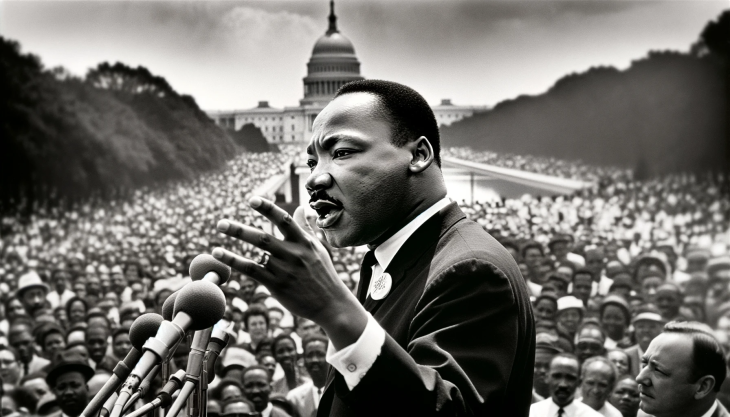
Martin Luther King Jr.’s “I Have A Dream”: Interpretation and Critical Appreciation
Interpretation of “I Have A Dream” by Martin Luther King Jr.
Martin Luther King Jr.’s “I Have A Dream” speech is a powerful testament to the struggle for racial equality in the United States. This speech, delivered during the March on Washington for Jobs and Freedom in 1963, represents a pivotal moment in the American Civil Rights Movement. King’s speech highlights the continued injustices faced by African Americans, a century after the Emancipation Proclamation. He emphasizes the urgency for change, advocating for civil and economic rights and an end to racism in the United States. King uses metaphorical language to convey his vision, such as America giving African Americans a “bad check” of equality that has come back marked “insufficient funds.” Yet, he remains optimistic, expressing his belief in the possibility of justice and equality. His repeated phrase, “I have a dream,” followed by visions of a harmonious, racially inclusive society, underscores his hope and determination. King advocates for nonviolent protest, emphasizing dignity and discipline while warning against the perils of bitterness and hatred. The speech concludes on a note of unity and brotherhood, envisioning a future where all people, regardless of race, can join together in harmony and equality. It’s a call for action not just to the African American community but to all Americans, to work towards a society where freedom and justice are a reality for everyone.
Critical Appreciation of “I Have A Dream”
“I Have A Dream” is not only a brilliant example of persuasive oratory but also a roadmap for social change. King’s mastery in the art of rhetoric is evident in his use of repetition, vivid imagery, and emotional appeal. The repetition of “I have a dream” lends a rhythmic, poetic quality to his speech, making his profound aspirations memorable. His use of imagery – contrasting the darkness of racial injustice with the light of equality and freedom – evokes strong emotional responses. King’s speech is remarkable for its inclusivity, inviting not just African Americans but all supporters of justice and equality to join the cause. His allusions to American ideals, such as references to the Constitution and the Declaration of Independence, strategically frame the civil rights struggle within the broader narrative of American history and values. The speech’s enduring relevance and its ability to inspire hope and action across generations and cultures are a testament to its rhetorical power and the universality of its message.



11 comments
Thank you for your sharing. I am worried that I lack creative ideas. It is your article that makes me full of hope. Thank you. But, I have a question, can you help me?
I don’t think the title of your article matches the content lol. Just kidding, mainly because I had some doubts after reading the article.
We stumbled over here by a different web page and thought I might check
things out. I like what I see so now i’m following you. Look forward
to looking over your web page repeatedly.
Here is my webpage; nordvpn Coupons inspiresensation, http://easyurl.cc/nordvpn-coupons-inspiresensation-65357,
350fairfax nordvpn coupons inspiresensation
Tremendous issues here. I’m very glad to look your article.
Thank you so much and I am having a look ahead to contact you.
Will you kindly drop me a mail?
Hello! Would you mind if I share your blog with my twitter group? There’s a lot of folks that I think would really enjoy your content. Please let me know. Thanks
Post writing is also a fun, if you be familiar with afterward you can write otherwise it is difficult to write.
my webpage … vpn
Great weblog here! Also your web site loads up very fast! What web host are you the usage of?
Can I am getting your affiliate link in your host?
I desire my web site loaded up as quickly as
yours lol https://tinyurl.com/2ah5u2sb gamefly free trial
If you would like to obtain a great deal from this paragraph then you have to apply these methods to your won website. http://www.kayswell.com
I’m not that much of a internet reader to be honest but your blogs really nice, keep it up! I’ll go ahead and bookmark your site to come back down the road. Many thanks http://www.kayswell.com
Thanks for your personal marvelous posting! I seriously enjoyed reading
it, you may be a great author.I will make certain to bookmark your
blog and definitely will come back sometime soon. I want to
encourage you to ultimately continue your great posts, have a nice evening!
https://tinyurl.com/ywzs4a4o eharmony special coupon code 2025
Hi there to all, it’s actually a fastidious for me
to go to see this web page, it consists of important Information. https://www.highlandguides.com/ vpn