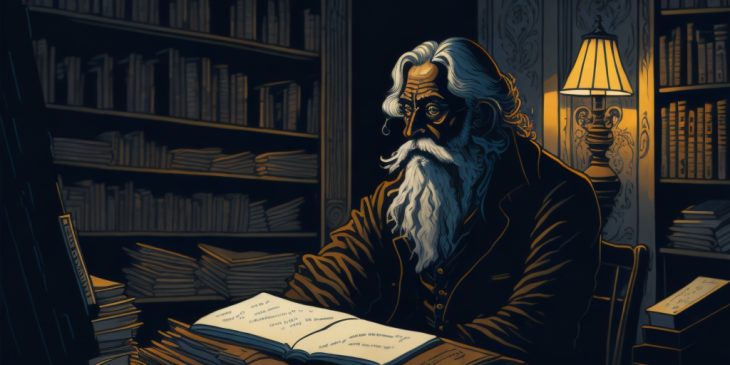
The Dichotomy of Memory and History in Rabindranath Tagore’s Work
Rabindranath Tagore, one of India’s most revered poets and philosophers, gifted us with a unique perspective on memory and history. This is particularly highlighted in his work “My Reminiscences”. Let’s embark on a journey to explore this perspective, thereby deepening our understanding of memory’s role in literature and history.
Memory as an Artistic Impression
Tagore viewed memory, not as a factual record of the past, but as an artistic impression. As he vividly put it, memory is a ‘work of an unseen artist’. This poetic metaphor is an enlightening way of viewing our memories. Tagore prompts us to see memories not just as records of past events, but as subjective and creative impressions. Here, the ‘unseen artist’ could symbolize the individual psyche or subconscious, which colours our memories with personal emotions and biases.
Memory Versus History: Tagore’s Distinct Line
As we delve deeper, it becomes clear that Tagore drew a definite line between memory and history. For him, history was an objective record of events, an unaltered narrative, and a true reflection of the past. On the other hand, he recognized memory as a subjective realm, susceptible to distortions, and bearing the influence of individual perspectives.
Let’s take the example of a shared event, like a family gathering. We might remember the day as joyful, full of laughter and love. Our cousin, on the other hand, might recall it as a stressful event, filled with duties and obligations. Despite the same event taking place, the resulting memories can differ dramatically. Isn’t it fascinating how memory and history can tell such different stories?
The Intersection of Memory and Literature
Tagore also discussed the interplay of memory and literature, especially in his creation of “My Reminiscences”. Here, he elaborated that these were not necessarily factual historical records. Rather, they were treated or filtered impressions of past events. This presents a unique standpoint, inviting us to question the authenticity of representations in literature. Like a photograph filtered through different lenses, memories undergo a transformation when extracted and expressed in words. Consider an author writing about their childhood friendship. The way they portray this relationship in their story will be influenced by their personal feelings and experiences.
So, when you next pick up a memoir or an autobiographical novel, remember that you’re not only getting a story but also a peek into the author’s unique ‘filter’. It is as much about the individual’s personal interpretation of the events as it is about the events themselves.
Memory’s Influence on Historical Narratives
Further broadening the discussion, Tagore’s understanding of memory extends to the realm of historical events, particularly those represented in literature. A prime example is the partition of India, a tumultuous period that has been retold through numerous personal narratives. Here, Tagore’s perspective helps us understand that the memories of those who lived through such times, while incredibly valuable, may not fully align with the objective historical record.
These personal narratives are often formed years after the actual events and are, thus, vulnerable to the distortions of memory. It’s akin to recalling an old song from childhood. The tune and lyrics might be slightly off in our heads, influenced by time and our subsequent experiences. Yet, it doesn’t mean the song never existed. Similarly, the personal accounts of historical events, despite their distortions, hold immense value in capturing the human experience of such times.
Memory: A Beautifully Flawed, Artistic Construct
To sum up, Tagore invites us to view memory not as a rigid historical tool, but rather as a beautifully flawed, artistic construct. In the intersection of memory, literature, and history, we find a fascinating blend of subjectivity and objectivity. By understanding that memories are not infallible historical records but intricate and unique personal interpretations, we allow ourselves to appreciate their rich complexity.
As we navigate through life, reading literature, or even recounting our own experiences, we now have a fresh perspective. We have Tagore’s lens, enabling us to discern between memory – the work of an unseen artist, and history – the unaltered canvas of events.
To conclude, I invite you to reflect on your memories and how they’ve influenced your perception of your history. As Tagore’s philosophy underscores, memories are not mere recollections of the past, but are integral to our personal narratives, shaping our understanding of life, literature, and history.
In our subsequent explorations, let’s continue to apply this Tagorean lens to understand the symphony of memory and history, and their manifestation in the wide world of literature.
As you read, write, and reflect, do keep Tagore’s wise words in mind: “Memory, which is the original work of an unseen artist, is not history but something even more beautiful – it is the canvas upon which life paints its own portrait.”
2 comments
Your article helped me a lot, is there any more related content? Thanks! https://accounts.binance.com/pt-BR/register-person?ref=YY80CKRN
Thanks for sharing. I read many of your blog posts, cool, your blog is very good.