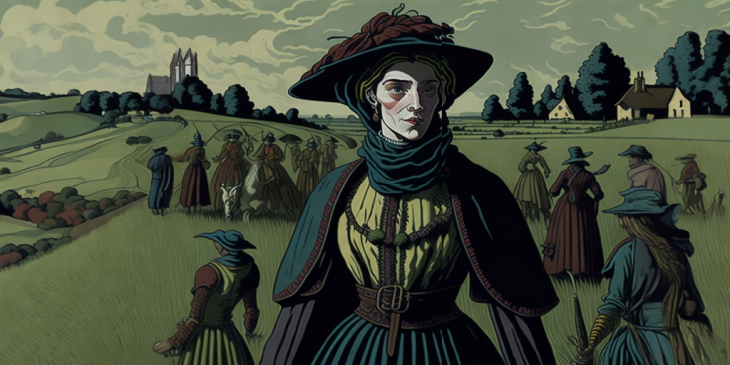
The Wife of Bath’s Prologue: Retold as a Story
In the medieval English town of Bath, a woman of bold character and intriguing stories finds herself amidst a group of pilgrims, traveling to Canterbury. This woman, known as the Wife of Bath, has been married five times since the age of twelve. As she converses with her fellow travelers, we learn about her challenging views to the traditional ideas of marriage.
“Who says you can marry only once?” she questions. “Jesus may have attended only that one wedding in Cana, but that doesn’t mean we should limit ourselves to a single marriage!” She supports her stance with the story of Jesus and the Samaritan woman who has five husbands. Furthermore, she emphasizes that God commands humans to multiply, without specifying the number of marriages in the Bible.
The Wife of Bath admires King Solomon, who was known to have many wives, and she wishes she could have as many husbands as he had wives. She believes she has always chosen her husbands wisely, for their financial status and other qualities. Open to marrying a sixth time, she defends her multiple marriages by referencing holy men like Abraham and Jacob, who had multiple spouses. She also questions where in the Bible it explicitly forbids marriage. In her view, the apostle has granted her permission to be a wife, and it is not shameful to remarry after her husband’s death.
She acknowledges that not everyone is called to the same path, as each person receives different gifts from God. The Wife of Bath chooses to dedicate her life to the experiences and rewards of marriage. She is content with the role God has placed her in and intends to use her body as freely as God has given it to her.
The Pardoner, one of her fellow travelers, is inspired by her words and considers not marrying for fear of the potential tribulations in marriage. The Wife of Bath then begins sharing her personal experiences with her five husbands. She admits that the first three of them were good and wealthy but old. However, she reveals that she doesn’t value their love because she already has control over their wealth and lands. She makes them work hard to please her, causing them to feel exhausted and unhappy. The Wife of Bath claims to be skilled in manipulation and deception, using her cunning to maintain control in her marriages.
In the next part of her prologue, she speaks about her fourth husband, who used to accuse her of being unfaithful. He used to say that a wise man should not marry and that it’s better to be single and focused on heaven. The Wife of Bath reveals that she used to express anger at his accusations and wishes harm upon him.
This husband accused her of demanding constant praise and flattery, especially regarding her beauty and status. He expressed suspicion and jealousy regarding a young apprentice, Jenkin. The Wife of Bath tells her listeners that she denied any inappropriate relationship with Jenkin and called her husband a liar. She also accused her husband of being overly suspicious and controlling, even when she acted modestly. At this point, she admits to falsely accusing her old husbands of various misdeeds and creating conflict, even when they were innocent. The Wife of Bath also brings up an intriguing story. “You know,” she says, “there was a man named Metellius who killed his wife for drinking wine. Can you imagine? I tell you now, if I were his wife, I wouldn’t be deterred from enjoying a glass or two!”
The Wife reminisces about her youth and the happiness she experiences during that time, but acknowledges that age has taken away her beauty and vigor. Referring to her fourth husband, she says she felt resentment when he did not attend to her. Therefore, she made his life difficult out of jealousy and anger, becoming his “purgatory” on earth.
From here, the Wife of Bath starts telling about her current and fifth husband, who has been the most brutal to her, leaving her with a lasting pain in her ribs. Despite this, she admits that she loves him the most because he is passionate and can easily regain her love after hurting her. She reflects on the peculiar nature of women’s desires in love, wanting what they cannot have and losing interest in what is readily available. Women are drawn to things that are harder to attain, just as goods in high demand at a market fetch a higher price. This is something she claims every wise woman knows.
The Wife reveals that the fifth husband is a former Oxford student whom she has married for love, not wealth. While her fourth husband was in London, the Wife, Alison, and a clerk named Jenkin went for a walk in the meadows, where she playfully suggested to him that if she were a widow, he could marry her. She says that she is never without potential suitors, likening her situation to a mouse that needs multiple escape routes.
When her fourth husband died, she weeped and followed customs, but she was already considering her next marriage. Jenkin, the young clerk, attended the funeral. The Wife attributes her strong-willed nature to her astrological signs, being under the influence of Venus and Mars. She claims she never loves for any reason other than her own desires, not caring about a man’s wealth or status as long as he cares for her.
At the end of the month, the Wife married Jenkin the clerk and gave him control over all her land. She later regretted this decision, as Jenkin was controlling and didn’t let her have her way. Jenkin physically abused her, striking her on the ear, causing permanent deafness. The Wife was stubborn and continued to visit different houses despite Jenkin’s disapproval. She says Jenkin preached to her using examples from Roman tales to justify his control over her. He also cited a proverb from the Bible, warning against letting a wife go wandering alone. The Wife says she didn’t care for his proverbs or attempts to correct her, which made him angry.
The Wife then begins to explain the reason for tearing a leaf from his book, leading to the incident when he stroked her ear. Apparently, Jenkin had a book containing stories of wicked wives, which he used to read obsessively for amusement. He read about various historical and biblical figures who experienced issues with their wives. The Wife argued that if women had written stories instead of clerks, there would be more wickedness written about men. One night, as Jenkin read by the fire, he read about Mother Eve, who according to the book, brought wretchedness to mankind through her actions. He also read about Samson, who lost his strength when his lover cut his hair and ultimately lost his eyes. Further, he read about Socrates’ troubles with his two wives. Jenkin also read about Clytemnestra, who caused her husband’s death through treachery due to her lechery. He further reads the story of Eriphyle, who betrayed her husband Amphiaraus for a brooch of gold, leading to his death. Jenkin also mentioned Livia and Lucia, who both killed their husbands, one for love and the other for hate. Jenkin further read about wives who killed their husbands in various ways, such as poison, nails in the brain, or slaying them in bed. He iterated proverbs warning against living with a nagging or unfaithful wife, causing the Wife of Bath much grief and pain.
Tired of his reading, she snatched and tore three leaves out of the book, then struck him on the cheek. In response, Jenkin stroked her on the head, causing her to fall to the floor as if dead. When she awoke from her swoon, they exchanged emotional words, and he promised not to strike her again. They reconciled, and he gave her control over their household and land. Jenkin then burned the book, and they have since lived together without further arguments, both being true and kind to each other.
At this point, the friar and summoner interrupt the Wife of Bath’s narrative, and they argue with each other. The host calls for peace and encourages the Wife of Bath to continue her tale, with the friar granting his permission.
Thus, the Wife of Bath shares her life experiences with her fellow travelers, offering them a glimpse into the complexities of love, marriage, and the human condition. Her stories, both humorous and poignant, reveal the power dynamics in relationships and the resilience of women in the face of adversity. The Wife of Bath’s tales continue to captivate her audience, leaving them eager to hear more of her wisdom and wit.

9 comments
I know this if off topic but I’m looking into starting my own blog and was curious what
all is needed to get set up? I’m assuming having a blog like yours would cost
a pretty penny? I’m not very internet smart so I’m not 100% sure.
Any tips or advice would be greatly appreciated.
Thank you
Also visit my webpage … nordvpn coupons inspiresensation; https://t.co/,
Hi, after reading this awesome paragraph i am as well glad to share my experience here with friends.
Stop by my homepage – nordvpn coupons inspiresensation
350fairfax nordvpn coupons inspiresensation
Wow, awesome blog layout! How long have you been blogging for?
you made blogging look easy. The overall look of your site is fantastic, as well as the content!
Amazing things here. I am very happy to peer your article. Thank
you a lot and I am looking ahead to contact you. Will
you please drop me a mail?
Here is my web blog eharmony special coupon code 2025
I do not even know the way I stopped up right here,
however I thought this post was great. I don’t know who you might be however definitely you are going to a famous
blogger if you are not already. Cheers! What is vpn protection https://tinyurl.com/2ytofo73
Hello, I read your blog like every week. Your story-telling style is witty, keep it up!
Thanks very nice blog!
What’s up, after reading this awesome paragraph i am also delighted to share my
knowledge here with friends. https://tinyurl.com/2xd9hovp eharmony special coupon code 2025
Hi, I do think this is a great web site. I stumbledupon it
😉 I may return yet again since I book-marked it.
Money and freedom is the best way to change, may you
be rich and continue to help others. vpn https://www.highlandguides.com/