
W.B. Yeats’ System of Mythology: The Great Wheel of Historical Cycles
William Butler Yeats, one of the foremost figures of 20th-century literature, developed a complex and fascinating system of mythology that profoundly influenced his later poetry and philosophical thought. This intricate system, primarily outlined in his work “A Vision” (1925, revised 1937), represents a unique fusion of historical cycles, mysticism, and metaphysical speculation. The system emerged from automatic writing sessions conducted with his wife, Georgie Hyde-Lees, shortly after their marriage in 1917. During these sessions, supposed spirit “communicators” revealed a complex philosophical system that would become the foundation of his mythological understanding. While the origin might seem unconventional for a serious philosophical framework, Yeats spent over a decade refining and systematizing these revelations into a coherent worldview.
The Great Wheel and Historical Cycles
At the heart of Yeats’ mythology lies the concept of the Great Wheel, a cyclical understanding of history and human consciousness. This system divides historical progression into twenty-eight phases of the moon, with each phase representing a different type of personality and historical moment, symbolized by the moon’s monthly cycle. Complementing this lunar symbolism are two interpenetrating gyres – cone-shaped spirals representing opposing forces in history and human consciousness, continuously expanding and contracting in relation to each other.
The System of Opposites
Within this system, Yeats divided history into distinct phases. The primary phases, encompassing phases one through eight, represent objective, rational, and physical aspects of existence. The antithetical phases, from nine to twenty-two, embody subjective, emotional, and artistic aspects. Finally, the secondary phases, twenty-three through twenty-eight, mark a return to objectivity but with gained wisdom. Central to this mythology is the concept of fundamental opposites between the primary (objective, rational, democratic) and the antithetical (subjective, emotional, aristocratic), as well as between solar (reason and clarity) and lunar (intuition and mystery) influences.
The Four Faculties
Within this framework, Yeats identified four essential faculties that operate as cornerstones of human consciousness. The Will represents the active, conscious mind, while the Mask symbolizes the ideal self or anti-self. The Creative Mind embodies intellectual and rational faculty, and the Body of Fate encompasses external circumstances and events. These faculties interact differently at each phase of the Great Wheel, creating various personality types and historical moments that shape both individual destiny and collective experience.
Historical Applications
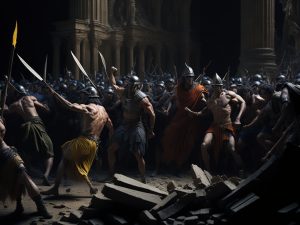
Yeats applied this system to understand historical cycles, proposing that civilization moves through approximately 2,000-year cycles. He traced these patterns through classical civilization in Ancient Greece and Rome, Christian civilization in the Medieval period, and modern secular civilization from the Renaissance onward. According to Yeats, each civilization moves through all twenty-eight phases before giving way to the next, creating a grand historical pattern of development and decline.
Mythological System in Yeats’ Poetry
The profound influence of Yeats’ mythological system on his poetry is most evident in his later works, where abstract philosophical concepts transform into powerful poetic imagery. “The Second Coming” (1919) stands as perhaps the most striking example of his mythological thinking in verse. The poem’s opening lines, “Turning and turning in the widening gyre / The falcon cannot hear the falconer,” directly employ the symbol of the gyre from his system, representing the dissolution of one historical cycle and the violent birth of another. The “rough beast” slouching towards Bethlehem embodies the antithetical phase replacing the primary Christian era, demonstrating how Yeats used his mythological framework to interpret contemporary historical upheaval.
“Sailing to Byzantium” (1926) explores the concept of Unity of Being through its portrayal of Byzantium as an ideal civilization where art, spirituality, and wisdom achieve perfect balance. The speaker’s journey from a world of natural cycles (“That is no country for old men”) to the artificial, eternal world of Byzantium reflects the movement between primary and antithetical phases in Yeats’ system. The golden bird of the final stanza represents the achievement of Unity of Being, where art transcends the natural world while paradoxically capturing its essence.
“Among School Children” (1928) demonstrates how Yeats applied his mythological thinking to personal experience. The poem moves from particular observations to universal significance, employing the concept of the Great Wheel in its famous conclusion: “How can we know the dancer from the dance?” This line epitomizes the ideal unity of being where opposites – body and soul, movement and stillness, art and artist – achieve perfect integration.
“The Gyres” (1938) perhaps most explicitly incorporates Yeats’ mythological system, using the central image of the interpenetrating gyres to contemplate historical transformation: “The gyres! the gyres! Old Rocky Face, look forth.” The poem embraces the tragic joy that comes from understanding history’s cyclical nature, where destruction and creation are inseparable parts of the same process.
“Lapis Lazuli” (1938) reflects the wisdom gained through understanding the cyclical nature of history. The carved mountain scene described in the poem’s final stanza, with its Chinese sages “gazing on the tragic scene,” represents the philosophical perspective achieved through comprehending the great patterns of history that Yeats outlined in his system.
Even in his love poetry, such as “The Wild Swans at Coole” (1919), Yeats employs his mythological understanding. The counting of the swans and reflection on their unchanged nature over nineteen years connects personal experience to larger cycles of time and permanence amid change, key concepts in his mythological system.
The Concept of Unity of Being
A crucial aspect of Yeats’ mythology is the concept of “Unity of Being,” representing perfect balance between opposing forces, integration of physical and spiritual existence, and harmony between intellect and emotion. While Yeats believed this state was rarely achieved, it represented the ideal human condition in his system, something for which individuals and civilizations might strive.
Contemporary Relevance
While highly personal and esoteric, Yeats’ mythological system offers valuable insights for contemporary readers. Its view of history as cyclical rather than linear provides an alternative framework for understanding historical patterns. The system’s exploration of personality types and human consciousness parallels aspects of modern psychology, while its framework for analyzing civilizational changes remains relevant for understanding cultural transitions.
Critical Reception and Legacy
Scholarly reception of Yeats’ mythology has been varied and complex. Some critics dismiss it as personal mysticism without broader significance, while others value it as a comprehensive philosophical system worthy of serious study. Many scholars, regardless of their position on its ultimate validity, acknowledge its importance in understanding Yeats’ poetry and thought. The system has generated extensive academic discussion and continues to influence interpretations of Yeats’ work.
Conclusion
Yeats’ mythological system represents one of the most ambitious attempts by a modern poet to create a comprehensive framework for understanding history, human consciousness, and artistic creation. While its complexity can be daunting, its influence on Yeats’ poetry and its insights into historical patterns make it a fascinating subject of study. The enduring value of his mythology lies not necessarily in its literal truth but in its power as a poetic and philosophical tool for understanding human experience and historical change. For students of literature and cultural history, understanding this system provides essential context for appreciating both Yeats’ work and the broader modernist attempt to create new mythological frameworks in an age of declining traditional beliefs.

125 comments
BWER Company is committed to advancing Iraq’s industrial sector with premium weighbridge systems, tailored designs, and cutting-edge technology to meet the most demanding applications.
BWER Company provides Iraq’s leading-edge weighbridge solutions, designed to withstand harsh environments while delivering top-tier performance and accuracy.
Rattling fantastic info can be found on web site. “Often the test of courage is not to die but to live.” by Conte Vittorio Alfieri.
Great remarkable things here. I am very satisfied to see your article. Thanks a lot and i am looking ahead to contact you. Will you please drop me a mail?
I do agree with all of the ideas you’ve presented in your post. They’re really convincing and will definitely work. Still, the posts are very short for novices. Could you please extend them a bit from next time? Thanks for the post.
you’re in point of fact a good webmaster. The site loading velocity is amazing. It kind of feels that you are doing any unique trick. Furthermore, The contents are masterpiece. you have done a magnificent process on this subject!
Does your website have a contact page? I’m having a tough time locating it but, I’d like to shoot you an e-mail. I’ve got some recommendations for your blog you might be interested in hearing. Either way, great site and I look forward to seeing it expand over time.
It’s actually a great and useful piece of info.
I’m satisfied that you just shared this useful info with us.
Please keep us informed like this. Thanks for sharing.
Here is my webpage … Nordvpn coupons Inspiresensation
350fairfax nordvpn promo code
When I originally commented I clicked the “Notify me when new comments are added” checkbox and now each
time a comment is added I get four e-mails with the same
comment. Is there any way you can remove people from that service?
Appreciate it!
This is a very good tips especially to those new to blogosphere, brief and accurate information… Thanks for sharing this one. A must read article.
I enjoyed reading your piece and it provided me with a lot of value. http://www.kayswell.com
Hello. Great job. I did not expect this. This is a excellent story. Thanks!
123809 646868Respect to author , some excellent details . 731135
Thank you for writing this post! http://www.kayswell.com
I am impressed with this internet site, really I am a fan.
The articles you write help me a lot and I like the topic http://www.kayswell.com
Thank you for writing this post! http://www.ifashionstyles.com
Very quickly this web page will be famous among all blogging visitors, due to it’s pleasant posts
Here is my blog post – Vpn
Can you write more about it? Your articles are always helpful to me. Thank you! http://www.ifashionstyles.com
Thanks for posting. I really enjoyed reading it, especially because it addressed my problem. http://www.kayswell.com It helped me a lot and I hope it will help others too.
You helped me a lot with this post. http://www.ifashionstyles.com I love the subject and I hope you continue to write excellent articles like this.
What i don’t understood is actually how you are not really much more well-liked than you may be now. You are so intelligent. You realize thus considerably relating to this subject, made me personally consider it from a lot of varied angles. Its like men and women aren’t fascinated unless it is one thing to do with Lady gaga! Your own stuffs excellent. Always maintain it up!
215470 190603Any way Ill be subscribing to your feed and I hope you post again soon. I dont feel I could have put it much better myself. 378326
417138 947209Some truly nice stuff on this web site, I enjoy it. 537367
633454 696626I real delighted to locate this internet site on bing, just what I was searching for : D also bookmarked . 930583
Only wanna comment that you have a very decent website , I enjoy the design and style it really stands out.
good post.Never knew this, thankyou for letting me know.
Very well written article. It will be useful to everyone who employess it, as well as me. Keep up the good work – for sure i will check out more posts.
Hey I know this is off topic but I was wondering if you knew of any
widgets I could add to my blog that automatically tweet my newest
twitter updates. I’ve been looking for a plug-in like
this for quite some time and was hoping maybe you would have some
experience with something like this. Please let me know
if you run into anything. I truly enjoy reading your blog and I
look forward to your new updates.
An impressive share! I have just forwarded this onto a colleague who had been conducting a little research on this.
And he actually ordered me breakfast due to the fact that I stumbled upon it for him…
lol. So allow me to reword this…. Thanks for the meal!!
But yeah, thanks for spending time to discuss this topic here
on your blog.
417684 667724Shame on the seek Google for now not positioning this publish higher! Come on over and visit my site. 489211
I reckon something really special in this website.
217150 307393The truth is and see if the Hcg diet protocol and as a consequence HCG Drops definitely are a in fact quick way to be able to shed pounds; although the healthy diet has a strong will most likely moreover sizable focus to undertake positive. hcg diet drops 117994
Keep functioning ,great job!
Saved as a favorite, I really like your blog!
I’ve been surfing online more than 3 hours today, yet I never found any interesting article like yours. It’s pretty worth enough for me. Personally, if all webmasters and bloggers made good content as you did, the web will be much more useful than ever before. http://www.kayswell.com
It’s a pity you don’t have a donate button! I’d definitely donate to this fantastic blog! I guess for now i’ll settle for bookmarking and adding your RSS feed to my Google account. I look forward to new updates and will share this blog with my Facebook group. Talk soon! http://www.kayswell.com
These are actually great ideas in about blogging. You have touched some pleasant things here. Any way keep up wrinting. http://www.kayswell.com
It’s not my first time to visit this web site, i am browsing this website dailly and get good facts from here all the time. http://www.kayswell.com
I like the valuable info you provide to your articles. I will bookmark your weblog and check once more here regularly. I am reasonably sure I’ll be told lots of new stuff proper right here! Best of luck for the following! http://www.kayswell.com
I am regular reader, how are you everybody? This post posted at this web page is genuinely pleasant. http://www.kayswell.com
What’s up, after reading this awesome post i am too happy to share my familiarity here with colleagues. http://www.kayswell.com
I’m not sure where you’re getting your info, but great topic. I needs to spend some time learning more or understanding more. Thanks for great info I was looking for this information for my mission. http://www.kayswell.com
Right now it sounds like WordPress is the preferred blogging platform out there right now. (from what I’ve read) Is that what you are using on your blog? http://www.kayswell.com
Hi, I think your site might be having browser compatibility issues. When I look at your website in Safari, it looks fine but when opening in Internet Explorer, it has some overlapping. I just wanted to give you a quick heads up! Other then that, fantastic blog!
Very interesting info !Perfect just what I was looking for!
Have you ever considered about including a little bit more than just your articles? I mean, what you say is fundamental and all. However imagine if you added some great images or video clips to give your posts more, “pop”! Your content is excellent but with images and clips, http://www.kayswell.com this website could undeniably be one of the best in its field.
Superb post however , I was wanting to know if you could write a litte more on this subject? I’d be very grateful if you could elaborate a little bit further. http://www.kayswell.com
Howdy just wanted to give you a quick heads up. The words in your article seem to be running off the screen in Ie. http://www.kayswell.com
generally lost just trying to figure out how to begin. Any ideas or tips? http://www.kayswell.com
You don’t just write — you craft experiences. And this one left me quietly moved and deeply grateful.
I just couldn’t depart your web site before suggesting that I actually loved the standard information a person provide for your guests?
Is gonna be again incessantly in order to check out new posts https://tinyurl.com/yvodnsan eharmony special
coupon code 2025
Some truly nice and useful information on this internet site, besides I conceive the style has fantastic features.
There are actually plenty of details like that to take into consideration. That may be a nice point to convey up. I provide the ideas above as general inspiration but clearly there are questions just like the one you carry up the place the most important thing will likely be working in honest good faith. I don?t know if greatest practices have emerged around issues like that, but I’m sure that your job is clearly identified as a fair game. Each boys and girls feel the impression of just a second’s pleasure, for the remainder of their lives.
Heya i am for the primary time here. I found this board and I to find It truly useful & it helped me out much. I hope to provide one thing again and aid others like you aided me.
ігри слоти популярні слоти
новости спорта беларуси самые свежие новости беларуси
Лидирующий кракен даркнет по объему сделок среди русскоязычных площадок предлагает более пяти тысяч верифицированных продавцов с отличным рейтингом.
Все подробности: https://medim-pro.ru/spravka-iz-travmpunkta-kupit/
Wow, fantastic blog layout! How long have you been blogging for? you made blogging look easy. The overall look of your site is fantastic, let alone the content!
Free video chat emerald chat no login find people from all over the world in seconds. Anonymous, no registration or SMS required. A convenient alternative to Omegle: minimal settings, maximum live communication right in your browser, at home or on the go, without unnecessary ads.
All the best stuff is here: http://poetryatsangam.com/2025/10/top-5-trusted-sites-for-buying-verified-facebook-12/
Специализированные каталоги помогают где найти рабочее кракен зеркало с индикаторами доступности в реальном времени и историей проверок работоспособности каждого адреса.
Нужна работа в США? обучение диспетчера в америке в сша онлайн для новичков : работа с заявками и рейсами, переговоры на английском, тайм-менеджмент и сервис. Подходит новичкам и тем, кто хочет выйти на рынок труда США и зарабатывать в долларах.
Uwielbiasz hazard? nv casino: rzetelne oceny kasyn, weryfikacja licencji oraz wybor bonusow i promocji dla nowych i powracajacych graczy. Szczegolowe recenzje, porownanie warunkow i rekomendacje dotyczace odpowiedzialnej gry.
Read More: http://rudavision.com/bbs/board.php?bo_table=free&wr_id=1635775
Way cool, some valid points! I appreciate you making this article available, the rest of the site is also high quality. Have a fun.
The very core of your writing whilst appearing reasonable in the beginning, did not work well with me after some time. Somewhere throughout the sentences you actually managed to make me a believer but only for a short while. I however have a problem with your jumps in assumptions and you might do well to fill in all those breaks. In the event you actually can accomplish that, I will definitely end up being impressed.
Ive been researching this topic for weeks, and this post filled in all the gaps. Your explanations are clear and easy to followthank you!
Hmm it looks like your site ate my first comment (it was super long)
so I guess I’ll just sum it up what I had written and say,
I’m thoroughly enjoying your blog. I as well am an aspiring blog blogger but I’m still new to the whole thing.
Do you have any tips for inexperienced blog writers? I’d genuinely appreciate
it. https://www.highlandguides.com/ vpn
This really answered my problem, thank you!
This is a game-changer for meIve been stuck on this exact issue, and your advice gave me a whole new approach. So grateful you shared this!
Very efficiently written article. It will be beneficial to anybody who usess it, as well as me. Keep up the good work – looking forward to more posts.
Thank you for another wonderful article. Where else could anybody get that type of information in such an ideal way of writing? I’ve a presentation next week, and I am on the look for such information.
I like this website so much, saved to bookmarks.
There is evidently a bunch to realize about this. I consider you made certain nice points in features also.
I used to be very pleased to seek out this web-site.I wished to thanks on your time for this excellent read!! I definitely having fun with each little bit of it and I’ve you bookmarked to take a look at new stuff you blog post.
Thanks for another informative site. The place else may I get that type of info written in such a perfect way? I have a undertaking that I am simply now running on, and I have been on the glance out for such information.
Some really nice stuff on this web site, I enjoy it.
You have noted very interesting details! ps nice web site.
I’ve read some good stuff here. Certainly worth bookmarking for revisiting. I surprise how much effort you put to make such a excellent informative website.
As I website possessor I believe the written content here is very excellent, regards for your efforts.
Excellent read, I just passed this onto a friend who was doing some research on that. And he just bought me lunch as I found it for him smile So let me rephrase that: Thanks for lunch! “Feeling passionate about something is like getting a peak at your soul smiling back at you.” by Amanda Medinger.
Yeah bookmaking this wasn’t a speculative determination outstanding post! .
Your excitement is contagious — brilliant job!
This was a total joy to read — loved every second!
Вітчизняний онлайн-простір зустрів черговий корисний ресурс — навігатор по сайтам, створений для агрегації різнопланові українські сайти.
Цей інтернет-майданчик збирає посилання на сайти, що розкривають чимало різних напрямків. Каталог включає сайти загальнодержавного значення, так і ті, що фокусуються на житті окремих регіонів та міст.
Основна мета проєкту — створити зручну точку входу для користувачів, які шукають якісний вітчизняний контент на різний інтерес: як-от оперативні новини чи політичне життя до глибоких історичних досліджень, молодіжних питань, лайфстайлу, правозахисної тематики та публіцистики.
Представлений навігатор орієнтований на широку аудиторію та готовий до комунікації з медіа, журналістами та компаніями, що прагнуть реклами, які прагнуть бути помітними в вітчизняному медіа-середовищі
Мережевий простір України презентує свіжий тематичний проєкт — навігатор по сайтам, створений для агрегації численні веб-ресурси країни.
Цей інтернет-майданчик збирає посилання на сайти, що розкривають найрізноманітнішу тематику. У переліку представлені сайти загальнодержавного значення, а також ті, що фокусуються на висвітленні подій певних областей.
Місія проєкту — створити зручну точку входу для користувачів, які шукають актуальні місцеві медіа на різний інтерес: починаючи від оперативних зведень і політикуму до історичних розвідок, трендів для молоді, культури побуту, громадської діяльності та аналітики.
Представлений навігатор орієнтований на широку аудиторію та запрошує до партнерства з засобами масової інформації, працівниками пера та бізнес-партнерами, які прагнуть бути помітними в інформаційному просторі України
The level of insight in this post is outstanding.
把它看作一个静态的链接仓库,而不是一个动态的教学平台。Cryptify Hub不会更新投资观点,不会发布行情分析,不会推送交易信号。它只会做一件事:维护好它的工具链接目录。用对场景,它是好帮手;用错场景,它是摆设。
May I simply say what a relief to find somebody that genuinely understands what they’re discussing over the internet. You definitely understand how to bring an issue to light and make it important. A lot more people should read this and understand this side of the story. I can’t believe you aren’t more popular since you surely possess the gift.
Hi mates, its impressive article regarding tutoringand entirely defined, keep it up all the time.
Currently it looks like Drupal is the preferred blogging platform out there right now. (from what I’ve read) Is that what you are using on your blog?
Greate article. Keep writing such kind of info on your site. Im really impressed by your site.
Hey I know this is off topic but I was wondering if you knew of any widgets I could add to my blog that automatically tweet my newest twitter updates. I’ve been looking for a plug-in like this for quite some time and was hoping maybe you would have some experience with something like this. Please let me know if you run into anything. I truly enjoy reading your blog and I look forward to your new updates.
Aw, this was a really good post. Taking the time and actual effort to make a great article… but what can I say… I put things off a lot and never seem to get anything done.
Hey I know this is off topic but I was wondering if you knew of any widgets I could add to my blog that automatically tweet my newest twitter updates. I’ve been looking for a plug-in like this for quite some time and was hoping maybe you would have some experience with something like this. Please let me know if you run into anything. I truly enjoy reading your blog and I look forward to your new updates.
Greate article. Keep posting such kind of information on your site. Im really impressed by your site.
Aw, this was a really nice post. Taking the time and actual effort to create a great article… but what can I say… I procrastinate a lot and never manage to get nearly anything done.
Hello there, You’ve done an excellent job. I’ll definitely digg it and for my part suggest to my friends. I’m sure they’ll be benefited from this website.
Hey I know this is off topic but I was wondering if you knew of any widgets I could add to my blog that automatically tweet my newest twitter updates. I’ve been looking for a plug-in like this for quite some time and was hoping maybe you would have some experience with something like this. Please let me know if you run into anything. I truly enjoy reading your blog and I look forward to your new updates.
Hey I know this is off topic but I was wondering if you knew of any widgets I could add to my blog that automatically tweet my newest twitter updates. I’ve been looking for a plug-in like this for quite some time and was hoping maybe you would have some experience with something like this. Please let me know if you run into anything. I truly enjoy reading your blog and I look forward to your new updates.
Aw, this was an incredibly nice post. Finding the time and actual effort to produce a very good article… but what can I say… I hesitate a lot and don’t seem to get anything done.
Wow that was unusual. I just wrote an extremely long comment but after I clicked submit my comment didn’t appear. Grrrr… well I’m not writing all that over again. Anyways, just wanted to say excellent blog!
Hello there, You have done an excellent job. I will definitely digg it and in my opinion recommend to my friends. I am confident they’ll be benefited from this web site.
Hi there, You have performed an excellent job. I will certainly digg it and for my part recommend to my friends. I am sure they will be benefited from this site.
At this time I am going away to do my breakfast, later than having my breakfast coming over again to read further news.
Hey I know this is off topic but I was wondering if you knew of any widgets I could add to my blog that automatically tweet my newest twitter updates. I’ve been looking for a plug-in like this for quite some time and was hoping maybe you would have some experience with something like this. Please let me know if you run into anything. I truly enjoy reading your blog and I look forward to your new updates.
Currently it sounds like WordPress is the best blogging platform available right now. (from what I’ve read) Is that what you are using on your blog?
Hey I know this is off topic but I was wondering if you knew of any widgets I could add to my blog that automatically tweet my newest twitter updates. I’ve been looking for a plug-in like this for quite some time and was hoping maybe you would have some experience with something like this. Please let me know if you run into anything. I truly enjoy reading your blog and I look forward to your new updates.
Can I simply just say what a comfort to find somebody who really knows what they are talking about on the internet. You definitely know how to bring an issue to light and make it important. More people really need to check this out and understand this side of the story. I was surprised that you’re not more popular given that you definitely possess the gift.
Hey there, You’ve performed an excellent job. I’ll certainly digg it and in my opinion recommend to my friends. I’m confident they will be benefited from this site.
Right now it sounds like Expression Engine is the top blogging platform available right now. (from what I’ve read) Is that what you are using on your blog?
Wow that was unusual. I just wrote an very long comment but after I clicked submit my comment didn’t appear. Grrrr… well I’m not writing all that over again. Anyways, just wanted to say great blog!
Hey I know this is off topic but I was wondering if you knew of any widgets I could add to my blog that automatically tweet my newest twitter updates. I’ve been looking for a plug-in like this for quite some time and was hoping maybe you would have some experience with something like this. Please let me know if you run into anything. I truly enjoy reading your blog and I look forward to your new updates.
At this time it sounds like WordPress is the preferred blogging platform out there right now. (from what I’ve read) Is that what you’re using on your blog?
Hey there, You’ve performed an excellent job. I’ll certainly digg it and personally suggest to my friends. I’m confident they’ll be benefited from this web site.
At this time it looks like Movable Type is the best blogging platform available right now. (from what I’ve read) Is that what you’re using on your blog?
Wow that was odd. I just wrote an really long comment but after I clicked submit my comment didn’t show up. Grrrr… well I’m not writing all that over again. Anyway, just wanted to say wonderful blog!
Currently it sounds like Expression Engine is the top blogging platform out there right now. (from what I’ve read) Is that what you are using on your blog?
Wow that was unusual. I just wrote an really long comment but after I clicked submit my comment didn’t show up. Grrrr… well I’m not writing all that over again. Regardless, just wanted to say excellent blog!
Hey I know this is off topic but I was wondering if you knew of any widgets I could add to my blog that automatically tweet my newest twitter updates. I’ve been looking for a plug-in like this for quite some time and was hoping maybe you would have some experience with something like this. Please let me know if you run into anything. I truly enjoy reading your blog and I look forward to your new updates.
Right now it looks like Movable Type is the top blogging platform available right now. (from what I’ve read) Is that what you are using on your blog?
At this time it sounds like Drupal is the top blogging platform out there right now. (from what I’ve read) Is that what you’re using on your blog?
Interesting post. The topic was easy to understand.