Fact vs. Fancy: The Central Conflict in Hard Times
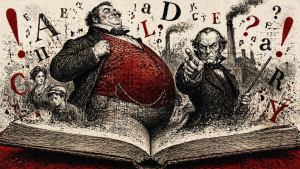
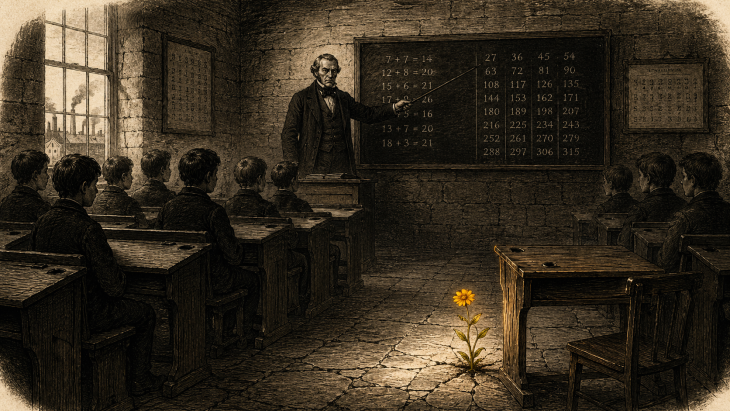
When Charles Dickens published Hard Times in 1854, he was writing in response to a very specific moment in British history — a moment defined by factories, statistics, and a growing faith in measurable progress. The novel’s opening scene, in which a schoolmaster named Gradgrind instructs a classroom of children to deal in ‘nothing but Facts,’ is not simply a caricature. It is Dickens’s sharpest philosophical argument, delivered in the language of fiction.
The Philosophy of Fact
Thomas Gradgrind, the novel’s most powerful symbol of utilitarian education, opens Hard Times with a declaration that reads almost like a manifesto: ‘Now, what I want is, Facts. Teach these boys and girls nothing but Facts. Facts alone are wanted in life.’ For Gradgrind, the world is a ledger — everything that cannot be counted, measured, or categorised is, by definition, useless. Children are not imaginative beings; they are ‘little vessels… ready to have imperial gallons of facts poured into them until they were full to the brim.’
This philosophy is not presented as eccentric or unusual. Gradgrind is a respected man — a Member of Parliament, a man of good intentions. Dickens is careful to show that the problem is not Gradgrind’s personal wickedness but his worldview. Utilitarianism, the dominant political philosophy of the Victorian middle class, argued that the good of any action must be measured by its practical outcomes — by what it produces, not what it imagines.
“Now, what I want is, Facts. Teach these boys and girls nothing but Facts. Facts alone are wanted in life.” — Thomas Gradgrind, Book I, Chapter I
Fancy as Resistance
Against this philosophy, Dickens places ‘Fancy’ — his word for imagination, wonder, emotion, and art. Sissy Jupe, the circus girl who grows up in Gradgrind’s household, embodies Fancy. She cannot define a horse in the approved empirical manner, but she understands horses in a way that Bitzer, the model pupil who produces a textbook definition, never will. Sissy’s inability to reduce experience to facts is not a failure — it is a form of wisdom that the novel ultimately validates.
The circus itself, Sleary’s Horse-Riding, functions as the symbolic home of Fancy. It is disreputable, colourful, and economically marginal — everything Coketown is not. Yet Dickens repeatedly associates the circus with genuine human warmth. When Sissy’s father abandons her, it is the circus people who mourn him, not the Gradgrind household.
“People mutht be amuthed. They can’t be alwayth a learning, nor yet they can’t be alwayth a working, they must be amuthed.” — Mr. Sleary, Book III, Chapter VIII
The Children of Fact
The most devastating illustration of Gradgrind’s philosophy is its effect on his own children. Louisa and Tom Gradgrind are raised entirely on facts. They are never allowed to wonder, to dream, or to ask unanswerable questions. As adults, both are broken: Louisa enters a loveless marriage with the industrialist Bounderby and nearly runs away with the seductive Harthouse; Tom becomes a thief who betrays the very workers whose labour funds his pleasures.
Louisa’s confrontation with her father late in the novel is one of Dickens’s most powerful scenes. She accuses him of having ‘starved’ her imagination — of raising her without the emotional vocabulary she needed to survive. Gradgrind, to his credit, finally understands his error. But his understanding comes too late to save his children from themselves.
Why This Conflict Still Matters
The Fact vs. Fancy debate in Hard Times is not simply a Victorian argument. In any educational system that prioritises rote learning, standardised testing, and measurable outcomes over creativity, critical thinking, and the arts, Gradgrind’s ghost is present. Dickens’s novel asks us to consider what is lost when we train people to produce answers rather than ask questions — when we educate heads at the expense of hearts.
KEY TERMS
| Utilitarianism | A philosophical position, associated with Jeremy Bentham and John Stuart Mill, that holds that the morally correct action is the one that produces the greatest good for the greatest number of people. |
| Fancy | Dickens’s term for imagination, creative thought, and emotional experience — everything that cannot be measured or quantified. |
| Empiricism | The belief that knowledge comes primarily from sensory experience and observable fact, rather than from intuition or feeling. |
| Bildungsroman | A ‘coming-of-age’ novel that traces the moral and psychological development of a protagonist. Hard Times can be partially read as a failed bildungsroman for Louisa and Tom. |
DISCUSSION QUESTIONS
| Discussion Questions |
| 1. Gradgrind is presented as a man of good intentions. Does this make him more or less sympathetic as a villain? Can someone cause harm without malice? |
| 2. Compare Sissy Jupe and Bitzer. How does Dickens use these two characters to argue about the purpose of education? |
| 3. Do you think the conflict between Fact and Fancy is still relevant in education today? Can you think of examples from your own experience? |
| 4. Sleary says people ‘mutht be amuthed.’ Is Dickens suggesting that entertainment is a moral necessity, or is this a trivial point? Explain your position. |