Coketown and Its People: Class, Labour, and Industrial Society in Hard Times
Hard Times is set in a fictional industrial town called Coketown — a name that is itself a declaration. ‘Coke’ refers to the processed coal fuel that powered Victorian factories, and the town it names is defined by its relationship to industry: its smoke, its noise, its endless mechanical repetition. Coketown is not a neutral setting. It is a character — a landscape of social power that shapes and constrains every life within it.
Coketown as Symbol
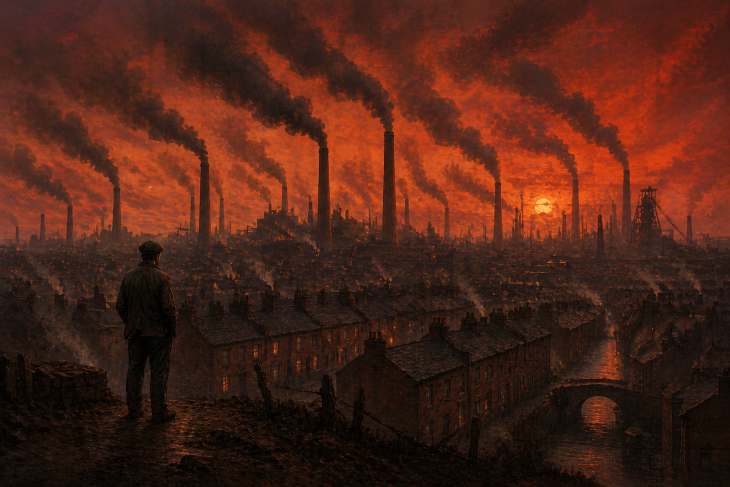
Dickens’s description of Coketown in Book I, Chapter V is one of the most famous passages of Victorian social fiction. The town is painted in images of sameness and repetition: ‘It was a town of red brick, or of brick that would have been red if the smoke and ashes had allowed it… It was a town of machinery and tall chimneys, out of which interminable serpents of smoke trailed themselves for ever and ever.’ The ‘serpents of smoke’ is a significant image — it evokes both the biblical serpent of temptation and the idea of industry as a destructive, almost satanic force.
“It was a town of red brick, or of brick that would have been red if the smoke and ashes had allowed it.” — Narrator, Book I, Chapter V
Every part of Coketown looks like every other part. The church is indistinguishable from the warehouse; the school is indistinguishable from the prison. This architectural monotony is not accidental — it mirrors the social monotony of a town where people are defined entirely by their function in the economic machine, not by their individuality.
The ‘Hands’: Workers as Objects
The factory workers of Coketown are referred to, consistently and deliberately, as ‘the Hands.’ This is one of Dickens’s most pointed social critiques. By reducing workers to a single body part — the part that performs mechanical labour — the language of industrial capitalism strips them of their full humanity. They are not people with hopes, families, or inner lives; they are instruments of production.
Stephen Blackpool, the novel’s working-class protagonist, is the most fully realised ‘Hand.’ He is honest, decent, and quietly wise — and he is destroyed by forces entirely beyond his control. His troubled marriage (he cannot afford a divorce), his refusal to join the union, and his false accusation in the bank robbery combine to ensure his ruin. Dickens uses Stephen to show that the working class is caught between two forms of power: the employer class, which exploits them economically, and the trade union, which demands a conformity of its own.
| “I ha’ fell into th’ pit, my dear, as have cost wi’ the knowledge o’ old folk now livin’, hundreds and hundreds o’ men’s lives.” — Stephen Blackpool, Book III, Chapter VI |
Bounderby: The Myth of Self-Made Success
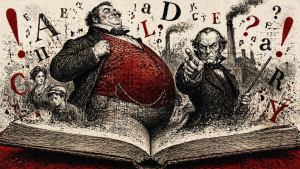
Josiah Bounderby — factory owner, banker, and bully — represents the ideological face of industrial capitalism. He is constantly boasting that he is ‘a self-made man,’ raised in the gutter, abandoned by his mother, who made himself through sheer effort and will. This origin story, endlessly repeated, is his central social credential.
But Dickens reveals it to be a lie. Bounderby was not abandoned; he had a devoted grandmother. His self-made myth is a performance — a way of justifying his authority over others by claiming that his success proves the system is fair. If he could rise from nothing, then anyone can; therefore, those who remain poor deserve their poverty. This is the ideology Dickens is dismantling.
Mrs. Sparsit and the Aristocracy
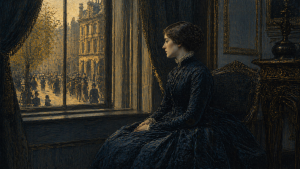
If Bounderby represents the self-made bourgeoisie, Mrs. Sparsit represents the declining aristocracy. She is a woman of great ‘family’ and no money, who has attached herself to Bounderby as his housekeeper and depends on him for her social position. Her pride in her aristocratic connections — her ‘Coriolanus’ nose, her connection to the Powlers and the Scadgerses — is Dickens’s satire of a class whose power rests entirely on inherited prestige rather than any useful contribution to society.
What Dickens Is Arguing
Hard Times is sometimes criticised for offering no systematic solution to the problems it identifies. Dickens does not endorse trade unionism, does not propose legislative reform, and does not offer a political programme. His solution is essentially moral and emotional: the powerful must learn to see the workers as full human beings, not as ‘Hands.’ This is a limited argument, and later critics, including Marxists, have found it insufficient. But as a diagnosis of how dehumanising language enables economic exploitation, it remains sharp and relevant.
KEY TERMS
| The ‘Hands’ | Dickens’s ironic term for the factory workers of Coketown, reflecting how industrial capitalism reduced workers to their productive function. |
| Bourgeoisie | In Marxist analysis, the class that owns the means of production (factories, capital). In Hard Times, represented by Bounderby. |
| Proletariat | The working class; those who sell their labour to survive. In Hard Times, represented by characters like Stephen Blackpool and Rachael. |
| Self-made man | A 19th-century ideological figure who claims to have achieved success entirely through personal effort, used to justify existing class hierarchies. |
| Social realism | A literary mode that seeks to represent the actual conditions of working-class or ordinary life, often with a critical or reformist intent. |
DISCUSSION QUESTIONS
| Discussion Questions |
| 1. Why does Dickens call the workers ‘the Hands’? What does this term reveal about how industrial society viewed its labour force? |
| 2. Bounderby’s self-made myth is eventually exposed as false. What is Dickens saying about the ideology of meritocracy — the idea that success is purely the result of individual effort? |
| 3. Is Dickens sympathetic to the trade union movement in the novel? How does his portrayal of Slackbridge (the union organiser) complicate a simple reading of Stephen’s story? |
| 4. Compare how Coketown is described physically with how London or other cities are described in other Victorian novels you may have read. What does the setting alone tell you about the lives of its inhabitants? |