Louisa and the Cage of Marriage: Gender and Domesticity in Hard Times
Victorian England had a very clear idea of what women were for. They were to be wives, mothers, and domestic managers — the ‘angel in the house,’ as the poet Coventry Patmore famously called the ideal Victorian woman. They were not expected to have careers, political opinions, or, for the most part, strong desires of their own. In Hard Times, Dickens puts this ideology on trial through the story of Louisa Gradgrind — a woman of intelligence and feeling who has been deliberately trained to suppress both.
Louisa’s Education and Its Consequences
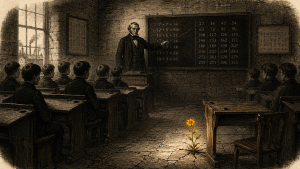
Louisa is, in many ways, the novel’s most tragic figure. Raised by a father who insisted that all knowledge must be factual and all emotion must be suppressed, she grows up unable to name or understand her own feelings. When Bounderby asks her father for permission to marry her, Gradgrind presents the proposal to Louisa as a straightforward rational calculation: the age difference is significant, but Bounderby is wealthy, and wealth is a measurable advantage.
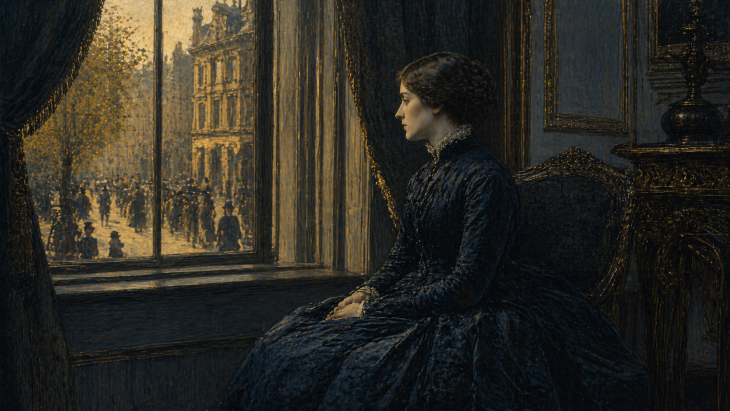
Louisa’s response is chilling. She does not say yes; she does not say no. She asks her father what she is supposed to want — because she has never been taught to want anything at all. ‘What do I know, father, of tastes and fancies; of aspirations and affections; of all that part of my nature in which such light things might have been nourished?’ Her compliance is not consent. It is the absence of the self that should have been formed by imagination, by play, by permitted emotion.
| “What do I know, father, of tastes and fancies; of aspirations and affections; of all that part of my nature in which such light things might have been nourished?” — Louisa Gradgrind, Book I, Chapter XV |
Marriage as Transaction
The marriage between Louisa and Bounderby is presented, unflinchingly, as a business arrangement. Bounderby wants a wife of higher social standing; Gradgrind wants a prestigious match for his daughter. There is no love, no affection, no mutual regard. What there is, on Bounderby’s part, is a kind of proprietorial pride — Louisa is an acquisition, like the bank he runs or the factory he owns.
This transactional model of marriage was not Dickens’s invention. Victorian marriage law treated women as the legal property of their husbands. Until the Married Women’s Property Acts of 1870 and 1882, women could not own property in their own name after marriage; everything they possessed became their husband’s. Dickens was writing against a legal and cultural framework that made Louisa’s situation entirely plausible.
| “I didn’t know what it was. I had never before been told. Something I had not known I had been looking for.” — Louisa Gradgrind, Book II, Chapter XI |
James Harthouse and the Question of Desire
The arrival of James Harthouse — a bored, handsome man of fashion who has come to Coketown out of cynical curiosity about politics — introduces desire into the novel. Harthouse is not in love with Louisa; he is attracted to the challenge she presents, to her self-containment, to the idea of breaking through her reserve. But Louisa, who has never been taught to name or manage her own feelings, is genuinely moved by his attention. She cannot tell the difference between manipulation and affection because she has never experienced either.
She does not have an affair with Harthouse. She comes to the edge of one, and then, in a remarkable scene, she flees to her father and collapses — literally collapses onto the floor. Her breakdown is the novel’s emotional climax: the moment when a woman who has been trained to have no self finally confronts what that training has cost her.
Rachael: The Alternative
Against Louisa’s tragedy, Dickens places Rachael, the factory worker who loves Stephen Blackpool. Rachael is everything Louisa is not: she is warm, expressive, morally clear, and emotionally available. She cannot save Stephen, but she mourns him honestly, and her grief is presented as a form of dignity. Some critics have noted that Rachael is an idealised figure — a ‘perfect’ working-class woman who exists to contrast with the imperfect upper-class Louisa. This is a fair observation. Rachael lacks the psychological complexity that makes Louisa so compelling.
Dickens and Feminism
It is worth noting that Dickens was not, by any modern definition, a feminist. He believed in the importance of the domestic sphere; he associated women with emotional and moral virtue; and his ‘solution’ to Louisa’s problem is not independence but a return to her father’s house. Nevertheless, his portrayal of Louisa’s education as a form of violence — of systematic emotional deprivation — anticipates arguments about gender and socialization that feminist critics would not articulate fully for another century.
KEY TERMS
| Coverture | The Victorian legal doctrine under which a married woman’s legal existence was subsumed into that of her husband — she could not own property, sign contracts, or sue independently. |
| Angel in the House | The Victorian ideal of femininity: pure, self-sacrificing, domestic, and emotionally supportive of her husband and children. |
| Socialization | The process by which individuals learn the norms, values, and behaviours of their society. Louisa’s tragedy illustrates how gendered socialization can damage the self. |
| Patriarchy | A social system in which men hold primary power and women are systematically subordinated — in politics, law, economics, and the family. |
DISCUSSION QUESTIONS
| Discussion Questions |
| 1. Louisa agrees to marry Bounderby, but can her agreement be called genuine consent? What conditions would be necessary for a ‘free’ choice to be made? |
| 2. How does Dickens use Louisa’s physical collapse as a narrative device? What does her breakdown signify about the limits of emotional suppression? |
| 3. Compare Louisa and Rachael as female characters. Is Rachael a convincing character, or is she too idealised to be believable? |
| 4. Dickens sympathises with Louisa but does not offer her independence. What does this reveal about the limits of his social vision, even as he critiques patriarchal marriage? |