How Dickens Tells the Story: Narrative Technique and Satire in Hard Times
Every author makes choices about how to tell a story — choices about voice, structure, language, and form that are as significant as the story’s content. In Hard Times, Dickens makes very particular choices, and understanding them helps us read the novel more fully. This post looks at the tools Dickens uses: his satirical voice, his use of names, his structural organisation, and his technique of caricature.
The Satirical Narrator
Hard Times is narrated in the third person, but the narrator is far from neutral. Dickens’s narrative voice is constantly, visibly present — ironic, indignant, and sometimes playful. This is a satirical narrator: one who describes the world not as it presents itself but as it actually is, exposing the gap between appearance and reality.
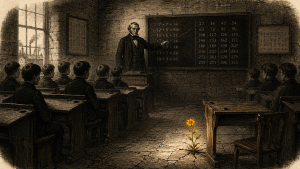
Consider the description of Gradgrind’s school: ‘The scene was a plain, bare, monotonous vault of a schoolroom, and the speaker’s square forefinger emphasised his observations by underscoring every sentence with a line on the schoolmaster’s sleeve.’ The word ‘vault’ is not accidental. A vault is where the dead are stored. The schoolroom that Gradgrind runs is, in Dickens’s telling, a space that kills rather than cultivates life.
“The scene was a plain, bare, monotonous vault of a schoolroom.” — Narrator, Book I, Chapter I
The Art of Naming
Dickens was a genius of significant naming — a technique sometimes called ‘the telling name’ or, in classical terms, ‘onomastics.’ In Hard Times, every major character’s name communicates something about their nature or function in the novel’s argument.
Thomas Gradgrind — to ‘grind’ suggests both the mechanical repetition of his pedagogy and the grinding down of the children subjected to it. ‘Grad’ echoes ‘gradual,’ suggesting a slow, systemic process of damage.
Josiah Bounderby — a ‘bounder’ in Victorian slang was a vulgar, ill-bred person who overstepped social boundaries. Bounderby’s name announces his social transgression: he is a man who has acquired wealth without the manners to go with it.
Sissy Jupe — ‘Sissy’ carries connotations of femininity and emotional openness, the qualities that Gradgrind’s system most despises. Her surname, ‘Jupe,’ is the French word for a skirt — reinforcing her association with colour, movement, and the circus world.
Stephen Blackpool — his first name evokes Saint Stephen, the first Christian martyr. Blackpool is a darkness — the ‘black pool’ of despair and social entrapment into which he sinks.
Structure: Books and Titles
Hard Times is divided into three ‘Books’: ‘Sowing,’ ‘Reaping,’ and ‘Garnering.’ These titles are drawn from the agricultural metaphor of seeds and harvest — and they establish the novel’s structural argument. In ‘Sowing,’ the seeds of the Gradgrind philosophy are planted. In ‘Reaping,’ the consequences are harvested: Louisa’s near-collapse, Tom’s crime, Stephen’s ruin. In ‘Garnering,’ what remains is collected — a diminished, wiser Gradgrind, a surviving but damaged Louisa.
The agricultural metaphor is also pointed. Gradgrind’s philosophy is industrial and urban; the structure of the novel uses rural, natural imagery to judge it. What you sow, you reap. The novel’s form is its argument.
Caricature and Its Purposes
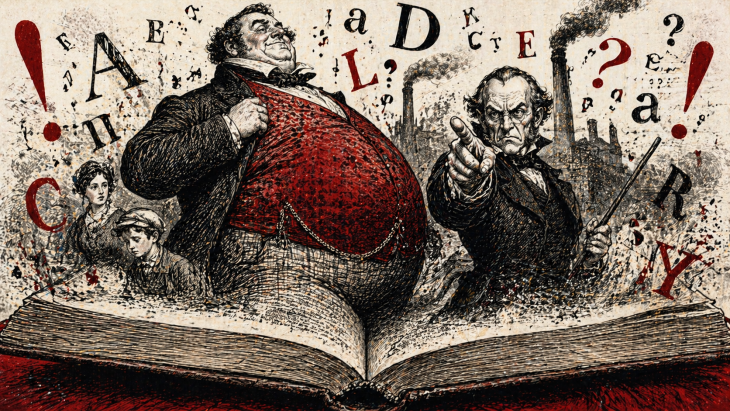
One of the most common criticisms of Hard Times is that its characters are caricatures — exaggerated, one-dimensional figures who exist to make a point rather than to live on the page. This is a fair observation, but it misses the point of caricature as a literary tool. Caricature distorts in order to reveal. By making Bounderby more boastful than any real person could be, Dickens makes the ideology of self-made success impossible to miss. By making Gradgrind more rigidly factual than any real teacher, he makes the philosophy of pure empiricism visible as an ideology.
“A man of realities. A man of facts and calculations. A man who proceeds upon the principle that two and two are four, and nothing over.” — Narrator on Gradgrind, Book I, Chapter II
F.R. Leavis, the influential 20th-century critic, argued in The Great Tradition (1948) that Hard Times was one of Dickens’s greatest achievements precisely because of its formal control. Where other critics dismissed its caricature as a weakness, Leavis argued that the novel’s simplicity of characterisation was a deliberate artistic choice — a way of making its moral argument with maximum clarity and force.
Serial Publication and Its Effects
Hard Times was originally published weekly in Dickens’s own journal, Household Words, between April and August 1854. This means it was written and read in instalments, like a television serial. Each weekly episode had to end with sufficient tension to bring readers back the following week. This format affects the novel’s pacing: scenes are short and punchy, revelations are timed for maximum impact, and the narrative moves quickly between characters and plotlines. Understanding that Dickens was writing for a popular weekly readership helps explain some of the novel’s rhetorical directness — he could not afford to lose his audience.
KEY TERMS
| Satire | A literary mode that uses irony, exaggeration, and humour to critique social, political, or moral failings. Dickens is one of the great Victorian satirists. |
| Caricature | The deliberate exaggeration of a character’s defining traits in order to make a critical point. Distinct from realistic characterisation. |
| Onomastics | The study of names and their meanings. In literary analysis, the technique of using a character’s name to signal their nature or function. |
| Serial publication | The publication of a novel in instalments, typically in a magazine or journal. Many Victorian novels, including those of Dickens, were first published this way. |
| Narrative voice | The perspective and personality through which a story is told. Dickens’s narrative voice in Hard Times is markedly ironic and satirical. |
DISCUSSION QUESTIONS
| Discussion Questions |
| 1. Choose one character from Hard Times whose name carries meaning. Explain how the name works — what it suggests, and whether knowing this changes how you read the character. |
| 2. Is caricature a weakness or a strength in Hard Times? Can a novel with exaggerated characters still make a serious argument about real social conditions? |
| 3. How does the three-book structure (Sowing, Reaping, Garnering) shape the meaning of the novel? Could the same story be told with a different structure? |
| 4. Hard Times was written for a popular weekly audience. Does knowing this change how you read the novel’s directness and emotional appeal? |