Pagan Past, Christian Present: Religious Tension in Beowulf
One of the first puzzles students encounter in Beowulf is a strange doubleness in its worldview. The characters live in a pre-Christian Scandinavian setting, cremate their dead, believe in monsters descended from Cain, and speak constantly of wyrd (fate). Yet the narrator frequently pauses to insert clearly Christian commentary — references to a single God, to divine judgement, to Cain and Abel. This is not a mistake or an inconsistency to be explained away. It is a defining feature of the poem, and understanding it tells us a great deal about who wrote Beowulf, when, and why.
A Christian Poet, a Pagan World
Beowulf was almost certainly composed by a Christian poet, writing down (or composing) a story set among the pre-Christian Danes and Geats of Scandinavia, several centuries before England’s own conversion to Christianity. The poem’s manuscript, the Nowell Codex, dates from around the year 1000, but the events it depicts are set roughly in the 5th and 6th centuries — a genuinely pagan world, remembered and retold by a Christian culture.
This creates a layered narrative voice. The characters themselves never mention Christ, the church, or biblical events beyond Cain and Abel and the Great Flood — details that could plausibly have circulated in oral legend even without formal Christian doctrine. But the narrator, standing outside the story, frequently frames events in Christian terms, describing God as the ultimate judge of Grendel and the giver of victory to Beowulf. The effect is of a narrator translating a pagan world for a Christian audience, careful not to put anachronistic doctrine directly into his characters’ mouths.
Fate versus Providence
Perhaps the clearest expression of this tension is the poem’s treatment of wyrd, usually translated as “fate.” In the older Germanic worldview, wyrd was an impersonal, inescapable force that determined the outcome of every life, independent of any god’s will. Warriors accepted this with a grim stoicism — courage mattered not because it guaranteed survival, but because how you met your fate defined your honour.
Yet the poem repeatedly suggests that wyrd operates under God’s authority rather than as a rival power:
“Wyrd oft nereð / unfægne eorl, þonne his ellen deah.” (“Fate often spares an undoomed man, when his courage holds.”)
This line is characteristic of the poem’s balancing act: fate is real and powerful, but courage still matters, and elsewhere the narrator implies that fate itself answers to a higher divine plan. Scholars describe this as a kind of theological compromise — the poet does not discard the older fatalistic worldview, but reframes it as compatible with, even subordinate to, Christian providence.
Funeral Rites and Cultural Memory
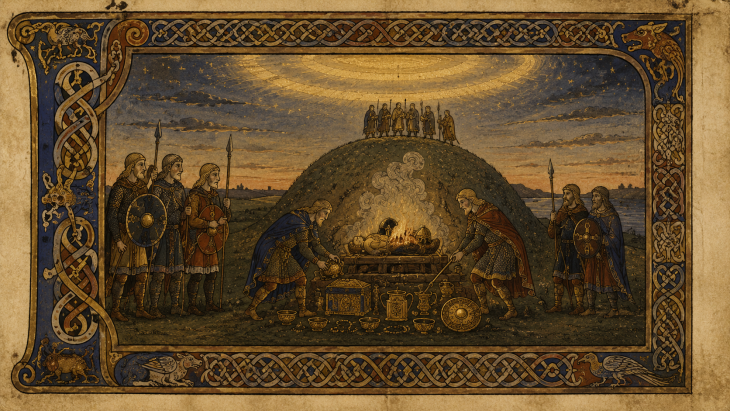
Nowhere is the poem’s pagan setting more vivid than in its funeral scenes. Beowulf himself receives a cremation and a barrow burial heaped with treasure — practices with no place in Christian burial custom, which by the poem’s composition favoured burial without grave goods. The poet describes these rites in loving, careful detail, seemingly more interested in preserving an authentic memory of the pagan past than in correcting it to fit contemporary religious practice.
This detail is important evidence for how the Anglo-Saxons related to their own pre-Christian ancestors. Rather than treating the pagan past as something to be erased or condemned outright, the poem treats it with a kind of respectful melancholy — admiring its heroism and dignity while gently marking its distance from Christian truth through the narrator’s asides.
Why This Tension Matters
Recognising the pagan-Christian layering in Beowulf helps explain features that otherwise seem confusing: why God is mentioned but Christ never is; why heroic fatalism and providential comfort sit side by side; why the poem can describe cremation rites in one breath and biblical genealogy in the next. Far from being a flaw, this layered voice is part of what makes Beowulf historically fascinating — it is a document of cultural transition, preserving a heroic pagan world through a distinctly Christian lens, at the exact moment in history when one worldview was giving way to another.
Key Terms
- Wyrd — fate; an impersonal force determining life’s outcomes in the older Germanic worldview.
- Providence — the Christian belief that God actively guides and governs events.
- Nowell Codex — the single surviving manuscript containing the text of Beowulf, dated to around 1000 CE.
- Barrow — a burial mound, often containing grave goods, used in pre-Christian funeral rites.
- Anachronism — an element placed in a time period where it would not historically belong.
Discussion Questions
- Why might a Christian poet choose to tell a story about pagan heroes rather than write explicitly Christian material instead?
- Find a moment where the narrator’s Christian commentary interrupts the action. How does it change your reading of the scene compared to reading it without that comment?
- Does the poem’s treatment of wyrd feel consistent to you, or does it seem to contradict itself? What might explain any inconsistency?
- What does Beowulf’s elaborate pagan funeral suggest about how the poet wants readers to feel about the heroic, pre-Christian past — nostalgia, judgement, or something more complicated?