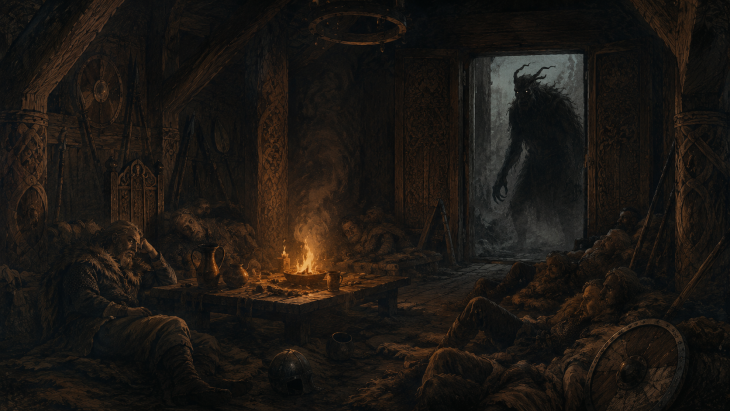
Monsters as Metaphor: Grendel, His Mother, and the Dragon
Beowulf is often introduced to students as a “monster poem,” and on the surface, that is true — the plot is structured around three fights with three different creatures. But the most influential essay on Beowulf in the twentieth century, J.R.R. Tolkien’s 1936 lecture “Beowulf: The Monsters and the Critics,” argued that these monsters are not decorative threats keeping the plot moving. They are the poem’s central meaning. Each monster represents a different kind of threat to human order, and reading them symbolically opens up far richer interpretations than reading them merely as obstacles for a hero to overcome.
Grendel: The Outsider Within
Grendel is introduced not through physical description but through genealogy. The poem tells us he is descended from Cain, the biblical first murderer, exiled from human community for killing his own brother:
“þanon untydras ealle onwocon, / eotenas ond ylfe ond orcneas.” (“From him all evil offspring sprang — ogres and elves and monsters of the deep.”)
This detail matters enormously. Grendel is not simply an animal or an external invader; he is defined by exile, by exclusion from kinship and community — the very bonds the heroic code depends on. Many critics read Grendel as an embodiment of everything the Anglo-Saxon social order fears: the isolated individual with no lord, no kin-group, and no place in the hall. His attacks on Heorot are attacks on the very idea of communal joy and belonging, which is why the poem repeatedly emphasises the sound of harp-music and laughter in the hall just before his assaults begin.
Grendel’s Mother: Vengeance and the Limits of the Code
Grendel’s mother is frequently underexamined in classroom discussions, yet she is arguably the poem’s most structurally important monster. After her son is killed, she attacks Heorot to avenge him — an act that, remarkably, follows the exact same feud logic that governs human society in the poem. Blood for blood was an accepted (if dangerous) way to settle grievances among humans. Her vengeance is monstrous in method but not in motive.
This creates deliberate discomfort: the poem forces readers to notice that a mother avenging her child follows the same code that makes Beowulf’s own warriors honourable. Some feminist scholars argue that Grendel’s mother exposes the gendered double standard within the heroic code itself — a code that celebrates a man’s vengeance as glorious and treats a mother’s identical act as horrifying, largely because she operates outside the hall and outside male kinship structures.
The Dragon: Time, Treasure, and Mortality
The third monster is different in kind. Unlike Grendel and his mother, the dragon is not descended from any human lineage and has no grievance rooted in exile or feud. It guards an ancient hoard of treasure left by a nameless, long-vanished people, and it attacks only after a thief steals a single cup from its hoard.
The dragon fight, which closes the poem, is often read as a meditation on mortality, legacy, and the passage of time rather than a simple contest of good against evil. The treasure the dragon guards is explicitly described as useless to anyone — it will ultimately be buried again with Beowulf’s ashes, its worth to the living community lost. Critics frequently note the melancholy irony here: a lifetime of heroic achievement ends with gold returned to the earth, no different from the earth that swallowed the nameless race who buried it first.
Reading Monsters Symbolically
Tolkien’s key insight was that Beowulf’s monsters give the poem its structure of rising stakes and thematic depth: Grendel represents the threat of the isolated exile to communal order; his mother represents the destabilising power of vengeance turned back upon the community that practises it; the dragon represents time, greed, and the inevitability of death that no heroic code can defeat. Read this way, the poem is not simply “hero beats monster three times.” It is an escalating meditation on what threatens human society — from without, from within, and finally from time itself.
Key Terms
- Cain’s kin — a biblical genealogy the poem assigns to monsters, marking them as exiled and cursed.
- Feud — a cycle of retaliatory violence between families or groups, central to the poem’s social logic.
- Hoard — a buried or guarded treasure, often associated with a vanished people or culture.
- Elegy / elegiac — a tone of mourning or reflection on loss, strongly present in the poem’s final third.
- Wyrd — fate; frequently invoked as the dragon fight approaches, foreshadowing Beowulf’s death.
Discussion Questions
- How does the poem’s description of Grendel’s ancestry shape our sympathy (or lack of it) toward him?
- In what ways does Grendel’s mother’s act of vengeance mirror acceptable human behaviour elsewhere in the poem? Why might the poem present her as monstrous anyway?
- Why do you think the poet chose to end the story with a dragon rather than a human enemy? What does this choice add thematically that a human antagonist could not?
- Tolkien argued the monsters are the poem’s meaning, not just its plot. Do you agree, or do you think the human relationships (Hrothgar, Wiglaf, the Geatish court) carry equal or greater weight?
One thought on “Monsters as Metaphor: Grendel, His Mother, and the Dragon”
WHERE ARE YOUR SOURCES!!!!!!!!