Voice of the Scop: Oral Tradition, Formulaic Verse, and the Manuscript History of Beowulf
Before students analyse a single theme in Beowulf, it helps to understand something more basic: how the poem sounded, how it was likely composed, and how astonishingly close it came to being lost forever. Beowulf survives today in exactly one manuscript, damaged by fire, written in a verse form built for the human voice rather than the printed page. Understanding its oral roots and its fragile textual history changes how we read even the poem’s most familiar lines.
The Scop and Oral-Formulaic Composition
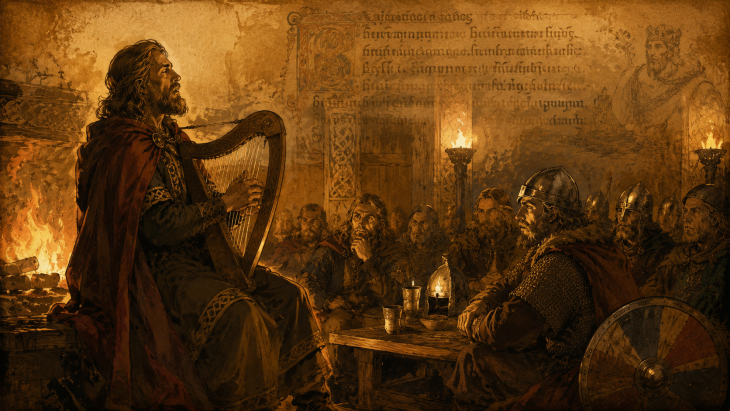
In Anglo-Saxon halls, poetry was performed aloud by a scop (pronounced roughly “shop”), a court poet who recited or sang narrative verse, often accompanied by a harp. Long before Beowulf was written down, stories like it likely circulated orally for generations, changing slightly with each performance.
In the mid-twentieth century, scholars Milman Parry and Albert Lord studied living oral epic traditions in the Balkans and discovered that oral poets did not memorise fixed texts word-for-word. Instead, they composed in performance using a stock of ready-made phrases — formulas — that fit the metrical requirements of the verse line and could be assembled flexibly to fit the story being told that night. Applying this “oral-formulaic theory” to Beowulf, scholars noticed the poem is full of repeated epithets and phrases: heroes are “ring-givers,” the sea is a “whale-road,” a ship is a “wave-floater.” These are not signs of a poet running low on inspiration — they are the fingerprints of a poetic tradition built for oral composition and memory, even if the version we have was eventually composed or transcribed in writing.
Alliteration, Kennings, and the Caesura
Beowulf is written in Old English alliterative verse, a very different system from the rhymed, syllable-counted verse most students associate with poetry. Each line is split into two halves by a pause called a caesura, and the halves are linked not by rhyme but by shared consonant or vowel sounds — alliteration — usually falling on stressed syllables:
“Þæt wæs god cyning!” (“That was a good king!”)
This alliterative structure made lines easier to compose and remember in performance, since the poet needed only to find words beginning with the right sound to fill a metrical slot, rather than searching for exact rhymes.
Equally distinctive is the poem’s heavy use of kennings — compressed, metaphorical compound phrases standing in for a simpler noun. The sea becomes a “whale-road” (hronrad), the body a “bone-house” (banhus), a king a “ring-giver.” Kennings are not decorative flourishes; they are compact units of meaning that also happen to fit the alliterative and rhythmic demands of the line, making them a practical tool of oral composition as much as an artistic one.
The Nowell Codex: A Single Surviving Copy
Beowulf survives in exactly one medieval manuscript, now known as the Nowell Codex, bound together with several other Old English texts and housed today in the British Library as part of the larger Cotton Vitellius A.xv manuscript. It was copied by two different scribes around the year 1000, though the poem itself is generally believed to have been composed earlier — estimates range widely, from the 8th to the early 11th century, and the exact date remains a genuinely open scholarly debate.
The manuscript’s survival was far from guaranteed. In 1731, a fire broke out at Ashburnham House in London, where the collection belonging to Sir Robert Cotton was being stored. Many manuscripts were destroyed outright; the Beowulf manuscript survived but suffered charring along its edges, and some letters and words at the margins of pages were permanently lost or made illegible. Later scholars, including the Icelandic-Danish scholar Grímur Jónsson Thorkelin, made early transcriptions that are now valuable precisely because they preserve readings of text that has since crumbled further.
Why the Manuscript History Matters for Interpretation
Knowing that Beowulf survives in a single, fire-damaged manuscript should change how confidently we treat any specific line or word. Editors of Beowulf frequently must choose between competing reconstructions of damaged passages, and translations can differ meaningfully depending on which editorial choices a translator accepts. When you read a modern English Beowulf, you are reading one scholar’s best reconstruction of a text that is, in places, genuinely uncertain — filtered first through oral tradition, then through at least one act of scribal transcription, and finally through centuries of fire, decay, and editorial guesswork.
This does not undermine the poem’s value. If anything, it makes Beowulf‘s survival more remarkable: a story shaped by generations of anonymous performers, written down by scribes we will never identify by name, nearly destroyed by fire, and still capable of moving readers a thousand years later.
Key Terms
- Scop — an Anglo-Saxon court poet-performer.
- Oral-formulaic theory — the theory that oral poets compose using reusable stock phrases fitted to metrical patterns.
- Kenning — a compressed metaphorical compound phrase (e.g., “whale-road” for sea).
- Caesura — a pause dividing each line of Old English verse into two halves.
- Nowell Codex — the single surviving manuscript containing Beowulf, part of the Cotton Vitellius A.xv collection.
Discussion Questions
- How does knowing that Beowulf likely originated in oral performance change your reading of its repeated phrases and epithets?
- Choose a kenning from the poem (or research one). What does it reveal about how Anglo-Saxon poets thought about the object or idea it describes?
- What are the risks of building literary interpretations on a text that survives in only one damaged manuscript? Should this make us more cautious about strong claims regarding specific words or lines?
- If Beowulf was originally composed for oral performance, what might be lost — or gained — by studying it silently on a printed page instead?