How to Read Prose Like a Critic: A Beginner’s Guide to Critical Appreciation
You’ve read the text. You think understood it. Now what?
This is the gap most students fall into. You finish reading a piece of prose, sit down to write about it — and what comes out is a summary: “In this passage, the narrator describes his childhood home. He remembers his grandmother. The children listen to him.”
That is not a critical appreciation. That is a plot summary with longer sentences.
A critical appreciation asks a different set of questions. Not what happened, but how it is written. Not what the author says, but why they say it in exactly this way, with exactly these words. It is the difference between watching a magician and studying how the trick works.
There is a reliable method, and once you learn it you can apply it to almost any piece of prose. In this post, we walk through it using one of the most beautiful short essays in English: Charles Lamb’s Dream Children: A Reverie (1823).
First: What Are We Looking For?
When you approach a prose passage for critical appreciation, think of six lenses you can hold up to the text, each one revealing something the others don’t: Subject and Theme. Structure and Form. Style and Tone. Language and Diction. Narrative Voice. Effect on the Reader.
Not all six will be equally important for every passage — sometimes the most interesting thing is the structure, sometimes it is one devastating word choice. The skill is knowing which lens to pick up, and always explaining the effect your observation creates.
Let’s see what each looks like in practice.
The Text: Dream Children: A Reverie
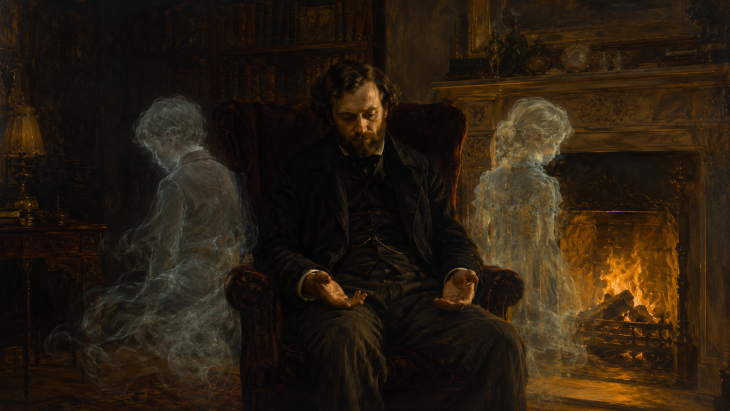
Dream Children is a short familiar essay by Charles Lamb, published in Essays of Elia (1823). The narrator sits by the fireside and tells his two children — Alice and John — stories about his childhood: his grandmother, the great house at Blakesmoor, his dead brother. The children listen and reach for his hand.
Then, in the final paragraph, the dream collapses. Alice and John dissolve. The narrator wakes, alone — because they were never real. Lamb never married, never had children, and his love for a woman named Alice went unreturned. He had imagined the whole scene.
On the surface: a cosy fireside story. Underneath: one of the most heartbreaking essays in the language.
Lens 1: Subject and Theme
The subject is what a passage is literally about. The theme is the deeper idea running beneath it.
In Dream Children, the subject is memory — a man remembering his childhood home and the people he loved who are now gone.
But the theme is something more complicated: the grief of an unlived life. Lamb is not just mourning the dead — he is mourning the family he never had, the love that was not returned, the version of himself that existed only in imagination. The full meaning arrives only at the end. When the children dissolve, we suddenly understand why every detail was so precise. Lamb was conjuring them into existence, knowing all along they would disappear.
A good critical appreciation always distinguishes between the two. The subject is what the essay describes. The theme is what it means.
Analogy: The subject is the menu. The theme is the taste you remember after the meal.
Lens 2: Structure and Form
Dream Children belongs to the tradition of the familiar essay — short, personal, digressive, written as if the author is talking to a friend by the fire. Its structure is deliberately loose: no formal argument, no thesis proven in steps. The essay drifts, as memories do.
This is not laziness. The form enacts the subject. We are inside a reverie, and reveries don’t have tidy structures — they slow down, get lost in a detail (a fishpond, the eyes of a marble bust), and circle back.
Look at the very first sentence: “Children love to listen to stories about their elders, when they were children; to stretch their imagination to the conception of a traditionary great-uncle or grandame, whom they never saw.” Notice how it keeps going, almost reluctant to end. The syntax mimes the action it describes: a child’s imagination stretching outward.
Then look at what happens at the end. The drifting structure suddenly collapses. The shift is brutal precisely because the preceding pages were so gentle — structural contrast as a deliberate tool.
Lens 3: Style and Tone
Style is how an author writes. Tone is the emotional attitude embedded in that writing.
Lamb’s style is what his contemporaries called familiar — warm, unhurried, full of digression, like a letter from someone you know well. He made the tradition of Addison and Montaigne more personally confessional.
The tone of Dream Children is elegiac: suffused with gentle, wistful sadness. But Lamb prevents that sadness from tipping into self-pity. His account of Blakesmoor — the tapestries, the “marble busts of emperors,” the ancient grape-vine — is rendered with real delight. We feel what has been lost more acutely because he first made us feel its beauty. Tenderness and irony held in the same breath — that is what keeps the essay from being merely sad, and what makes it devastating.
Lens 4: Language and Diction
Diction means word choice — and every word an author chooses is a decision about rhythm, tone, and the precise shade of meaning required.
Lamb’s diction in Dream Children is deliberately archaic and literary: words like “traditionary,” “grandame,” “enamoured” give the essay a quality of recovered time, as though the language has been retrieved from the past along with the memories. These sit alongside moments of plain English — and the contrast matters. The elevated register belongs to the world of imagination; the simpler language breaks through when reality reasserts itself.
The essay is also rich in sensory specificity. Lamb doesn’t tell us the house was grand; he shows us the marble busts, the fishpond, the “old busto” of a man whose name no one remembered. These details make the past feel present — which makes the loss feel real.
And then there is the word that appears three times near the end:
“We are not of Alice, nor of thee, nor are we children at all… We are nothing; less than nothing, and dreams.”
Nothing. Nothing. Nothing. The repetition is not clumsy — it is a controlled collapse. The children don’t just disappear; they deny ever having existed. That abyss has been prepared for, word by word, throughout the entire essay.
Lens 5: Narrative Voice
The narrator of Dream Children is Lamb’s famous persona “Elia” — a melancholy, bookish bachelor who appears throughout the Essays of Elia. This persona lets Lamb explore deeply personal material while maintaining a crucial distance. He is not writing autobiography; he is writing an autobiography of feeling.
The narrative voice operates across multiple layers of time. The “I” at the opening sits by the fire in the present. The “I” in the middle sections is a child in memory. The “I” at the end is a man who has briefly tricked himself — by the force of his own imagination — into believing he was someone he was not.
What makes this voice especially effective is that Lamb gives the imaginary children their own voices. They ask questions. John smiles. Alice reaches for his hand. By convincing us they are real, Lamb ensures their disappearance feels like genuine loss — not a literary device.
Lens 6: Effect on the Reader
Dream Children produces one of the most unusual effects in English prose: it makes you feel tender toward grief itself. Lamb does not ask for pity or rage against his losses — he simply conjures, with extraordinary care, a version of the life he might have had, and then, very gently, takes it away. Reading the final paragraph is like watching someone wake from a beautiful dream. You want to help them back into it, and you can’t.
Putting It Together
A critical appreciation does not summarise a plot or simply call something “sad.” It makes specific observations, backs them with specific references, and explains the effect those choices create. Every paragraph follows one rhythm: observation → quotation or reference → effect.
Dream Children is an ideal text to practise on because everything in it is deliberate — the drift, the archaic diction, the triple “nothing.” Lamb knew exactly what he was doing. Which is why, two hundred years later, the essay still works.
This post is part of the Skill Enhancement Course in Critical Appreciation of Prose, Department of English, Jadavpur University.