The Ending That Broke Its Own Rules
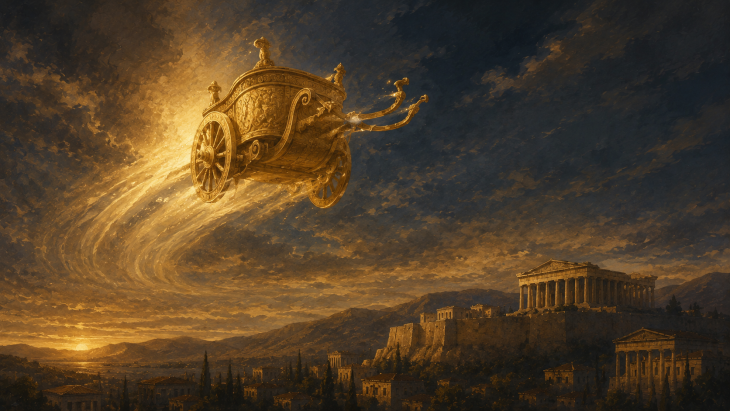
Greek tragedy generally ran on a kind of moral accounting, however brutal: characters who overreached, who committed hubris against the gods or the natural order, eventually paid for it, often catastrophically. Audiences in the Theatre of Dionysus expected the ledger to balance by the final scene, even if balancing it meant watching a hero die. Medea refuses to balance its ledger. Its protagonist murders her own children, her husband’s new bride, and the bride’s father, and then — instead of facing punishment — she flies away in a golden chariot sent by her divine grandfather, untouched, unrepentant, and entirely out of Jason’s reach. Euripides doesn’t just give his play a shocking ending. He gives it an ending that argues with the very machinery Greek tragedy usually relied on to make sense of suffering.
What “Deus Ex Machina” Actually Meant on Stage
The term deus ex machina — literally “god from the machine” — describes a literal piece of Athenian stage technology: a crane (the mechane) that could lift an actor playing a god above the skene, the building at the back of the playing area, so the god appeared to descend from or ascend into the sky. Playwrights used this device, sparingly, to resolve plots that had spiraled beyond what human characters could sort out on their own — a god arrives, delivers judgment or explanation, and the play can end. It was a recognized convention, not a cheat code invented by critics later; ancient audiences knew exactly what they were looking at when the crane creaked into motion.
What Euripides does with the device in Medea is unusual on two counts. First, the “god” who appears isn’t a deity arriving fresh to sort out a mess — it’s Helios’s chariot, already promised to Medea earlier in the play as insurance for exactly this outcome, meaning her escape isn’t a last-minute rescue but the payoff of a plan she’d secured in advance. Second, and more importantly, the device doesn’t resolve the moral chaos of the plot at all. Normally a deus ex machina clarifies: a god explains what should happen next, assigns appropriate outcomes, restores order. Medea’s chariot does the opposite — it removes the one character everyone wants held accountable from any possibility of accountability, and does so using a purely genealogical claim (she is Helios’s granddaughter) rather than any judgment about right and wrong.
An Ending That Refuses Catharsis
Aristotle, writing decades after Euripides, would describe good tragedy as producing catharsis — a purging of pity and fear through the audience’s emotional experience of the drama, typically arriving via a resolution that makes sense of the suffering shown. Medea‘s ending seems almost engineered to deny that resolution. Jason is left alive but utterly destroyed — childless, wifeless, cursed by Medea to die ignobly, struck by a piece of his own ship the Argo in most versions of his eventual death — while Medea, who committed the play’s most horrifying acts, suffers no visible consequence at all within the story’s own terms. The Chorus’s final words, appearing in similar form at the end of several Euripidean tragedies, comment on how the gods bring about the unexpected, that what was anticipated is not fulfilled, and that heaven finds a way for what no one foresaw — a summation that sounds almost mechanical, as though even the play itself isn’t sure how to editorialize on what just happened.
Divine Favor Without Divine Judgment
One of the most-debated aspects of the ending is what Helios’s rescue implies about the gods’ view of Medea’s actions. The chariot could be read as tacit divine approval — perhaps the gods side with a wronged woman against an oath-breaking man, given that oath-breaking (perjury, violating a sworn pledge) was considered a serious offense against Zeus himself in Greek religious thought, and Jason’s betrayal of his marriage vows to Medea counts as exactly that kind of violation. Under this reading, Medea’s escape isn’t an absence of justice but a strange, uncomfortable form of it: the oath-breaker loses everything, and the wronged party, however extreme her retaliation, receives protection from the heavens.
Alternatively, the ending can be read as showing that divine favor and moral justice are simply not the same thing — that being someone’s granddaughter buys protection regardless of what you’ve done with it, a bloodline privilege rather than a verdict on right and wrong. This reading makes the ending less a statement about cosmic justice and more a bleak commentary on power: those with the right connections escape consequences that would destroy anyone else, a dynamic recognizable well outside the world of Greek myth.
Why the Discomfort Was the Point
Euripides had a reputation among his contemporaries — including the comic playwright Aristophanes, who mocked him repeatedly — for endings and plots that unsettled Athenian theatrical expectations, often using the deus ex machina in ways that felt more like a shrug at tidy resolution than a genuine solution. Medea‘s ending fits that pattern precisely because it refuses to tell the audience how to feel. It does not reward Medea. It does not punish her either. It simply removes her from the human, legal world entirely, leaving Jason — and the audience — to sit with a devastation that no chariot, human or divine, can undo. That refusal to resolve is, itself, the play’s final and most unsettling argument: some wounds don’t come with a verdict attached, and pretending otherwise would have been the real dishonesty.