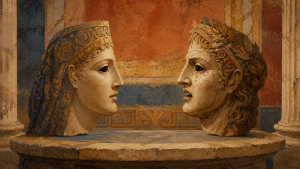
The Women Who Watched and Did Nothing — On Purpose
Fifteen Corinthian women stand in the orchestra of the Theatre of Dionysus, watching a foreign princess plan the murder of her own children, and they do not stop her. They do not run for help. They do not even leave. Euripides’ Chorus in Medea is one of the strangest moral positions in Greek tragedy: sympathetic almost to the point of complicity, horrified almost to the point of intervention, and ultimately frozen exactly in between — a portrait of solidarity that curdles the moment it’s tested against its limits.
What a Tragic Chorus Was Supposed to Do
In Athenian tragedy, the Chorus conventionally functioned as a kind of collective conscience for the audience — commenting on the action, voicing communal wisdom, sometimes warning characters against hubris, and generally representing the values of the ordinary citizen watching events unfold from a slight remove. Choruses were usually not neutral furniture; their odes shaped how an audience was meant to feel about what they’d just seen. Crucially, choruses in Greek tragedy were performed by male citizens even when playing female characters, which means the fifteen Corinthian women judging Medea’s actions on stage were, physically, an all-male ensemble voicing female solidarity for an audience that was itself overwhelmingly, if not exclusively, male.
That layered performance matters, because it means Euripides is asking male citizens to perform female sympathy convincingly enough that other male citizens in the audience feel its weight. The Chorus’s first extended response to Medea’s suffering is not condemnation but recognition — they open by validating her anger at Jason’s betrayal, and one choral ode goes as far as declaring that the old stories about women’s faithlessness have it backward, that men are the ones who break oaths and deserve the bad reputation. For a play written and performed almost entirely by men, this is a startling moment of the Chorus stepping fully into Medea’s corner.
Solidarity With Real Limits
The turn comes gradually, and Euripides paces it with care. As Medea’s plan to kill Creon, the princess, and eventually her own sons becomes explicit, the Chorus’s sympathy doesn’t vanish, but it fractures. They plead with her directly, invoking the sanctity of motherhood and warning her that this act will bring her more suffering than Jason’s betrayal ever did. One of the Chorus’s later odes turns to lament — not accusation exactly, but grief, mourning in advance for children who are, as far as the Chorus is concerned, still saveable. This is solidarity meeting its ceiling: the Corinthian women can accompany Medea through her rage at patriarchal betrayal, but they cannot follow her into infanticide, and the play never pretends otherwise.
What makes this dramatically potent rather than simply moralizing is that Euripides refuses to let the Chorus act on their horror. They know what is coming. They say as much, in plain language, to each other and to the audience. And yet — bound by the conventions of the choral form, which kept the Chorus largely outside the main dramatic action, and perhaps by something more human, a reluctance to betray a woman whose grievance they still believe is just — they let it happen. Some readings treat this paralysis as a devastating critique: sympathy without action is just spectatorship, and the Chorus becomes a mirror for an audience that will also do nothing but watch.
Sisterhood as Structural Critique
The Chorus’s early solidarity with Medea isn’t only personal, it’s structural. Their odes repeatedly widen the frame from “this one wronged wife” to “women’s condition” more broadly — the line about women being the most wretched of all creatures that live and breathe comes from Medea herself, but the Chorus echoes and validates the broader argument rather than dismissing it as one woman’s bitterness. They describe the specific vulnerabilities of the position: a wife who buys a husband with dowry only to then become subject entirely to a stranger’s temperament, who has no way to know in advance what kind of man she’s bound herself to, who cannot simply leave the way a husband can walk away to seek pleasure elsewhere. This is not incidental color — it is Euripides using the Chorus to make an argument about the systemic condition of Greek wives that the plot then illustrates in its most extreme, unbearable form.
A Solidarity That Implicates the Audience
By the play’s final movement, the Chorus has shifted almost entirely into lament, praying to the earth and sun to somehow prevent the murders, then mourning once they’ve happened. They never turn on Medea with outright condemnation matching the horror of her acts; their grief remains oddly suspended between judgment and continued, aching sympathy for what drove her there. Euripides leaves the audience without a clean surrogate to tell them how to feel — the Chorus that started as their emotional guide ends the play as confused and complicit as anyone watching from the stone benches. That confusion may be the point. A community that structurally abandons women like Medea to powerlessness, Euripides seems to suggest through his silent, watching Chorus, doesn’t get to be shocked when the only power left to wield turns catastrophic — and doesn’t get to pretend it was only ever watching from a safe distance.