“He Comes, Ever Comes”: An Essay on Gitanjali 45
The Poem That Refuses to Stand Still
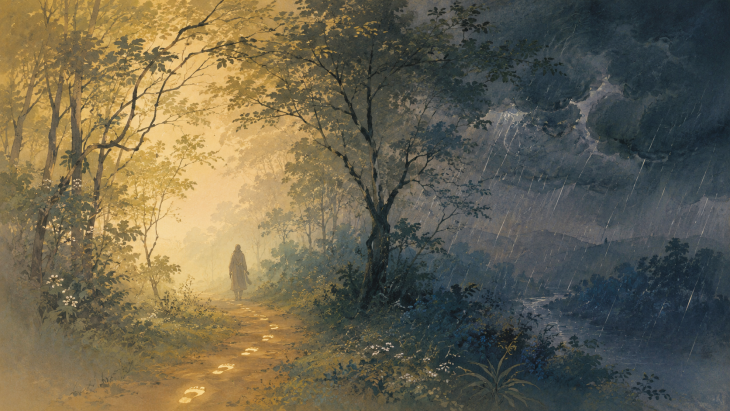
There is a peculiar quality to Rabindranath Tagore’s forty-fifth poem from Gitanjali (1912) — it feels less like something you read and more like something you hear. Or rather, something you almost hear: a sound at the edge of perception, a footfall just around the corner. The poem opens with a question — “Have you not heard his silent steps?” — and this is not a rhetorical flourish. It is an invitation, perhaps even a gentle accusation. You have been inattentive, the poem implies. He has been coming all along.
This essay explores how Tagore builds, sustains, and deepens that central claim across seven lines of extraordinary simplicity and extraordinary richness.
Who Is “He”?
The first thing an attentive reader notices is that “he” is never named. This is a deliberate and significant choice. In the context of Gitanjali as a whole — a collection of 103 prose-poems translated by Tagore himself from Bengali into English — the unnamed presence is generally understood to be the divine: God, the Eternal, the Beloved in the devotional (or bhakti) tradition of Indian spirituality. W.B. Yeats, who wrote the famous introduction to the English edition, described reading Gitanjali as encountering “a whole people, a whole civilisation, immeasurably strange,” and part of that strangeness is precisely this — the divine is everywhere in these poems, and yet almost never named.
But here is what makes Tagore’s “he” so compelling: the poem works even if you do not share its theological premises. “He” can be read as Time itself — that relentless, silent arrival that marks every moment and every age. “He” can be the creative impulse that returns to the poet again and again. “He” can be death — the final visitor who “comes, comes, ever comes” whether we are ready or not. The poem’s power lies partly in this refusal to close down interpretation. Tagore gives us an arrival without a face, and we instinctively fill that blank with whatever we most deeply understand as the thing that will not stop coming.
The Refrain and What It Does
The most immediately striking feature of the poem is its refrain: “He comes, comes, ever comes.” It appears in some form in every line. By the time we reach the end of the poem, we have encountered it seven times, and something interesting has happened. What begins as a statement has become, through sheer repetition, something closer to a heartbeat.
Think of how repetition works in music. A single chord struck once is just a chord. The same chord struck seven times, in rhythm, becomes something physical — you feel it in your chest. Tagore is doing something similar with language. The triple rhythm of “comes, comes, ever comes” has a pulse to it, an insistence that mimics the very thing it describes: an arrival that never stops. The refrain is formally enacting its own content.
This technique has deep roots in Indian devotional poetry. The bhajan and kirtan traditions — forms of religious music that Tagore grew up surrounded by — rely heavily on repetition precisely because repetition is understood as a form of attention, a way of concentrating the mind on the divine. To say something once is to state it. To say it seven times is to dwell in it. Tagore brings this essentially musical, devotional logic into the written lyric poem, and the result is something that reads like a bhajan translated into English prose — which is, in some sense, exactly what it is.
Nature as Calendar of the Divine
The poem’s middle section moves through the seasons. April and July are not chosen arbitrarily. April in the Indian context means the onset of heat, the burst of spring flowers, the fragrant days of a year’s first warmth. July means the monsoon — “the rainy gloom of July nights on the thundering chariot of clouds.” These are the two great poles of the Indian seasonal experience: the delicate and the overwhelming, the scented breeze and the thunderstorm.
What Tagore is doing here is mapping the divine presence onto the full range of natural experience. “He” does not come only in pleasant weather. He does not come only in moments of spiritual alertness or emotional readiness. He comes in April through the fragrant forest path — quietly, sweetly, easy to miss. He comes in July on a thundering chariot — loudly, dramatically, impossible to ignore. The point is the same: he always comes. Whether the world is gentle or violent, the presence is constant.
This is a significant theological and philosophical claim, and it also has an immediate human application. How many of us, in our own lives, tend to look for meaning, beauty, or the divine only in the pleasant moments? Tagore is insisting that the July thunderstorm is as sacred as the April morning. The uncomfortable, the dark, the noisy — these too are visitations.
Sorrow, Joy, and the Golden Touch
The poem’s final line is its most emotionally complex:
“In sorrow after sorrow it is his steps that press upon my heart, and it is the golden touch of his feet that makes my joy to shine.”
This is a remarkable piece of writing. Sorrow and joy are placed not in opposition but in continuity. The same presence that weighs upon the heart in grief — “press upon my heart” — is the presence that illuminates joy. The word “press” is physical, almost painful. There is weight here. These are not abstract sorrows but the accumulated sorrows of a human life. And yet the poem does not resolve sorrow into consolation or explain it away. Instead, it says: he is present in both. His steps are felt in grief. His touch makes joy shine.
The image of the “golden touch” is worth dwelling on. Gold, across cultures and across Tagore’s own work, is associated with the divine, with the luminous, with what does not tarnish. The feet of the divine leave a golden trace on joy — joy is not simply experienced but made to shine, as though polished, made more itself by the contact. This is mystical language, but it is also recognisable human experience: the moments of joy that feel most radiant are often those that come after, or alongside, significant pain.
A Poem About Attention
If Gitanjali 45 is about one thing most fundamentally, it is about attention. The opening question — “Have you not heard his silent steps?” — places the reader in a position of possible negligence. We may have been busy, distracted, looking the wrong way. The poem then enacts, through its insistent refrain, what it would feel like to truly attend: to hear in every moment and every age, in April’s fragrance and July’s thunder, in sorrow and in joy, the same continuous arrival.
In a broader literary context, this connects Gitanjali to a long tradition of devotional lyric — from the medieval bhakti poets like Kabir and Mirabai to the European mystical tradition, to Keats’s odes or Hopkins’s The Grandeur of God. What these poems share is the conviction that the world is not merely material and indifferent but charged with presence — if only we can train ourselves to notice.
Tagore’s gift in this poem is to make that attention feel achievable. The poem does not demand theological expertise or spiritual practice. It asks only that you slow down, that you listen for the silent steps, that you recognise — in the ordinary rhythm of days and seasons and feeling — that something is always, always, coming.