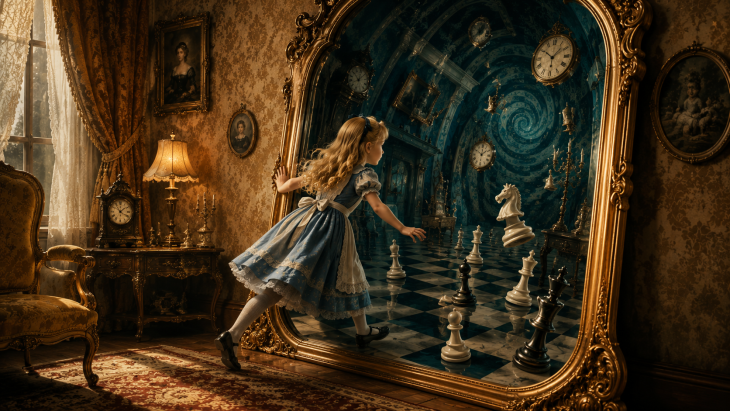
The Looking-Glass World: Mirror Logic and Narrative Structure in Through the Looking-Glass
When Lewis Carroll sat down to write the sequel to Alice’s Adventures in Wonderland (1865), he did not simply send Alice tumbling down another rabbit hole. Instead, he invented an entirely new structural conceit — one built around the logic of mirrors. Published in 1871, Through the Looking-Glass, and What Alice Found There is a more tightly organized and philosophically ambitious book than its predecessor, and much of that ambition is embedded in the very way it is shaped. Understanding how Carroll uses the mirror as both a literal doorway and a governing structural principle is the first step to reading this novel well.
What Does a Mirror Actually Do?
Before exploring the novel, it helps to think about what mirrors do in the real world. A mirror reverses left and right. It shows you a version of the world that looks identical but is fundamentally flipped. Writing held up to a mirror becomes unreadable. A clock face reflected shows the numbers running backwards. Carroll was deeply interested in this logic of reversal — he was, after all, a mathematician and logician by profession (his real name was Charles Lutwidge Dodgson, and he lectured at Christ Church, Oxford). The Looking-Glass world is not a random fantasy; it is a world constructed according to the rigorous, rule-bound logic of reflection.
The novel opens with Alice playing with a kitten and musing aloud about what the “Looking-Glass House” might be like — the house she imagines existing on the other side of the mirror above the fireplace. When she steps through, she finds exactly what mirror logic would predict: a world that is, in most respects, the reverse of her own.
“Now, if you’ll only attend, Kitty, and not talk so much, I’ll tell you all my ideas about Looking-glass House. First, there’s the room you can see through the glass — that’s just the same as our drawing room, only the things go the other way.”
— Lewis Carroll, Through the Looking-Glass
The Chess Board as Narrative Architecture
One of the most remarkable features of Through the Looking-Glass is that Carroll uses a game of chess as the structural framework for the entire narrative. At the front of the book, Carroll provides an actual chess diagram showing the positions of all the pieces. Alice begins the story as a White Pawn and, by the end, becomes a Queen — a progression that maps directly onto the rules of chess, where a pawn that reaches the eighth rank is promoted.
The landscape Alice travels through is divided into a grid of brooks and hedges, like the squares of a chessboard. Each time Alice crosses a brook, she moves to the next square. This gives the novel a strikingly different feel from Wonderland: rather than wandering chaotically through a dreamscape, Alice is moving purposefully (if confusingly) through a landscape with a structure, a destination, and rules.
Carroll noted, somewhat apologetically, in his preface that the chess moves in the book are not always strictly accurate by the rules of chess. Scholars have debated this for decades. What matters more for literary students is the symbolic function of chess: it is a game of strategy and logic, played on a grid, with clearly defined roles (King, Queen, Knight, Pawn). By embedding Alice in a chess game, Carroll is making a statement about the nature of the world she inhabits — it is a world of systems, rules, and predetermined moves, even if those rules are sometimes baffling to the player inside them.
Reversal as a Literary Device
Mirror logic produces reversals throughout the narrative, and Carroll exploits this with wit and precision. Consider the Red Queen’s famous declaration that in her country, “it takes all the running you can do, to keep in the same place.” This is a reversal of ordinary logic — in the real world, running moves you forward. In the Looking-Glass world, you must run simply to stay still.
“Now, here, you see, it takes all the running you can do, to keep in the same place. If you want to get somewhere else, you must run at least twice as fast as that!”
— The Red Queen, Through the Looking-Glass
This reversal is not mere nonsense. It is a recognizable satirical observation — scholars have read it as a commentary on Victorian social competition, on evolutionary theory (the “Red Queen Hypothesis” in biology is named after this very passage), and on the exhausting pace of industrial modernity. Carroll’s mirror logic is always double-edged: it is funny, but it also illuminates something true about ordinary life by showing it flipped.
Other reversals include: memory that works backwards in time (the White Queen remembers things before they happen); punishment administered before the crime is committed; and shopping where you pay first and receive your purchase later. In each case, Carroll takes a familiar transaction from everyday Victorian life and reverses its sequence, making the familiar strange and thought-provoking.
Dreams, Frames, and the Question of Reality
Like Alice’s Adventures in Wonderland, the Looking-Glass adventure is framed as a dream. At the end of the novel, Alice wakes up and the entire journey is revealed to have been her dream — or was it? Carroll ends the book with a tantalizing question: “Which do you think it was?” Was it Alice’s dream, or the Red King’s dream (since the Red King is shown sleeping throughout the chess game, and Tweedledee and Tweedledum suggest that Alice herself exists only in his dream)?
This question — who is dreaming whom? — is one of the most philosophically rich moments in the novel. It anticipates ideas that would later become central to twentieth-century philosophy and literature: questions about the nature of consciousness, the instability of the self, and the impossibility of knowing whether our waking life is itself a kind of dream. For first-year students, it is worth pausing over this question not to answer it definitively, but to notice that Carroll is using the structure of the narrative itself — the frame of the dream — to ask deep questions about reality and identity.
Why Structure Matters for Reading the Novel
Understanding the mirror logic and chess structure of Through the Looking-Glass changes how we read every individual scene. When the White Knight falls off his horse repeatedly, we can read it as pure slapstick comedy — and it is funny. But we can also read it as a chess piece that does not quite know how to inhabit its own rules. When Alice finds that she cannot walk directly toward the Red Queen but must walk in the opposite direction to reach her, we recognize this as mirror reversal made physical. The novel rewards readers who keep the governing logic in mind, because Carroll is always playing with it, testing it, and subverting it in small ways.
Carroll’s genius in this novel is to give nonsense a rigorous internal architecture. The Looking-Glass world is not random; it is systematic. And that system — grounded in the logic of mirrors and the geometry of chess — is what distinguishes Through the Looking-Glass as a work of literary art rather than merely a whimsical children’s book.
Key Terms
- Narrative structure: The way a story is organized — its sequence, framework, and governing logic.
- Reversal: A literary device in which the expected order or logic of something is flipped.
- Frame narrative: A story-within-a-story structure, where an outer narrative (e.g., a dream) contains the main adventure.
- Conceit: An extended metaphor or central organizing idea that governs a literary work.
- Pawn promotion: The chess rule whereby a pawn reaching the far end of the board becomes a more powerful piece, typically a Queen.
Discussion Questions
- How does the chess-game structure shape Alice’s experience of agency and choice in the novel? Does she feel like a player, or a piece being moved?
- Choose one example of reversal from the novel and explain what it might be saying about the “real” world by showing it backwards.
- Carroll ends the novel by asking whether the adventure was Alice’s dream or the Red King’s dream. What does this ambiguity suggest about the nature of identity and reality in the novel?


