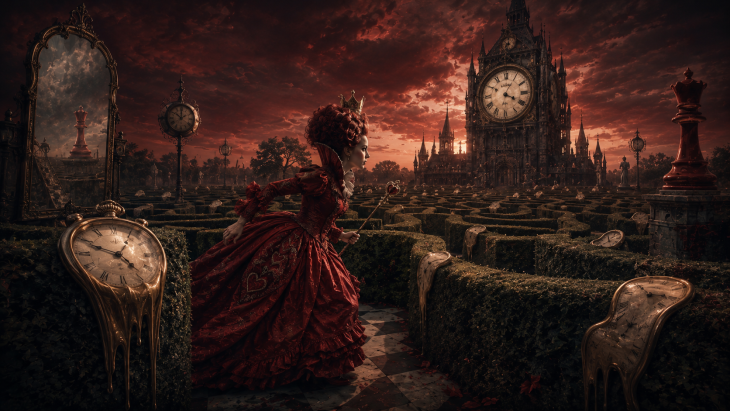
Running Backwards: Time, Logic, and Victorian Satire in Through the Looking-Glass
One of the pleasures of reading Lewis Carroll is that his apparent nonsense almost always has a precise target. Behind the jokes about jam and birthdays, behind the backwards memory and the reversed causality, Carroll is consistently satirizing specific features of Victorian life, thought, and culture. Through the Looking-Glass, published in 1871 at the height of the Victorian era, is a book shot through with social and intellectual commentary. Understanding the satirical dimensions of the novel deepens our appreciation of Carroll’s art — and sheds light on the world his first readers inhabited.
Victorian England and the Logic of Progress
The Victorian era was characterized, above all, by a faith in progress. The nineteenth century had brought the Industrial Revolution, the expansion of the British Empire, the railways, the telegraph, and Darwin’s theory of evolution. To many educated Victorians, history was moving forward — toward greater knowledge, greater prosperity, greater civilization. Carroll was not entirely convinced.
The Red Queen’s famous observation — that you must run as fast as you can just to stay in the same place — is one of Carroll’s most penetrating satirical strokes. In one reading, it captures the exhausting competitive logic of Victorian capitalism: you work harder and harder, produce more and more, and end up no better off than you began. The industrial working classes were living this reality every day. The middle classes, anxious about social position, were running a different version of the same race.
“Now, here, you see, it takes all the running you can do, to keep in the same place. If you want to get somewhere else, you must run at least twice as fast as that!”
— The Red Queen, Through the Looking-Glass
Evolutionary biologist Leigh Van Valen later named this dynamic the “Red Queen Hypothesis” — the idea that organisms must constantly evolve simply to maintain their fitness relative to co-evolving competitors. Carroll’s joke has embedded itself so deeply in scientific thinking that many scientists are unaware it originated in a Victorian satirical novel.
Time Running Backwards: Memory and Causality
Carroll’s most systematic assault on Victorian logic involves his treatment of time. In the Looking-Glass world, time flows in the opposite direction from the real world. The White Queen explains to Alice that she lives backwards: she remembers the future but not the past. As evidence, she describes a wound on her finger that she will sustain next week — and sure enough, she then pricks it a moment later.
This reversal of causality — effect before cause, punishment before crime — is on one level pure comic invention. But it is also a precise philosophical challenge. Victorian science and philosophy generally assumed that causality was linear and universal: causes precede effects, the past is fixed, and the future is open. Carroll’s Looking-Glass world destabilizes all of these assumptions. The White Queen’s backwards memory suggests a universe where the relationship between past and future is not as straightforward as Victorian rationalism supposed.
The trial of the Knave of Hearts in Alice’s Adventures in Wonderland offers an earlier version of this joke — sentence first, verdict afterwards — but in Through the Looking-Glass, Carroll develops it more systematically. The entire structure of the book, with its mirror reversals, can be read as a sustained philosophical thought experiment: what would the world look like if our assumptions about time, logic, and causality were wrong?
Satire of Education and Examinations
Carroll spent his professional life at Oxford, and his frustration with the formalities of Victorian academic culture is detectable throughout both Alice books. In Through the Looking-Glass, the examination Alice is subjected to upon her coronation is a brilliant parody of the Victorian examination system.
The two Queens pepper Alice with absurd arithmetic questions, demand she answer in impossible timeframes, change the rules mid-examination, and declare her answers wrong regardless of whether they are right. The scene captures something real about the experience of being examined by authority: the purpose of the examination is not to measure knowledge but to demonstrate the examiner’s power and the examinee’s subordination.
Carroll himself was a meticulous and somewhat conventional teacher of mathematics, but he was also sharply aware of the ways in which Oxford’s institutional culture could be self-serving, hierarchical, and indifferent to genuine intellectual curiosity. The Looking-Glass examination is gentle enough to be funny, but pointed enough to sting.
The White Knight and the Romantic Idealist
The most affectionate — and most self-aware — of Carroll’s satirical portraits is the White Knight, who accompanies Alice on the final leg of her journey. The White Knight is an inventor of useless contraptions, a dreamer who cannot stay on his horse, and a man who delivers a long, melancholy song under the impression that it is deeply moving — while Alice is impatient to get on with her journey.
“Of all the strange things that Alice saw in her journey Through The Looking-Glass, this was the one that she always remembered most clearly. Years afterwards she could bring the whole scene back again, as if it had been only yesterday — the mild blue eyes and kindly smile of the Knight — the setting sun gleaming through his hair…”
— Lewis Carroll, Through the Looking-Glass
Many scholars have read the White Knight as a self-portrait — Carroll gently mocking his own tendency toward elaborate, impractical schemes (he designed all sorts of gadgets, writing aids, and games throughout his life) and his habit of performing sentimentality. The White Knight’s song, “A-sitting On A Gate,” is a parody of Wordsworth’s “Resolution and Independence” — a Romantic poem in which the narrator is moved to philosophical reflection by an encounter with an old leech-gatherer. Carroll’s version deflates Romantic self-importance by having the Knight obsess over trivial material concerns even in the middle of his supposedly uplifting song.
The Victorian Dinner Party and Social Ritual
The climactic dinner party that Alice destroys is Carroll’s most direct satirical target: the Victorian upper-middle-class social ritual as a theatre of absurdity. The Victorian dinner party was a highly codified social performance, with strict rules of precedence, conversation, and behaviour. Carroll turns all of these codes on their head — guests appear before they are invited, food introduces itself, and the whole event dissolves into chaos.
That Alice, on the verge of adult social participation, destroys the dinner party rather than presiding over it can be read as a fantasy of liberation — a child’s rejection of the elaborate and arbitrary rituals that adult life demands. It is one of Carroll’s most radical moments, and it is all the more powerful for being framed as the natural response of a reasonable person to an unreasonable world.
Carroll’s Satire and Its Limits
It is worth noting what Carroll does not satirize. He does not attack the Empire, the class system as a whole, or the economic structures of Victorian capitalism in any sustained way. His satire is sharp but socially conservative in its targets: he mocks pomposity, pedantry, and ritual, but does not call for radical change. His sympathy is always with Alice — the reasonable individual baffled by an irrational world — rather than with any collective transformation of that world.
This limitation does not diminish Carroll’s achievement. Within the constraints of Victorian children’s fiction — and within the social world he inhabited — his satire is remarkably precise and wide-ranging. Through the Looking-Glass repays reading not only as a fantasy adventure but as a document of Victorian intellectual culture, anxiously examining its own assumptions through the innocent eyes of a child.
Key Terms
- Satire: Writing that uses irony, humour, or exaggeration to critique human behaviour, society, or institutions.
- Victorian era: The period of British history during the reign of Queen Victoria (1837–1901), characterized by industrialization, imperial expansion, and social conservatism.
- Causality: The principle that causes precede their effects — a foundational assumption of both everyday logic and Victorian science.
- Red Queen Hypothesis: A concept in evolutionary biology (named after Carroll’s character) describing the need to constantly evolve simply to maintain competitive parity.
- Parody: A literary work that imitates and exaggerates another work for comic or critical effect.
Discussion Questions
- The Red Queen’s famous running paradox has been applied to evolutionary biology and economics. What does it suggest about the social and economic conditions of Carroll’s era?
- How does Carroll use the White Knight to gently mock the Romantic tradition in literature? What is he suggesting about the relationship between artistic sincerity and self-importance?
- Carroll’s satire does not challenge the class system or empire. Does this limit the radicalism of the novel, or does it make its critique of authority more universal? Discuss.


