Who Controls the Words? Language, Nonsense, and the Politics of Meaning in Through the Looking-Glass
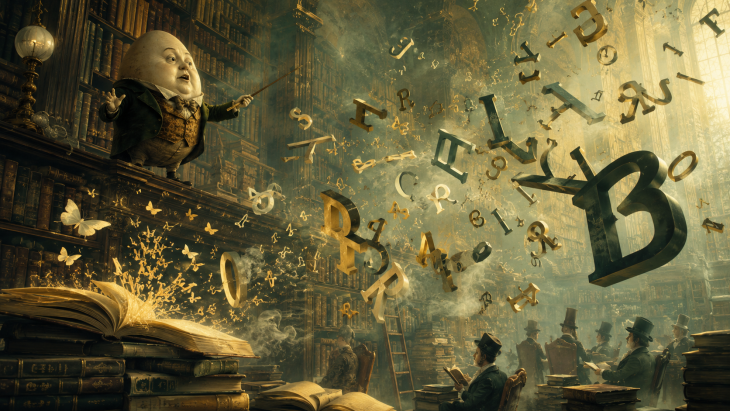
One of the most famous exchanges in all of English literature happens when Alice meets Humpty Dumpty sitting on his wall. They get into an argument — not about politics or history, but about the meaning of words. Humpty Dumpty insists that a word means exactly what he chooses it to mean, “neither more nor less.” Alice pushes back. The question of who gets to decide what words mean turns out to be one of the central preoccupations of Through the Looking-Glass. For students of English literature, this is not just a funny scene — it is a starting point for thinking about language, power, and meaning in ways that connect to major ideas in twentieth-century linguistics and literary theory.
Humpty Dumpty and the Arbitrariness of Language
The Humpty Dumpty chapter (Chapter VI) is a masterclass in what linguists call the arbitrariness of the sign. In the early twentieth century, Swiss linguist Ferdinand de Saussure argued that the relationship between a word (the “signifier”) and what it refers to (the “signified”) is arbitrary — there is no natural or necessary connection between the sound “cat” and the animal it describes. Different languages use entirely different sounds for the same thing. Carroll anticipates this insight decades earlier through Humpty Dumpty’s outrageous claim:
“When I use a word,” Humpty Dumpty said, in rather a scornful tone, “it means just what I choose it to mean — neither more nor less.”
“The question is,” said Alice, “whether you can make words mean so many different things.”
“The question is,” said Humpty Dumpty, “which is to be master — that’s all.”
— Lewis Carroll, Through the Looking-Glass
Humpty Dumpty’s position is philosophically extreme — he is arguing for total individual control over meaning. But his final word — “master” — is revealing. He does not merely claim that words are flexible; he claims that meaning is a matter of power. Whoever has authority gets to decide what things mean. This is a surprisingly political observation for a comic scene involving a talking egg.
Portmanteau Words and “Jabberwocky”
Humpty Dumpty also provides Alice (and the reader) with an explanation of the famous nonsense poem “Jabberwocky,” which Alice encounters early in the novel, printed in mirror-script. When she finally reads it, the poem is full of invented words: slithy, toves, gimble, wabe. Humpty Dumpty explains that slithy means “lithe and slimy” — it is what he calls a “portmanteau word,” a word that packs two meanings into one, like a portmanteau (a type of travelling bag that opens into two separate compartments).
Carroll’s coining of the term “portmanteau word” is itself a significant contribution to the English language. Words like brunch (breakfast + lunch), smog (smoke + fog), and — in our own era — blog (web + log) are all portmanteau words. Carroll did not invent the phenomenon, but he named it and theorized it, making his nonsense a contribution to the study of language itself.
“Jabberwocky” is the most celebrated example of what scholars call literary nonsense — writing that is grammatically well-formed (you can parse the sentences) but semantically empty or invented (the words do not refer to known things). Yet the poem does not feel meaningless. It has a clear narrative arc — a hero goes out, slays a monster, returns victorious. The invented nouns and adjectives carry emotional weight through their sounds: “the vorpal blade went snicker-snack” sounds sharp and violent even if you do not know what “vorpal” means. Carroll demonstrates that poetry communicates through rhythm, sound, and structure as much as through conventional meaning.
Alice as the Reasonable Interlocutor
Throughout the novel, Alice functions as a kind of straight-woman to the absurdity around her. She is consistently polite, reasonable, and committed to ordinary rules of language and logic. When the Looking-Glass characters play fast and loose with meaning, Alice is the one who objects — and her objections represent the reader’s own bewilderment.
But Carroll does not entirely side with Alice. Many of the Looking-Glass characters who distort language are not simply being foolish — they are exposing genuine instabilities in how language works. When the White Queen explains that jam is always “jam to-morrow and jam yesterday — but never jam to-day,” she is not being illogical. She is drawing attention to how the word “today” shifts its reference depending on when it is spoken — a real feature of language that philosophers call indexicality. Language, Carroll suggests, is a more slippery instrument than Alice (or most of us) tend to assume.
Naming and Identity
Another dimension of language in the novel is the relationship between names and identity. In the forest where things have no names (Chapter III), Alice forgets her own name and, crucially, so does the fawn she meets. Without names to mark their difference, Alice and the fawn walk together “in perfect friendship.” The moment they emerge from the forest and the fawn remembers it is a fawn and Alice is a human child, it runs away in fear.
“I’m a Fawn!” it cried out in a voice of delight. “And, dear me! you’re a human child!” A sudden look of alarm came into its beautiful brown eyes, and in another moment it had darted away at full speed.
— Lewis Carroll, Through the Looking-Glass
This episode is quietly profound. Carroll suggests that the categories we use — the names we give to ourselves and others — are not merely descriptive. They are social and political. Names divide the world into kinds, and those divisions carry consequences. Without names, the boundary between human and animal dissolves; with names restored, so does the fear that boundary carries. For students interested in questions of identity, otherness, and the role of language in constructing social reality, this brief scene is extraordinarily rich.
Nonsense as Serious Literature
There is a long tradition of dismissing Carroll’s work as “mere” children’s entertainment. This view underestimates him considerably. The language games in Through the Looking-Glass are in genuine dialogue with the most serious philosophical questions about meaning, reference, and power. Twentieth-century thinkers — including Ludwig Wittgenstein, who was deeply interested in language games, and Roland Barthes, who wrote about the instability of signs — were working in intellectual territory Carroll had already mapped, through the medium of comic fantasy.
For first-year undergraduates beginning to study literary theory, Through the Looking-Glass is an unusually accessible entry point. You do not need to have read Saussure to notice that Humpty Dumpty’s claim about mastery raises a real question: in everyday life, who does get to decide what words mean? Dictionaries? Governments? Majority usage? The people with the most social power? Carroll’s nonsense keeps the question alive, without providing a comfortable answer.
Key Terms
- Arbitrariness of the sign: The linguistic principle (associated with Saussure) that the connection between a word and its meaning is conventional, not natural.
- Portmanteau word: A word formed by blending two words together (e.g., slithy = slimy + lithe), a term Carroll coined.
- Literary nonsense: Writing that is grammatically structured but uses invented or illogical content, typically for comic or philosophical effect.
- Indexicality: The property of words whose reference shifts depending on context (e.g., “today,” “here,” “I”).
- Signifier / Signified: Saussure’s terms for the word-sound and the concept it represents, respectively.
Discussion Questions
- Humpty Dumpty says meaning is a matter of “mastery.” Can you think of real-world examples where the power to define words matters politically or socially?
- Read “Jabberwocky” aloud. Even without knowing what the invented words mean, does the poem create an emotional effect? How does Carroll achieve this?
- What does the nameless forest episode suggest about the relationship between language and the way we see — and treat — others?


