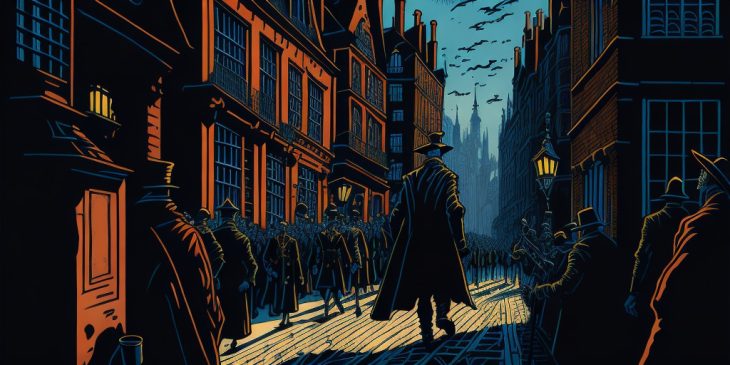
Johnson’s “London” – An Escape from Corruption and Hypocrisy
In this article, we’re diving into Samuel Johnson’s poem “London,” his first major splash in the literary scene from way back in 1738.
At the time, Johnson was a young poet who followed in the footsteps of Augustan poets like Alexander Pope, imitating classical poets to make a name for himself. “London” is Johnson’s satirical take on Juvenal’s Third Satire, following the character of Thales as he ditches London for the tranquility of the Welsh countryside.
Despite being published anonymously, “London” caught the attention of critics, including Pope himself, and was reprinted in multiple editions the same year. The poem’s political basis was a significant factor behind its praise, but over time, it’s been overshadowed by Johnson’s later works like “The Vanity of Human Wishes” and his famous dictionary.
But let’s rewind a bit to understand the context in which Johnson wrote “London.” In 1737, he moved to the city, soon finding employment with Edward Cave and penning articles for The Gentleman’s Magazine. Inspired by Pope’s “imitations” of Horace, Johnson took a stab at his own imitation, targeting political corruption in the process.
So, what’s “London” all about? Johnson channels Juvenal’s Third Satire, replacing Rome with London and Umbricius with Thales. Thales has had enough of London’s corruption and hypocrisy, deciding it’s time to seek solace in Wales. The poem’s epigraph, from Juvenal, translates to: “Who is so patient of the foolish [wicked] city, so iron-willed, as to contain himself?”
Thales doesn’t hold back when it comes to speaking his mind. Frustrated with living among hypocrites, he takes a jab at the corrupt government for bribing people to stay in line. But amidst the chaos, Thales and the narrator find time to reminisce about England’s golden days (apparently, when England was “the Dread of Spain”). Together, they daydream about King Henry V and Queen Elizabeth’s positive contributions to London and, in a moment of patriotic passion, even kneel to kiss the sacred ground, celebrating Britannia’s past glories.
Alas, Thales can’t lament forever. A boat arrives, and he bids his friend farewell before setting sail for a life away from London’s vices. The poem leaves us to reflect on the city’s condition and ponder the state of its government.
So, that is a birds’ eye view of Samuel Johnson’s “London.” A poem born from the desire to showcase his talent, it remains a relevant reminder of the hypocrisy and corruption that can seep into society, especially big cities like London or maybe even the city that you live in. So the next time you’re feeling overwhelmed by the chaos around you, let Thales’ escape to the countryside be your inspiration. Remember that sometimes, finding solace in nature’s embrace and choosing a simpler life – even if it means living with less – can bring the peace and happiness we crave.
28 comments
Your article helped me a lot, is there any more related content? Thanks!
Thanks for sharing. I read many of your blog posts, cool, your blog is very good.
Thank you for the auspicious writeup. It in fact was a amusement account it. Look advanced to far added agreeable from you! By the way, how can we communicate?
Hi, Neat post. There is a problem with your web site in internet explorer, would test this?IE still is the market leader and a big portion of people will miss your fantastic writing due to this problem.
Heya i am for the first time here. I found this board and I find It truly useful & it helped me out a lot. I hope to give something back and aid others like you helped me.
I appreciate, cause I found exactly what I was looking for. You have ended my four day long hunt! God Bless you man. Have a nice day. Bye
Thank you for your articles. I find them very helpful. Could you help me with something? http://www.hairstylesvip.com
May I request that you elaborate on that? http://www.hairstylesvip.com Your posts have been extremely helpful to me. Thank you!
I’d like to find out more? I’d love to find out more details. http://www.hairstylesvip.com
excellent put up, very informative. I’m wondering why the opposite experts of this sector do not understand this. You must proceed your writing. I’m confident, you have a great readers’ base already!
You could definitely see your enthusiasm within the article you write.
The world hopes for more passionate writers like you who are not afraid to mention how they believe.
Always follow your heart.
my web site nordvpn coupons Inspiresensation
350fairfax nordvpn
Hi there! This is kind of off topic but I need some
advice from an established blog. Is it hard to set up your own blog?
I’m not very techincal but I can figure things out pretty fast.
I’m thinking about creating my own but I’m not sure where to begin. Do you
have any points or suggestions? With thanks
Feel free to visit my web-site … nord vpn promo
Thank you for writing this post. I like the subject too. http://www.kayswell.com
May I request that you elaborate on that? http://www.kayswell.com Your posts have been extremely helpful to me. Thank you!
Thank you for your post. I really enjoyed reading it, especially because it addressed my issue. http://www.kayswell.com It helped me a lot and I hope it will also help others.
Aw, this was an exceptionally good post. Finding the time
and actual effort to make a really good article… but what can I say… I procrastinate a whole lot and don’t manage
to get anything done.
Here is my webpage … eharmony special coupon code 2025
Amazing! This blog looks exactly like my old one! It’s on a
totally different topic but it has pretty much the same
layout and design. Wonderful choice of colors!
https://tinyurl.com/28555853 gamefly
Good day! I just want to give you a big thumbs up for the excellent info you have here on this post.
I’ll be coming back to your website for more soon. What
is vpn connection https://tinyurl.com/2c2rno87
Thank you for the good writeup. It in fact was a amusement
account it. Look advanced to far added agreeable from you!
However, how can we communicate?
Aw, this was a very nice post. Taking the time and actual effort to create a great article… but what can I say… I hesitate a whole lot and never seem to get nearly anything done. http://www.kayswell.com
Hello There. I found your blog the use of msn. This is a really well written article. I will make sure to bookmark it and come back to read extra of your useful info. Thanks for the post. http://www.kayswell.com
Hello mates, nice article and fastidious urging commented here, I am actually enjoying by these. http://www.kayswell.com
I feel this is one of the such a lot important information for me. And i’m satisfied reading your article. But should observation on some normal issues, The site style is perfect, the articles is actually nice : http://www.kayswell.com
Hello, I enjoy reading through your article. I wanted to write a little comment to support you. http://www.kayswell.com
Hey there fantastic blog! Does running a blog similar http://www.kayswell.com
I feel this is among the most vital info for
me. And i am glad studying your article. However want to statement on few normal issues, The website taste is perfect, the articles is in point of fact great :
D. Excellent activity, cheers vpn https://www.highlandguides.com
Fala, pessoal. Na minha experiência com cassino seguro sem enrolação.
Opa. Já testei no tigrinho na cassino online e com disciplina funciona.