Odysseus: The Man Who Wouldn’t Go Home
Troy fell in ten years. Getting home took Odysseus ten more. Somewhere in that gap between “the war is won” and “the hero returns,” Homer found the only plot twist that actually matters: winning was the easy part.
The Odyssey doesn’t open with a war hero sacking a city, and it doesn’t open with him on a beach in Ithaca either. It opens with his son, seventeen years old and furious, watching strangers eat his father’s cattle in his father’s house — and it doesn’t even bother explaining how any of this happened until Book 9, when Odysseus finally sits down at a stranger’s dinner table and says, essentially, fine, you want the whole story? Here it is.
A war hero, a missing father, and a house full of freeloaders
By the time the poem begins, the Trojan War has been over for a decade. Every other Greek commander who survived it has made it home — badly, in some cases (Agamemnon gets murdered in his own bathtub by his wife, a fact the poem brings up constantly as a warning), but home nonetheless. Odysseus alone is missing, last seen sailing away from Troy and never seen again.
In Ithaca, everyone assumes he’s dead. A crowd of noblemen — the suitors — have moved into his palace, are eating him out of house and hearth, and are competing for the hand (and kingdom) of his wife, Penelope, who has spent years fending them off with increasingly desperate stalling tactics, including famously weaving a burial shroud by day and unpicking it by night. Their son, Telemachus, is old enough to be humiliated by all this and too young to do anything about it. The goddess Athena — Odysseus’s patron and the poem’s most reliable fixer — decides it’s time to intervene, disguises herself as an old family friend, and sends Telemachus off to find news of his father. This opening stretch, four books long, is sometimes called the Telemachy, and its real job isn’t plot — it’s proving that Odysseus’s absence has a cost. A kingdom is rotting because one man hasn’t come home.
The story within the story
Odysseus himself doesn’t show up until Book 5, and even then, Homer holds off on the famous adventures for a while longer. He’s discovered weeping on the shore of the island of the nymph Calypso, who has kept him as a reluctant, comfortable prisoner-lover for seven years. Once the gods force her to let him go, he’s shipwrecked, naked, and washed ashore on the island of the Phaeacians, a seafaring people who take him in without knowing who he is.
It’s at their banquet table, in Book 9, that Odysseus finally tells his own story — and this is Homer’s structural masterstroke. Everything the audience thinks of as “the plot of the Odyssey” — the Cyclops, the witch, the descent into the underworld — isn’t narrated by Homer at all. It’s narrated by Odysseus, to an audience within the poem, years after it happened, and not always in a way that invites total trust. He is, after all, the man the poem itself calls “of many wiles.”
Monsters, witches, and the dead: the wanderings
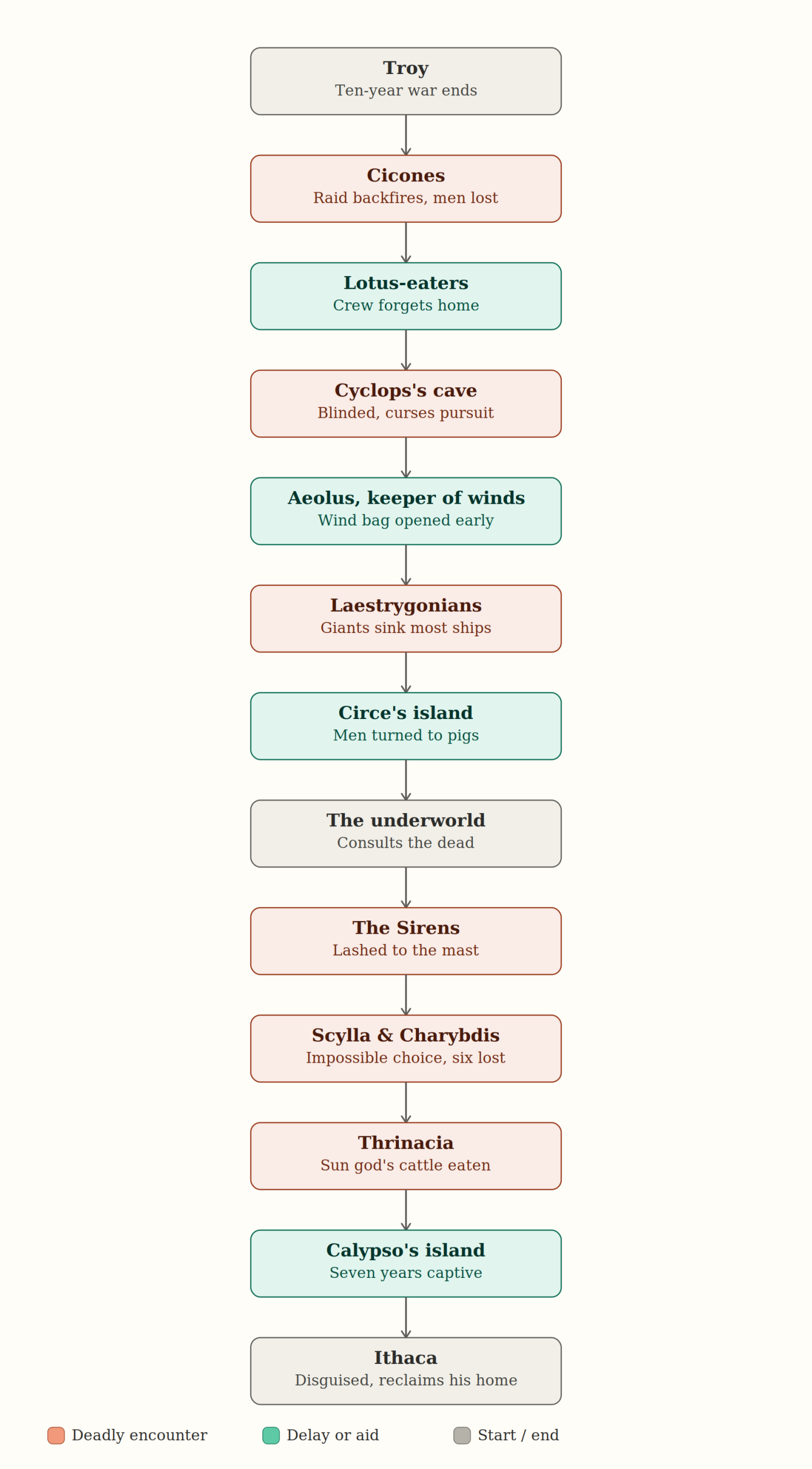
What follows is the sequence most people actually mean when they say “the Odyssey”: his fleet, blown off course leaving Troy, blunders from one lethal wonder to the next. They raid the Cicones and pay for it. They eat the memory-erasing fruit of the Lotus-eaters and have to be dragged back to the ships. They wander into the cave of the Cyclops Polyphemus, a one-eyed giant who eats several of the crew before Odysseus blinds him with a sharpened stake and escapes by clinging to the bellies of sheep — a triumph immediately soured when Odysseus, unable to resist a parting boast, shouts his real name back at the shore. Polyphemus, it turns out, is the son of Poseidon, god of the sea, and the boast earns Odysseus a decade of divine grudge-holding from the one god who can make a sea voyage genuinely miserable.
The god of winds, Aeolus, gives Odysseus a bag containing every contrary wind, which his own crew — convinced it’s treasure — opens within sight of home, blowing them straight back out to sea. The witch-goddess Circe turns half his men into pigs before Odysseus, protected by an herb the god Hermes gives him, resists her magic and becomes her lover instead, staying on her island for a year. On her advice, he sails to the edge of the underworld and speaks with the dead, including the blind prophet Tiresias, who tells him how to get home — and how not to — and his own mother, who died of grief waiting for him.
Then come the set pieces everyone remembers even without having read a line of Homer: the Sirens, whose song lures sailors to their deaths, past whom Odysseus sails lashed to his own mast, ears unstopped, so he alone can hear them and live; the sea monster Scylla and the whirlpool Charybdis, an impossible choice between two horrors that costs him six men either way; and the Cattle of the Sun God, which his starving crew slaughter against every warning, a sacrilege that gets every last one of them killed by a lightning-thrown storm. Only Odysseus survives, washing up — alone now — on Calypso’s island, which is where his own telling of the tale catches up to where the poem actually began.
Coming home in disguise
The Phaeacians, moved by the story, finally sail Odysseus home to Ithaca themselves. But arriving isn’t the end — it’s the start of the poem’s second half, which is really a revenge plot dressed as a homecoming. Athena disguises Odysseus as an old beggar so he can scout his own house unrecognized. He’s reunited first with his loyal swineherd Eumaeus, then with Telemachus, who doesn’t know his father’s face at all — a recognition scene the poem plays for genuine tenderness rather than triumph.
In disguise, Odysseus endures being insulted, threatened, and mocked in his own hall by the suitors who’ve spent years devouring his estate. Even his old dog, Argos, recognizes him and dies moments later, as if he’d only been holding on for this. Penelope, whether or not she has guessed the beggar’s true identity — the poem is deliberately coy about how much she knows — announces a contest: she will marry whichever suitor can string Odysseus’s old hunting bow and shoot an arrow through a row of twelve axe heads. Every suitor fails. The beggar asks to try.
The reckoning
He strings it easily, makes the shot, and reveals himself. What follows is not a duel but a slaughter: with Telemachus and two loyal servants at his side, Odysseus and Athena’s help, he kills every suitor in the hall. Penelope, informed of what’s happened, is famously unwilling to simply believe it — she tests the stranger with a riddle about their marriage bed, built around a living olive tree, that only the real Odysseus could answer correctly. He does, and the recognition between husband and wife, after twenty years, is the emotional peak the entire poem has been building toward. The families of the dead suitors threaten one last uprising, but Athena, ever the fixer, steps in to broker an uneasy peace, and the poem ends not with more war but with its refusal.
Why the story still holds
It’s worth noticing what the Odyssey actually decided was worth ten thousand lines of poetry: not the sacking of Troy, which gets a single other epic, but the getting home — the waiting wife, the untested son, the house that falls apart in a father’s absence, the identity a man has to hide and then reclaim. Every monster Odysseus survives is really a delay tactic against the thing the poem actually cares about, which is whether “home” still exists to return to, and whether the people in it still know who you are.
That’s the trick sequels rarely manage and Homer nailed on his second try: the reunion works because the poem never let the audience forget what, exactly, was at stake in a bed made from a living tree.