The Odyssey: the stranger at the door, the ache to go home, and the man who wouldn’t say his name
Every stranger who washes up on a shore in the Odyssey is a test. Not of strength, not of cunning — of manners. Long before anyone reaches for a sword, someone reaches for a chair, a meal, a hot bath, and a change of clothes, because in Homer’s world, how a person treats a stranger says more about their character than how they fight one.
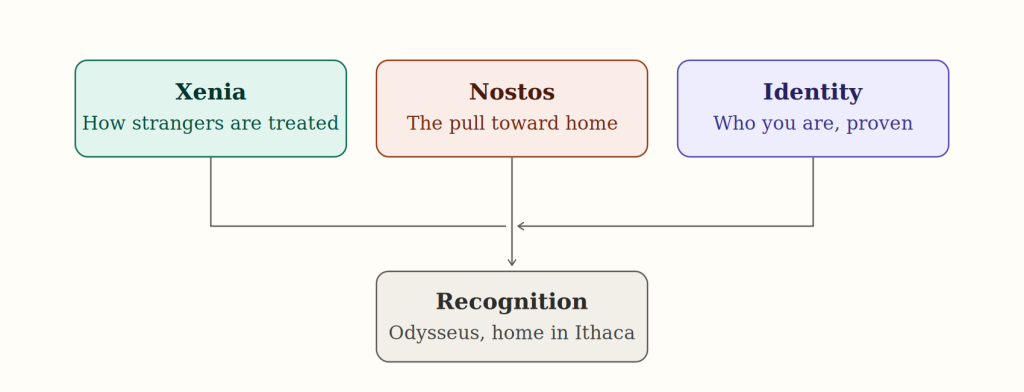
That single idea — the sacred obligation owed to a guest — turns out to be one of three threads holding the entire poem together, alongside the ache of getting home and a far trickier question: who is a man expected to be once he’s finally there?
A world without embassies
Archaic Greece had no consulates, no passports, no international law to protect a traveler washed up on a foreign coast. What it had instead was xenia — usually translated as “hospitality,” though that undersells it. Xenia was a binding social contract, guarded by Zeus himself in his role as Xenios, protector of guests. A host was obligated to feed, bathe, and shelter a stranger before even asking their name; a guest was obligated not to abuse that welcome. Break the code, and a god was watching.
This wasn’t background color. It was the operating system the entire poem runs on, and Homer spends nearly every episode testing it from a different angle.
Xenia: the test that reveals character
The poem’s best hosts appear early. When young Telemachus goes searching for news of his father, King Nestor and King Menelaus both receive him with textbook hospitality — feasts, gifts, honest counsel — before he’s even said who he is. The Phaeacians do the same for Odysseus himself, feeding and clothing a shipwrecked, nameless stranger on their shore before asking a single question about his identity.
The poem’s worst hosts appear too, and they’re worse precisely because they invert the rule instead of merely ignoring it. The Cyclops Polyphemus doesn’t just fail to feed his guests — he eats them, and when Odysseus invokes the guest-guarantee, appealing to Zeus’s protection, Polyphemus laughs it off, declaring that the Cyclopes care nothing for Zeus or his rules. It’s the clearest villain-defining moment in the whole poem, and it isn’t about violence for its own sake — it’s about a character who has opted out of the social contract entirely.
Then there are the suitors, camped in Odysseus’s own hall for years, eating his livestock and courting his wife. On the surface they look like guests. Structurally, they’re the opposite: guests who have overstayed their welcome, consumed their host’s wealth, and shown him no respect in absentia. Their deaths at the poem’s climax land less as simple revenge and more as hospitality’s own verdict finally being carried out.
Nostos: the ache with a name
The Greek word nostos means “homecoming,” and it’s the root of the English word “nostalgia” — literally, the pain of longing to return. Where the Iliad is a poem about kleos, the glory a warrior wins through combat and dies to keep, the Odyssey is a poem about the opposite impulse: the pull toward home strong enough to make a man walk away from glory, monsters, and even a goddess’s offer of eternal life.
That last detail matters more than it might seem. On Calypso’s island, Odysseus is offered immortality if he’ll simply stay. He says no. Homer has him weep on the beach every day, gazing out at the sea, not because he doesn’t appreciate paradise, but because nostos has a stronger pull on him than permanence ever could.
The poem constantly measures Odysseus’s homecoming against other Greek heroes’ fates, and the comparisons aren’t flattering to anyone but him. Agamemnon, the expedition’s commander, makes it home only to be murdered in his bath by his own wife — a story other characters bring up so often it functions as a running warning. Menelaus, by contrast, gets a long, storm-delayed but ultimately happy return. Odysseus’s own ten-year detour becomes readable as a gauntlet of temptations designed to substitute for home: the drugged oblivion of the Lotus-eaters, the comfortable captivity with Circe, the luxury of the Phaeacian court. Each stop offers a version of “good enough.” The poem’s entire tension is whether Odysseus will settle for one.
Identity: proving you are who you say you are
Which leads to the third thread, and the one the poem saves for its most dramatic use: identity. When Odysseus blinds Polyphemus, he tricks the Cyclops by claiming his name is “Nobody” — a pun that saves his life and becomes, unintentionally, a small thesis statement for the whole second half of the poem. Odysseus spends much of his return journey as exactly that: nobody. He arrives home disguised as a beggar, unrecognized by nearly everyone he meets, including his own son.
Recognition becomes the poem’s real structuring device. His old dog, Argos, knows him instantly and dies moments later, as though he’d only been waiting. His childhood nurse, Eurycleia, recognizes a scar on his leg while washing his feet. And Penelope — twenty years a widow in all but confirmation — refuses to take anyone’s word for it, testing the disguised stranger with a riddle about their marriage bed, built around a living olive tree, that only the real Odysseus could possibly answer. He does. That’s the moment the poem finally lets him become, again, Odysseus.
Where the three threads meet
These aren’t three separate ideas running in parallel — they braid together at the poem’s climax. Odysseus’s homecoming (nostos) cannot be completed until his identity is proven, and that proof takes the form of a hospitality crisis running in reverse: a returning host has to earn his way back into his own house as though he, too, were the stranger at the door. The man who spent the poem’s middle third being tested on how he treats guests spends its final third being tested, by his own household, on whether he still deserves to be treated as one of the family.
The stranger was him all along
It’s worth sitting with the shape of that ending for a moment. A poem obsessed with strangers arriving on foreign shores closes with its hero arriving, disguised, on his own shore — beggared, unrecognized, forced to prove through patience, scars, and shared memory that the person standing in the doorway is exactly who he claims to be. The rules Odysseus watched other hosts and guests break all across the Mediterranean turn out to be the same rules his own household applies to him. Twenty years of testing strangers, and in the end, he was the one who had to pass.