The other siege: Penelope and the women who run the Odyssey
While Odysseus is off blinding cyclopes and resisting witches, the Odyssey quietly runs a second plot back home that is, by any fair measure, just as hard as anything he faces at sea. A woman holds a kingdom together for twenty years against an occupying force of over a hundred suitors, with no army, no husband, and no guarantee he’s even alive — and she does it with patience, timing, and a loom.
That woman is Penelope, and she’s only the most visible member of a cast of women — goddesses, princesses, servants — without whom Odysseus doesn’t survive a single book, let alone make it home.
A house under siege
In archaic Greek society, a woman’s power was largely confined to running the household, the oikos — but that’s exactly the institution under direct threat in the Odyssey. With Odysseus presumed dead, Penelope faces a genuine crisis: over a hundred suitors have occupied the palace, are eating through the family’s livestock and wine, and are pressuring her to remarry and hand the kingdom to whichever of them wins her. She has no legal standing to simply order them out. What she has instead is her own version of her husband’s defining trait — cunning.
Penelope: a match for “the man of many wiles”
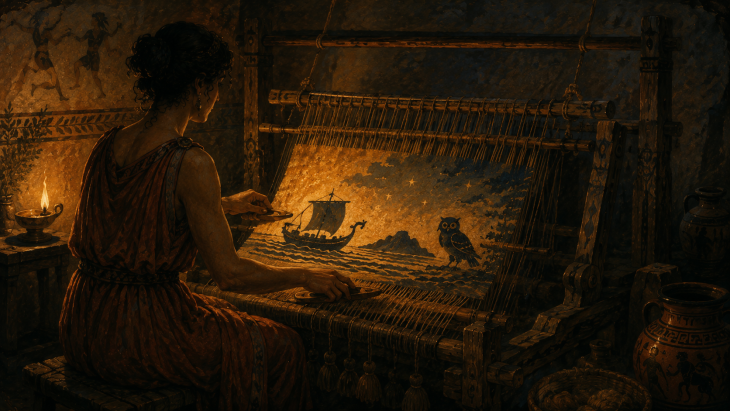
Homer’s Odysseus is famous for his epithet polymetis, “of many wiles” — but Penelope gets a version of that same praise, and she earns it. Her most celebrated maneuver is the shroud trick: she announces she’ll choose a suitor once she finishes weaving a burial cloth for Odysseus’s elderly father, then spends years secretly unraveling by night whatever she wove by day, buying time with a piece of domestic labor turned into open-ended stalling tactic.
Her cleverness peaks at the very end of the poem, in a scene that puts her on genuinely equal footing with her husband. When the disguised Odysseus finally reveals himself after slaughtering the suitors, Penelope doesn’t simply fall into his arms. She orders a servant to move the bed out of their bedroom — apparently a small, practical request. It’s a trap. The bed cannot be moved; Odysseus built it himself around the trunk of a living olive tree, a detail no impostor could know. His outraged reaction proves his identity more surely than any scar could. Homer has spent the whole poem building tests of recognition, and here he hands the cleverest one to Penelope, not Odysseus.
Scholars still debate a genuinely open question in the text: how much does Penelope suspect about the beggar’s true identity before that final test? Homer keeps her interior life deliberately opaque — she may know, half-know, or simply be too disciplined to risk hoping out loud. The ambiguity isn’t sloppy writing; it’s the poem trusting her enough not to explain her.
It also matters who Penelope is not. The poem keeps invoking Clytemnestra, the wife of the commander Agamemnon, who murdered her husband the moment he returned from Troy — a cautionary tale other characters bring up so often it starts to feel like a warning aimed squarely at Odysseus. Penelope is the poem’s answer to that anxiety: proof that a wife’s long, unsupervised independence doesn’t have to end in betrayal.
The goddesses who help, hinder, and complicate
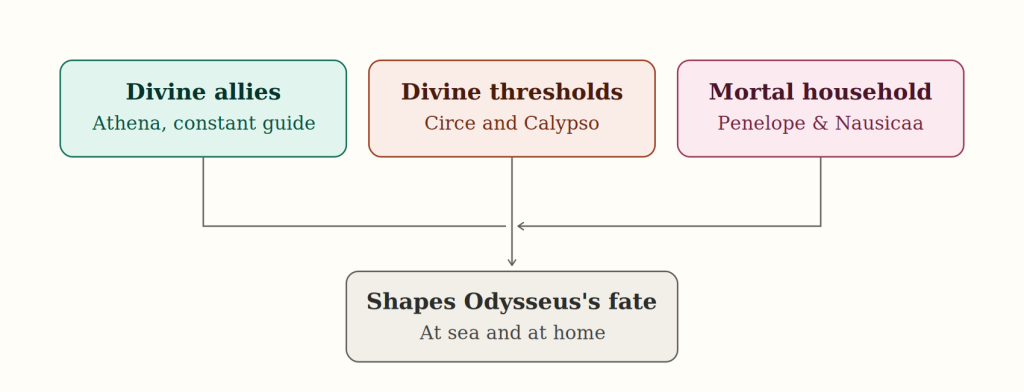
Above the mortal plot, three goddesses shape Odysseus’s entire journey, and none of them fit into a simple box. Athena is the poem’s most active force — disguising herself, coaching Telemachus, steering Odysseus’s homecoming at nearly every turn, functioning less like a background deity and more like the story’s producer.
Circe and Calypso are trickier. Both rule islands where ordinary heroic force is useless, and both initially trap Odysseus through female-coded power rather than combat — Circe turns his men into pigs with a drugged feast, Calypso keeps him as a reluctant, comfortable companion for seven years. Read only as temptresses, they’d be flat obstacles. But the poem complicates that reading almost immediately: Circe, once bested, becomes a genuinely crucial ally, giving Odysseus the exact instructions he needs to survive the Sirens, Scylla, and the underworld. Calypso, ordered by Zeus to let him go, does so without a fight, delivering one of the more quietly generous farewells in the poem even as she loses her chosen companion.
The mortal women beyond the queen
Nausicaa, the young Phaeacian princess who finds a shipwrecked, naked Odysseus on the beach, is arguably the most purely kind character in the entire poem — she feeds him, clothes him, and guides him safely to her parents’ court, all with nothing to gain. Homer even lets the possibility of romance flicker between them before quietly closing the door on it; Nausicaa represents a home Odysseus could have chosen and doesn’t, one more version of “good enough” set against the pull of nostos.
Eurycleia, Odysseus’s childhood nurse, provides the poem’s most physical recognition scene, identifying her disguised master by an old scar while washing his feet — and then keeping his secret, a small act of loyalty that costs her nothing less than total discretion in a house full of enemies.
The poem’s treatment of women isn’t uniformly generous, though, and it’s worth naming that honestly. In the final books, twelve of Penelope’s maidservants are executed alongside the suitors for having slept with them during the occupation — a brutal, morally uneasy episode that modern readers and scholars alike have pushed back on, since the servants had little real choice in a house under hostile occupation. It’s a reminder that the Odyssey‘s women aren’t uniformly celebrated by the text; they’re judged by standards the poem doesn’t always apply evenly.
A story running the whole time, offstage
Taken together, the women of the Odyssey aren’t a subplot to the monsters and shipwrecks — they’re a parallel narrative engine, arguably a more sophisticated one. Divine women test, delay, and ultimately enable Odysseus’s survival at sea; mortal women test, delay, and ultimately enable his survival at home. The poem’s most famous adventures happen in four action-packed books told in Odysseus’s own voice. Penelope’s siege runs the entire length of the poem, off the page, in real time, and gets no flashback because it never needed rescuing by cunning speech — only by cunning itself.
The next time the Odyssey gets summarized as “a guy fights a cyclops and a bunch of monsters on his way home,” it’s worth remembering the woman who spent that same decade running an occupied kingdom to a stalemate with nothing but a loom and her nerve.