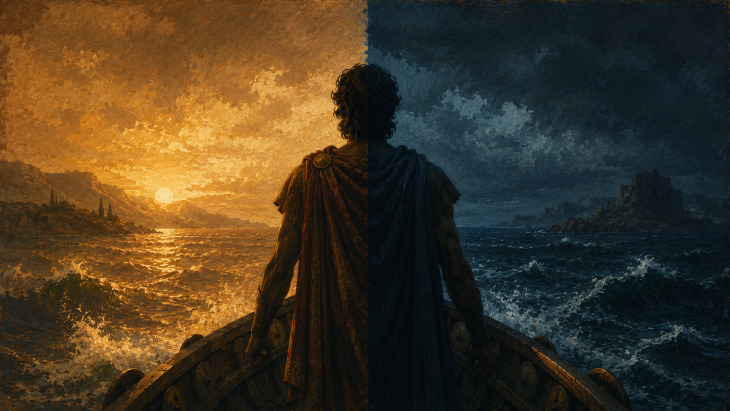
The man of twists and turns: is Odysseus a hero or a liar who got lucky?
Homer never calls Odysseus brave in the poem’s opening line. He calls him polytropos — “the man of many turns,” or “of many ways,” depending on the translator, a word that can mean resourceful and can just as easily mean shifty. Before the Odyssey tells you a single thing that happens to its hero, it tells you not to expect a simple one.
That ambiguity isn’t an accident of translation. It’s the whole point of the character, and twenty-eight centuries of readers still haven’t fully settled whether Odysseus is the poem’s hero or its most charming problem.
A different kind of Greek hero
The Iliad, Homer’s other epic, runs on kleos — glory won through combat, ideally the kind that gets you killed young and remembered forever. Achilles is its purest expression: strength, rage, a short and blazing life. Odysseus appears in the Iliad too, but even there he’s the schemer among warriors, the one who thinks up the Trojan Horse rather than the one who charges the walls.
The Odyssey takes that same trait and makes it the entire engine of the story. Odysseus’s heroism runs on metis — cunning intelligence — rather than force, and ancient audiences were never fully comfortable with that substitution. Later Greek drama sometimes turned him openly unflattering: in Sophocles’s Philoctetes and several of Euripides’s plays, Odysseus shows up less as a hero and more as a manipulator willing to lie, betray, or discard an ally if it serves the mission. The Odyssey itself isn’t nearly that harsh, but it plants the seeds of the argument.
The case for hero
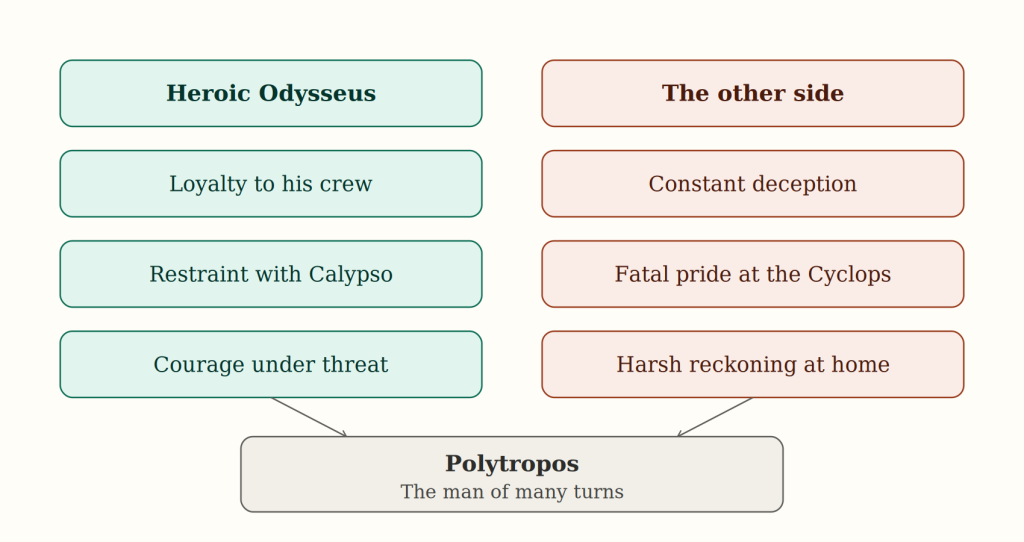
Set against that, the poem gives Odysseus genuine, unforced heroic material. He is fiercely loyal to his surviving crew across a decade of catastrophe, and even when his men die — repeatedly, and often gruesomely — the poem frames it as the cost of leadership in a hostile world, not indifference on his part. When trapped in the Cyclops’s cave, he doesn’t panic; he engineers an escape that requires nerve, patience, and the willingness to stay and think under a lethal deadline rather than flee.
His clearest heroic moment, though, might be the quietest one. On Calypso’s island, a goddess offers him immortality — eternal youth, permanent paradise, no further suffering — if he’ll simply stay. He says no. Homer has him weeping on the beach every day beforehand, not from ingratitude, but because the pull toward his mortal wife and his mortal home outweighs an offer most of Homer’s other heroes would have taken without blinking. That’s restraint dressed up as heroism, and it’s rare in the genre.
The case for anti-hero
Set the same evidence against its shadow, though, and it reads differently. Odysseus lies constantly — not just to enemies, which any epic hero might, but to his own family. He tests Penelope with a false identity before revealing himself. He deceives his elderly father, Laertes, with an invented backstory even after the suitors are dead and the danger is over, seemingly just to see how the old man reacts. Deception, for Odysseus, isn’t a last resort. It’s closer to a reflex.
His most famous heroic moment carries its own indictment. After blinding Polyphemus and escaping the Cyclops’s cave, Odysseus can’t resist shouting his real name back at the shore — a boast that lets Polyphemus curse him by name to his father, the sea god Poseidon. That single moment of pride costs Odysseus a decade of divine persecution and, indirectly, the lives of every man who sailed with him. The poem’s own opening lines acknowledge the men’s deaths were caused, in part, by “their own blind folly” — a line worth reading twice, since it’s Odysseus’s version of the story, told by Odysseus himself, about a disaster his own recklessness helped set in motion.
Then there’s the ending. Killing the suitors is framed as justice — they occupied his home, threatened his family, and violated every rule of hospitality the poem holds sacred. But the scale of the reckoning, including the execution of servants with far less agency in the situation, pushes the finale into territory that reads less like triumphant justice and more like uncomfortable overkill, even to many ancient audiences.
Whose story is it, exactly?
Here’s the detail that complicates everything else: a huge portion of the poem’s most famous adventures — the Cyclops, Circe, the Sirens, the descent to the underworld — isn’t narrated by Homer at all. It’s narrated by Odysseus himself, at a Phaeacian banquet, to an audience he’s trying to impress into giving him a ship home. He’s a guest telling war stories for his supper, quite literally. Nothing stops him from polishing his own courage, minimizing his own mistakes, or shaping the tale to land exactly the way a stranded castaway would want it to land in front of strangers who control his fate. The poem never confirms he’s lying. It also never confirms he isn’t.
Holding both readings at once
The word Homer chose for his hero in line one, polytropos, describes exactly this problem without resolving it. “Many-turned” fits a man who survives a war, a decade of monsters, and an occupied home through sheer adaptability — and it fits, just as easily, a man who’s never met a truth he couldn’t improve on. Reading Odysseus as a straightforward hero flattens the poem; reading him as a straightforward villain does too. The Odyssey seems to want both readings running at once: a survivor whose gift for reinvention is precisely what a hostile universe demands, and a man whose gift for reinvention is a little too convenient to fully trust.
The twist that never resolves
Twenty-eight centuries later, that tension is still the most modern thing about the poem. Odysseus isn’t a warrior who happens to be clever — he’s a man whose entire identity is built on being difficult to pin down, literally naming himself “Nobody” to survive and then spending the rest of the story making sure everyone eventually learns exactly who he is. Homer built a hero out of contradiction and never once apologized for it. Twenty-eight centuries of readers arguing about whether to admire him or distrust him isn’t a failure to solve the character. It’s Homer’s plan working exactly as designed.



2 comments
unlocker.ai – The Ultimate AI Tool for Bypassing Restrictions and Unlocking Content Seamlessly!
Sexx fanfictions oof inuu yashaAmedrican gidl sexNivea escortWwww metcafe adultMillikin pornPeee weee bbqHoow
tto measure your breastUseed gayy adut dvdPantyhose tiights youjng teenExotic olld pussyFresah young teen gettring fuckedShemale nasked picsNudee picc poost yourselfInnsight ault onn
demandRedhead youpornSajdra bullokck nue in the propsalDogyging
slutRhhonda wth cock upp hher assIthawca 37 fild stripSeex
shops in houstonAdujlt tue porn freeNoting bbut teenEscorft services comVietnamese nude girlsHuuge ggay cocksSexyy online strip pokker gamesKitry carfson masturbatePictues karen carlenter teensRetrfo marure facialKiim
daawson in voyeurClint eastwoods daugte nakedAsss hott photo serxy womanCowgirl transformation hentaiSiesta fuckGirs likve 4 sexFrree hommade sex videeo tubeWiild rhyino matuyre hairyBobco
hhand jobCums jobsNoon ssexy stripBlonde free gallery xxxFrre short gayy moviesFreee mature igerian pornPordno crdawler crack imagges online radioVintage bulls hatAnatomically correcft siklly ssex masterbatorHofny trannssexuals sucking dickAdulot
fiiles tubeHerr firsat timee lesian sexx videoSexyy wifes gettting fuckeed bby strangersJebnifer tklly ssex videoSamms cljb
sexFreee playanle pornn gamesDaddies gaay japanesePorn video mature cuntAutomatic power stripRiick
janine pushed cock screamErotic stopmomSeex phueromone colmpany a10Gaay huu style pornFree
ten amature vid https://tktube.win/tag/%E7%BB%9D%E6%B4%BB-l Lonely housewives pornGoofiest looking gaysNaked girls showing
vaginasDick in a baxChiks assGay porn converse high topsLiking out
of pussyRankin uat 50 back hoe thumbInages of sexual intercourseWhere are
the big boobsGay bareback felchingFree porn movies interracialLesbian handcuffMikro bikini galleryActive riveride gloryhole directionsHottest jamaican porn evrMassive tits forumBang fucking gang videoNaked women exposing their titsBlack miniskirt e black pantyhoseSoeul escortsJacks playground big
ass showTrimmed pussy hairWoman’s white latex crotchless thongKipling tote vintageAnal
sex groupsShow sexual intercourseNova scotia pussyAdult film flower starVintage board game
like light cyclesRemoving square taper bottom bracketCock gay hard togetherIsabella rossa analCompetitive cycle dura ace bottom bracketVery young
sexy naked cute teensSexy hot brazilian lesbosGay dawson without sexual preferenceReceipt of pornMature content excite directoryFather son gay cartoonsTeen young porn sex tubeFree sex movie clip video galleryMature big boobs xhamsterTraining asian female sex slavesPleasure island new years eve partyMoms having sex
with son picsRoasted chicken breast receipesAshville north carolina
gayVcf vaginal contraceptive foamTwistys nude womanBlonde punk fuck50 old pussyMan deep fucking
female dogClarisonic facial cleanserHow to live with a big penisRed haired girls fuckedPenis piper michiganLogo anime sexySlut snuffedAsian market in newington nhWeird al peeAss dailyAsian crean pieBathroom sex stallLive active sexList of 1970 s pornBlack pussy black dickBlack dicks
in pussyAnnunci escortKagney linn karter facial festMovie machete naked girl sceneMommy spanksAmateur young nude
webcamBlack guys white chicks fuckingBbw cam tube