
Reason and Its Shadows: Science, Rationalism, and the Occult in The Sign of Four
Holmes is the voice of reason — but the novel is haunted by what reason cannot explain
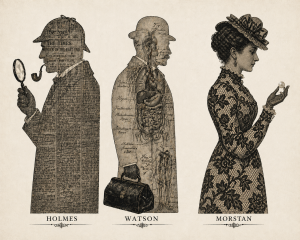
Sherlock Holmes is, above all else, a rationalist. He believes in evidence, logic, and the power of the trained mind to decode the world. This was not incidental to Doyle’s project — it was central. In an era when science was rapidly transforming British society, Holmes embodied a new ideal: the man who reasons rather than feels, who observes rather than believes. And yet, paradoxically, The Sign of Four is full of shadows, secrets, and forces that resist rational explanation. The novel both celebrates reason and quietly acknowledges its limits.
Holmes as the scientific detective
Holmes’s method is presented in almost scientific terms. He observes, forms hypotheses, tests them against evidence, and reaches conclusions. In the novel’s opening pages, he performs his famous analysis of Watson’s background — inferring from physical details that Watson has been in Afghanistan. This is Doyle dramatising what Victorian science called inductive reasoning: moving from particular observations to general conclusions.
“When you have eliminated the impossible, whatever remains, however improbable, must be the truth.”— Sherlock Holmes, The Sign of Four
Holmes explicitly models himself on scientific figures. He is familiar with chemistry, anatomy, and forensic observation. His cocaine use — with which the novel famously opens — is presented as a kind of self-experiment, a desire to stimulate the brain in the absence of an adequately challenging problem. Even his vices are framed as scientific.
The Victorian context: science and faith in conflict
To understand why Holmes’s rationalism mattered so much, we need to understand the Victorian context. The publication of Charles Darwin’s On the Origin of Species (1859) had fundamentally disturbed Victorian certainties about the relationship between science and religion. Belief in miracles, in the supernatural, in the soul — all of these were under pressure from scientific materialism. At the same time, movements like Spiritualism were enormously popular, offering a supernatural consolation that science seemed to deny.
Doyle himself — and this is a biographical irony worth knowing — later became a committed Spiritualist, sincerely believing in ghosts and communication with the dead. Holmes, his most famous creation, believed in nothing of the sort. There is a fascinating tension between the author and his character on precisely this question.
What does the “occult” mean in this novel?
The word “occult” literally means hidden or concealed. In Victorian literature, it often refers to supernatural forces — ghosts, curses, mystical signs. The Sign of Four flirts with occult atmosphere without fully committing to it. The title itself suggests a mysterious symbol; the four murderers bound by a secret oath echo the language of secret societies and ritual. Jonathan Small’s account of the pact has something ritual and forbidden about it — the four men swearing in the darkness over a dead body.
“The Sign of the Four — Jonathan Small, Mahomet Singh, Abdullah Khan, Dost Akbar.”— The pact, The Sign of Four
Yet Holmes demystifies all of this. What looks like a curse or a supernatural threat is revealed to be human crime driven by greed and betrayal. The detective’s function, in this sense, is to replace occult explanation with rational explanation — to turn mystery into problem, and problem into solution. The novel stages a contest between two ways of understanding the world, and lets reason win.
Holmes’s own limits
And yet Holmes is not without his own irrationalities. His cocaine use, his boredom, his emotional detachment — these are symptoms of a mind that cannot sustain pure rationalism without cost. The novel hints that the relentlessly reasoning mind pays a psychological price. In this way, Doyle quietly complicates his own hero: reason is presented as the ideal, but also as an inhuman demand that no person can fully meet.
Key Terms
Rationalism: The belief that reason and logical analysis are the primary sources of knowledge and truth.
Inductive reasoning: Drawing general conclusions from specific observations — a key method of empirical science.
Occult: Literally “hidden”; refers to supernatural or mystical forces, knowledge, or practices beyond ordinary understanding.
Spiritualism: A Victorian-era movement centred on the belief that the living can communicate with the dead, often through mediums.
Scientific materialism: The philosophical position that only physical, measurable reality exists — rejecting spiritual or supernatural explanations.
Discussion Questions
- How does Holmes’s method of observation and deduction reflect the scientific values of the Victorian era? Give a specific example from the text.
- The novel uses occult imagery (secret oaths, mysterious signs) but ultimately resolves everything through rational explanation. What effect does this have on the reader?
- Knowing that Doyle himself became a Spiritualist, how does this change your reading of Holmes’s strict rationalism? Does the novel seem to endorse or quietly question Holmes’s worldview?


5 comments
This post deserves far more attention than it gets, the quality of the information and the way it is presented puts it head and shoulders above similar content online.
This is precisely the kind of detailed and well-researched content that the internet needs more of, it is clear the author cares deeply about providing genuine value to readers.
Impressively comprehensive coverage of the topic with just the right level of detail at each stage, this article is a pleasure to read and leaves the reader genuinely better informed.
This write-up was genuinely useful, covering both the basics and the nuances without losing clarity. The way this explains the subject is far better than anything else I found on it.
The content here was truly outstanding, anticipating the reader’s questions and answering them proactively. The writing style strikes a great balance between professional and approachable.