Empire Comes Home: Colonialism and Race in The Sign of Four
Reading Doyle’s novel as a document of Victorian imperial anxiety
When Sherlock Holmes solves a mystery, he restores order. But whose order? And at what cost? The Sign of Four is set in the comfortable drawing rooms of Victorian London, but its roots lie in colonial India — specifically in the 1857 Uprising, the British Raj, and the vast wealth that the empire extracted from South Asia. To read this novel critically is to ask: what does it reveal about how Victorian Britain thought about empire, race, and the non-European world?
India as origin of crime
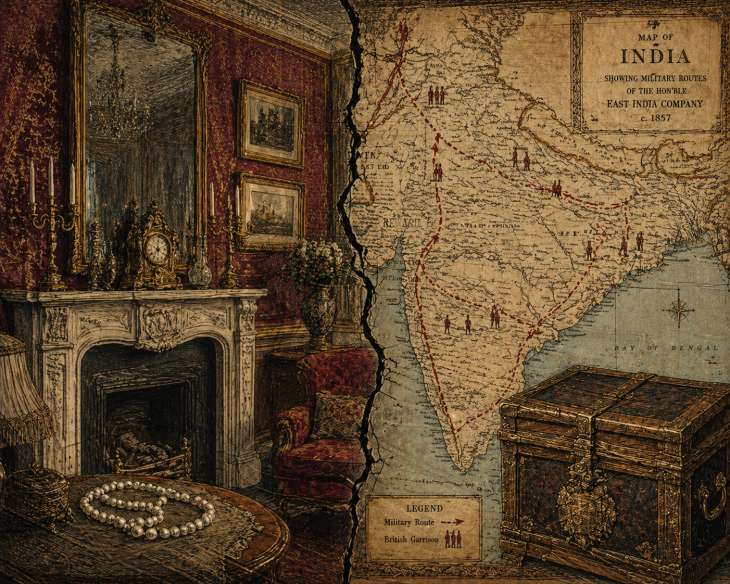
The plot’s central object — the Agra treasure — comes from India. The murder that sets everything in motion happens in India. The backstory of betrayal and violence takes place during and after the 1857 Uprising. In Doyle’s novel, India is not simply a setting; it is the source of contamination. Danger, greed, and violence travel from the colony to the metropolis, threatening the domestic peace of London.
This is a common pattern in Victorian Gothic and adventure fiction — what scholars call the return of the repressed. The violence that Britain enacted in its colonies is not forgotten; it comes back, transformed into mystery and threat, to haunt the home country. The Agra treasure is cursed not by magic but by history: it is built on colonial theft and murder.
“The treasure can never be ours… it is as though it were blighted and accursed.”— Dr. Watson, The Sign of Four
How are Indian and colonial characters represented?
This is where critical reading becomes most important. The novel’s non-white characters — Tonga, the Andaman Islander who travels with Jonathan Small, and the Indian sepoys who feature in the flashback — are represented through the lens of Victorian racial stereotyping. Tonga is described in language that dehumanises him, associating him with animality and savagery. He does not speak; he acts as a weapon. He is given no interiority, no moral complexity, no name beyond the one Small gives him.
The three Indian soldiers who form the original “sign of four” pact are drawn with slightly more complexity — they are capable of cunning and loyalty — but they are still firmly subordinated to Small’s narrative. We hear their story through a white Englishman, not directly from them.
“Never have I seen features so deeply marked with all bestiality and cruelty.”— Dr. Watson, describing Tonga, The Sign of Four
As a student of literature, it is important to name this clearly: these are racist representations. They reflect the ideological assumptions of Doyle’s time — assumptions that constructed non-white people as inferior, dangerous, or subhuman in order to justify colonial rule. Reading critically does not mean dismissing the novel; it means seeing it whole, including what it reveals about the society that produced it.
Jonathan Small and the “loyal” colonial subject
Jonathan Small is an interesting case. He is the novel’s primary villain, and yet Doyle gives him a full confession and something close to sympathy. Small is a working-class Englishman who went to India in search of fortune and was, in his own telling, a victim of circumstance as much as a criminal. His narrative asks us to see him as a man betrayed by his social superiors.
This is revealing: the novel is more willing to grant interiority and moral complexity to a white criminal than to any of its non-white characters. Even in its portrayal of villainy, the novel operates along racial lines.
The empire and the domestic ideal
The novel ends with the treasure lost and Watson married. The domestic, the English, the settled — these triumph over the chaotic, the foreign, the colonial. Mary Morstan, who might have become wealthy from the treasure, is instead saved from it. The message, whether Doyle intended it or not, is that the wealth of empire is dangerous; it corrupts and destroys. Yet this does not lead to a critique of empire itself — only to a reassertion of English domestic virtue against imperial contamination.Key Terms
Colonialism: The political and economic domination of one country or people by another, involving settlement, resource extraction, and cultural suppression.
Postcolonial criticism: A critical approach that examines literature for its representations of colonised peoples and colonial power structures.
Return of the repressed: A concept (from Freud, applied to culture) describing how suppressed or denied aspects of experience return in displaced, often threatening forms.
Racial stereotyping: The reduction of individuals to simplified, often dehumanising traits associated with their racial or ethnic identity.
Interiority: In narrative, a character’s inner life — their thoughts, feelings, and self-awareness — as made available to the reader.
Discussion Questions
- How is India represented in The Sign of Four? Is it a place, a symbol, or both? What qualities does Doyle associate with it?
- Compare the narrative treatment of Jonathan Small with the treatment of Tonga. What does the difference reveal about the novel’s racial assumptions?
- The treasure is ultimately lost. What does this ending suggest about the relationship between imperial wealth and English domestic life?