The Anchor’s Script: Why Preparation Is Not Cheating
Here’s a question I’d like you to sit with for a moment: when you watch a brilliant anchor — someone who flows through an event with effortless confidence, who cracks a joke at exactly the right moment, who introduces a speaker so well that the room leans forward before that person has even said a word — what do you imagine is happening in their head?
Most of us assume something like: they’re just naturally good at this. Or: they’re winging it. Or even: they’re too cool to have prepared.
That assumption is wrong. And it’s holding a lot of us back.
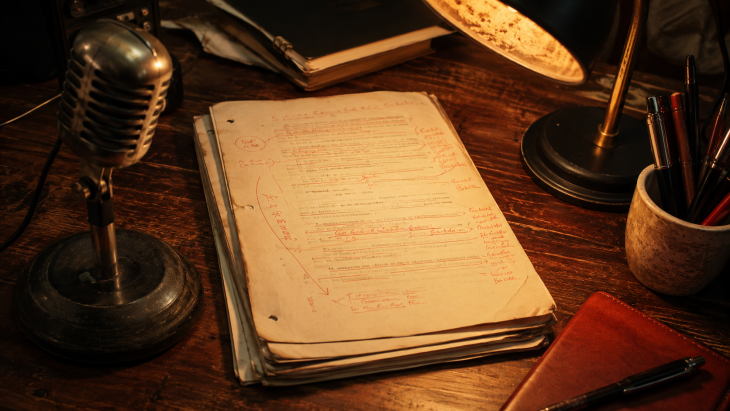
The most reliably excellent anchors — in television studios, on festival stages, in college auditoriums — are the most reliably prepared anchors. Their scripts are not scraps of paper they glanced at twenty minutes before the show. They are carefully structured documents, often drafted and revised multiple times, practised aloud until the words feel like breath.
And here’s the paradox that trips everyone up: the more thoroughly you prepare, the more natural you sound. Because preparation isn’t the enemy of spontaneity — it’s the ground that makes spontaneity possible. When you know your material so deeply that you could deliver it in your sleep, your conscious mind is freed up for the thing that actually requires real-time thinking: the room. You can listen. You can respond. You can notice that someone in the third row looks confused, or that the audience just laughed at something unexpected, or that the previous act ran three minutes long and you need to trim the transition.
An anchor without a script is a tightrope walker without a rope. They might get across occasionally. But they won’t get across consistently, and they definitely won’t get across gracefully.
So what should a proper anchor’s script actually contain?
At minimum, four things. The opening, which sets the tone and welcome before anything else happens. The transitions — the bridges between acts or speakers that hold the event together as a coherent narrative rather than a list of unrelated items. The introductions of each performer or dignitary, which require accurate names, correct titles, and enough warmth to create genuine anticipation. And the closing — the send-off that gives the event its meaning, rather than just marking its end.
None of these sections need to be written word-for-word, though it helps to have key lines fixed. What you’re building is a map, not a cage. You know where you’re going, you know your landmarks, and you know the route. That’s what gives you the freedom to take a small detour when the moment calls for it — and find your way back.
There’s also a deeper benefit to scripting that nobody talks about enough: it forces you to think about the event rather than just participate in it. When you sit down to write a transition between a classical dance performance and a contemporary poetry reading, you’re forced to ask yourself: what connects these two things? What emotional thread runs through this evening? What do I want this audience to carry home?
Those are curatorial questions. They’re also, as it happens, humanistic questions — the kind that English students are trained to ask. Scripting an event, it turns out, is closer to writing an essay than it looks. Both require a beginning that earns the reader’s trust, a middle that sustains their attention, and an end that feels like arrival rather than abandonment.
So the next time someone tells you that “real” anchors don’t use scripts, you can smile and nod and disagree entirely. The greatest public performers in the world — from stand-up comedians to heads of state — prepare obsessively. They just practise until the preparation disappears.
That disappearance? That’s the craft.