How Narayan Writes: Irony, Symbols, and the Art of the Understated Novel
A Reader’s Guide to Narayan’s Style, Technique, and the Craft of Waiting for the Mahatma
When students first read R.K. Narayan, they sometimes mistake his style for simplicity. His sentences are short. His characters are ordinary. He rarely moralises. There are no long philosophical passages or dense lyrical prose. The novel seems to proceed at the pace of a gentle walk through a small town.
But Narayan’s apparent simplicity is one of the most carefully crafted things in Indian English fiction. His restraint is not absence of skill — it is skill at its most refined. This post explores the key literary techniques in Waiting for the Mahatma, and explains how to write about them in essays and exams.
1. The Comic Style: Gentle Irony, Not Satire
Narayan is often described as a ‘comic’ writer, but it’s important to understand what kind of comedy he practises. He is not a satirist in the manner of Jonathan Swift or Oscar Wilde — he is not trying to expose or condemn. His comedy is gentler than that: it arises from the gap between what characters believe about themselves and what the reader can see.
Consider Sriram’s first entrance into Gandhi’s camp. He has invented a thin pretext — he tells himself and others that he is driven by political conviction. Gandhi, in about thirty seconds of conversation, sees through this completely. But he does not expose Sriram. He accepts him.
This is free indirect discourse — a narrative technique in which the narrator temporarily adopts the character’s perspective and vocabulary, allowing the reader to see both the character’s self-image and the gap between that self-image and reality. Narayan uses it constantly with Sriram, and it produces the novel’s characteristic effect: we are laughing at Sriram gently, while simultaneously recognising ourselves in him.
2. Understatement: The Power of Not Saying
The most powerful moments in the novel are also the most restrained. Consider the burning ghat scene: Granny is taken to be cremated. She is not actually dead. Sriram is present but cannot acknowledge her. She survives and is exiled. Narayan recounts all of this in clear, flat prose. There is no authorial anguish. No moralising. Just the facts, in sequence.
“The Mahatma fell on the dais. He was dead in a few seconds.”
The assassination of Gandhi in the final pages is the ultimate example of Narayan’s understatement. The sentence is spare, almost journalistic. There is no authorial grief, no reflection, no rising lyrical passage. The book simply ends. Narayan trusts the reader to supply the emotion. And because the reader has been with Sriram for the whole novel — has watched him wait, hope, suffer, and finally receive Gandhi’s blessing — the emotional impact of the flat final paragraph is devastating precisely because of its restraint.
In your essays, this is worth noting: Narayan’s understatement is a formal choice, not a failure of feeling. When you write about his style, explain what effect the restraint produces on the reader.
3. Symbols and Their Meanings
Waiting for the Mahatma is rich in symbols. Here are the four you most need to understand:
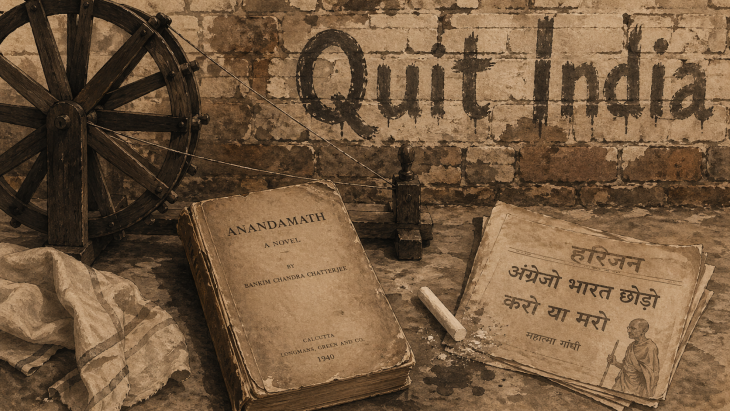
The Charkha (Spinning Wheel): When Bharati teaches Sriram to spin, the charkha becomes the site of his political education. Spinning demands patience, discipline, and the subordination of the ego to repetitive, productive labour. These are exactly the qualities Sriram lacks. His repeated failures at the spinning wheel are not just comic — they are an index of his political and moral development. When he finally learns to spin, something has genuinely changed.
The Quit India Slogan: The slogan ‘Quit India’ in the novel functions as a test of how political language travels between intention and reception. Sriram paints it on walls; schoolchildren chant it as a song; a cautious teacher tries to change it to ‘Quiet India.’ The same words mean completely different things to different people. This is Narayan’s comment on the gap between nationalist ideology and popular consciousness.
The Burning Ghat: Granny’s near-cremation is the novel’s most symbolically dense episode. The burning ghat is a place where the boundary between life and death is crossed. Granny’s return from that threshold makes her an anomaly — neither fully alive nor fully dead in the community’s eyes. At a symbolic level, this mirrors the condition of tradition itself in a society undergoing revolutionary change: it cannot go back to what it was, but it has no clear place in what is coming.
Waiting itself: The title’s verb is its most important symbol. Throughout the novel, Sriram waits — for Bharati’s approval, for Gandhi’s blessing, for independence, for reunion. In Gandhian terms, waiting is not passive: it is a form of satyagraha, a readiness to receive what history and conscience demand. But the novel’s final scene transforms the meaning of all this waiting retroactively. The thing Sriram was waiting for — Gandhi’s final blessing — ends in assassination. The waiting is over, but not in the way anyone hoped.
4. The Picaresque Structure
The novel’s structure is loosely picaresque: a series of episodes, each of which places Sriram in a new situation and tests him in a new way. There is no tight, cause-and-effect plot machinery. Things happen to Sriram more than they are planned by him.
This is a deliberate formal choice. The picaresque structure reflects Sriram’s character: he is not a planner or a strategist. He is a reactor, an improviser, a muddler-through. The episodic structure also allows Narayan to move freely through the historical period of 1942–1948 — stopping at moments that illuminate different aspects of the independence movement.
When you are asked to write about the novel’s structure in an essay, note that its apparent looseness is purposeful: it mirrors both the protagonist’s character and the unpredictability of historical experience.
5. Gandhi as Character: The Double Register
One of the novel’s most technically challenging achievements is its portrayal of Gandhi as a fictional character. Narayan manages a double register: Gandhi must be simultaneously a historical personage (recognisable from his actual statements, practices, and mannerisms) and a literary character responsive to the novel’s narrative needs.
Narayan’s solution is to give Gandhi specific, small gestures and a dry, gently humorous personality rather than grand speeches or heroic action. Gandhi notices Sriram’s real motives immediately, and gently teases him about them. He gives advice about spinning and diet and brahmacharya. He accepts donations with practical efficiency. He is not mythologised. He is humanised.
“Narayan refuses to mythologise Gandhi even as he honours him. In his hands, Gandhi has been ‘Malgudi-ised’ — brought to human scale while retaining grandeur.”
The scholar Satish Aikant argues that this humanisation is a form of ‘colonial ambivalence’ — that Narayan’s ironic detachment from the independence struggle reflects his position as an Indian writer publishing in English for British and American audiences. This is a sophisticated critical argument worth engaging with in advanced essays: does Narayan’s restraint represent artistic integrity, or ideological compromise?
Key Terms
| Term | Definition |
| Free indirect discourse | A narrative technique where the narrator’s voice temporarily merges with a character’s perspective, allowing the reader to see the gap between self-image and reality. Narayan uses it constantly to generate gentle irony. |
| Understatement | Saying less than the emotional weight of the situation seems to demand. Narayan’s most powerful technique — think of the flat prose describing Gandhi’s assassination. |
| Picaresque structure | A loose, episodic narrative structure featuring a roguish protagonist stumbling through varied situations. Reflects both Sriram’s character and the unpredictability of historical experience. |
| Symbol | An object or image that carries a meaning beyond its literal function. The charkha, the Quit India slogan, the burning ghat, and the act of waiting are all symbolic in this novel. |
| Colonial ambivalence | Satish Aikant’s term for Narayan’s complex relationship to the independence movement — the suggestion that his ironic detachment reflects his dependency on British and American literary culture. |
| Double register | The technique of operating simultaneously at two levels — in this case, Gandhi as historical person and as fictional character. Narayan manages both without collapsing either. |
Discussion Questions
| 1. | Choose one symbol from the novel (the charkha, the burning ghat, the Quit India slogan, or waiting) and explain in detail how it accumulates meaning across the narrative. |
| 2. | Narayan’s style has been described as ‘deceptively simple.’ Using at least two specific passages or scenes, show how his apparent simplicity actually conceals sophisticated literary technique. |
| 3. | What is the effect of narrating Gandhi’s assassination in flat, journalistic prose? How would the novel’s meaning change if Narayan had written a lyrical, emotionally expressive passage instead? |
| 4. | Satish Aikant argues that Narayan’s ironic detachment reflects ‘colonial ambivalence.’ Do you agree? Is Narayan’s restraint a form of political evasion, or is it an artistic virtue? |

One thought on “How Narayan Writes: Irony, Symbols, and the Art of the Understated Novel”
Very insightful article, thank you for sharing. rodweqzmuooyamylrpytkpcua