Gandhi on the Page: History, Non-Violence, and the Fictional Mahatma
How Narayan Brings India’s Independence Struggle into the World of Malgudi
Waiting for the Mahatma is unusual in R.K. Narayan’s career. His other Malgudi novels are largely self-contained: a small town, its comic characters, their everyday dramas. History is mostly background. But this novel, published in 1955, places Mahatma Gandhi himself at its centre — a real, historical figure, given fictional dialogue and personality. The independence movement, the Quit India agitation, the Partition, and Gandhi’s assassination all enter the story of Malgudi directly.
To understand why this is remarkable — and how Narayan pulls it off — it helps to know something about the historical events the novel is built around. This post gives you that context, and explores the philosophical framework that makes the novel more than just a historical novel.
The Historical Background: 1942–1948
The novel is set across roughly a decade, from 1942 to 1948. These were the most dramatic years in India’s modern history. Here are the events you need to understand:
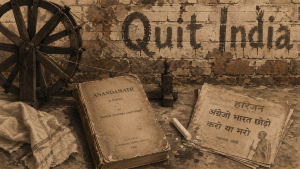
1. The Quit India Movement (August 1942): Gandhi’s call for immediate British withdrawal from India, launched at a mass meeting in Bombay. Within hours, the British arrested Gandhi and nearly all Congress leaders. The movement went underground, and a wave of protest, sabotage, and civil disobedience swept across the country. This is the political world of Parts Two and Three of the novel.
2. World War II (1939–1945): India was drawn into the war without the consent of its political leadership. The Bengal Famine of 1943, which killed an estimated two to three million people, took place in this period. The war is largely background in the novel but shapes its atmosphere.
3. Partition (August 1947): The division of British India into the independent nations of India and Pakistan, accompanied by mass communal violence, displacement, and killing. The novel’s final section refers to the chaos of Partition. Gandhi was fasting to contain Hindu-Muslim violence when Sriram and Bharati are reunited.
4. Gandhi’s Assassination (30 January 1948): Mahatma Gandhi was shot by Nathuram Godse at Birla House, New Delhi. Godse was a Hindu nationalist who believed Gandhi had betrayed India by his efforts to contain anti-Muslim violence. The novel ends at this moment.
Gandhian Philosophy: What Sriram Is Actually Being Taught
Much of the novel’s first half is spent with Sriram learning — however incompetently — the basics of Gandhian practice. For a first-year student, it helps to understand what Gandhi actually stood for, because the novel makes no sense without it.
“The Mahatma immediately identified that Sriram’s motives were personal rather than political, but accepted him anyway — assigning Bharati as his instructor.”
Ahimsa, or non-violence, is the foundational principle. It means more than just not hitting people. It means refusing to cooperate with injustice, absorbing suffering rather than inflicting it, and maintaining moral pressure on the oppressor through one’s own example. This is Gandhi’s greatest philosophical contribution — the idea that political change can be achieved through suffering willingly embraced, not violence.
Satyagraha, often translated as ‘truth-force’ or ‘soul-force,’ is Gandhi’s method of non-violent resistance. Civil disobedience, refusal to obey unjust laws, peaceful protest, self-imposed suffering — all of these are forms of satyagraha.
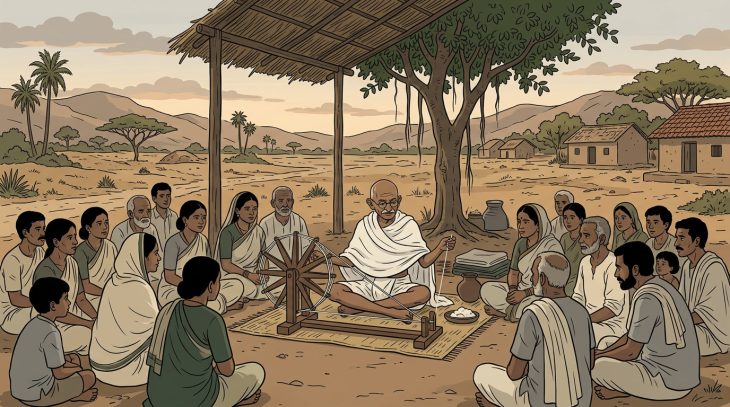
The charkha (spinning wheel) and khadi (hand-spun cloth) represent Gandhi’s economic programme: resist British manufacturing by making your own cloth, and in doing so, assert Indian self-sufficiency and dignity. When Bharati teaches Sriram to spin, she is not just giving him a hobby. She is introducing him to a complete ethical and economic worldview.
Brahmacharya — celibacy or self-restraint — is one of the personal disciplines Gandhi required of himself and commended to his followers. This is why Gandhi tells Sriram, gently but clearly, that marriage will have to wait. The Mahatma’s own life was organised around the subordination of personal desire to public service.
Gandhi as a Fictional Character: A Remarkable Formal Achievement
Writing Gandhi as a character in a novel is genuinely difficult. Gandhi is one of the most iconic figures of the twentieth century — a person who means very different things to different people. Turning him into a character risks either trivialising him or turning him into a statue.
Narayan’s solution is elegant and characteristic. He gives Gandhi dialogue, physical presence, and specific personality traits — but without either excessive reverence or irreverence. Narayan’s Gandhi is humane, shrewd, gently humorous, and fundamentally practical.
Consider the scene in which Gandhi accepts Sriram despite seeing through his motivations. Gandhi does not lecture Sriram or send him away. He simply assigns Bharati to educate him and puts him to work. This is not the Gandhi of hagiography (idealised biography). This is a man who understands human weakness and works with it.
The scholar Satish Aikant has argued that Narayan’s Gandhi is ‘too saintly’ — that he lacks the warmth and fleshly specificity that would make him fully human. This is a fair critical point. But others find Narayan’s restraint exactly right: he refuses to mythologise Gandhi even as he honours him. In Narayan’s hands, Gandhi has been, in one critic’s memorable phrase, ‘Malgudi-ised’ — brought down to human scale while retaining grandeur.
The Assassination: Restraint as Tragedy
The novel’s final pages take place at Gandhi’s prayer meeting in Delhi. Sriram and Bharati are in the crowd, waiting to receive Gandhi’s blessing. Gandhi enters the prayer ground. And then:
“The man took aim and fired. Two more shots rang out. The Mahatma fell on the dais. He was dead in a few seconds.”
This is Narayan’s prose at its most controlled and devastating. There is no authorial grief. No lyrical mourning. No reflection on what it means. The assassination is narrated in the same flat, precise, almost journalistic tone that Narayan uses for Sriram’s misadventures in the countryside.
The effect is enormous precisely because the style does not rise to the occasion. Narayan trusts the reader to bring the emotion. He simply records the fact. And because the novel’s title is Waiting for the Mahatma, and because Sriram has been waiting all novel long, the reader understands retroactively what that title was always pointing toward: this moment, this crowd, this terrible end to the waiting.
Key Terms
| Term | Definition |
| Ahimsa | Non-violence; the foundational principle of Gandhian practice. More than avoiding harm — it involves actively refusing to cooperate with injustice. |
| Satyagraha | Truth-force or soul-force; Gandhi’s method of non-violent resistance through civil disobedience and self-imposed suffering. |
| Quit India Movement | Gandhi’s 1942 call for immediate British withdrawal from India. The British arrested Gandhi and Congress leaders within hours; the movement went underground. |
| Partition | The 1947 division of British India into India and Pakistan, accompanied by mass communal violence and displacement of millions. |
| Brahmacharya | Celibacy or self-restraint; one of the personal disciplines central to Gandhian practice, representing the subordination of personal desire to public service. |
| Hagiography | A type of writing that presents its subject in an excessively idealised or saintly way. Narayan deliberately avoids this in his portrayal of Gandhi. |
Discussion Questions
| 1. | Why does Narayan choose to end the novel with Gandhi’s assassination rather than the marriage of Sriram and Bharati? What does this ending suggest about the novel’s ultimate perspective on Independence? |
| 2. | How does Narayan present Gandhi’s philosophy of non-violence through Sriram’s failures? What is the effect of showing Gandhian principles through someone who repeatedly fails to live by them? |
| 3. | Compare the historical events in the novel (Quit India, Partition, the assassination) with how they are experienced by ordinary Malgudi residents. What does Narayan suggest about the relationship between ‘big’ history and everyday life? |
| 4. | Does the flat, understated style of the final paragraph describing Gandhi’s assassination strike you as appropriate or insufficient? What does this stylistic choice communicate? |
One thought on “Gandhi on the Page: History, Non-Violence, and the Fictional Mahatma”
Boa madrugada, informação de verdade. agradeço proteger banca já joguei muito isso sem enrolação.