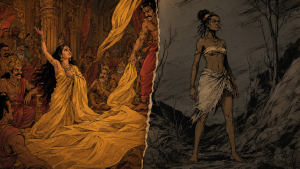
The Man Who Reads the Wrong Books: Senanayak and the Problem of Understanding
On Power, Knowledge, and the Limits of the Liberal Mind in “Draupadi”
Here is a thought experiment. Imagine a professor who spends twenty years studying poverty — reading every book, writing every paper, giving every lecture. They know the statistics, the theory, the historical context. They can hold the perfect conversation about inequality at any dinner party. And yet they have never actually talked to a poor person for longer than the duration of a research interview. What does that professor actually know?
This tension — between knowing about someone and truly understanding them — is one of the deepest questions buried in Mahasveta Devi’s “Draupadi.” And the character who forces us to confront it is not Dopdi herself, but her captor: the elderly Bengali army officer called Senanayak.
Senanayak: The Most Interesting Villain
Senanayak is not your typical military brute. He is cultured, sophisticated, and self-aware. He reads — not just army manuals, but literature. We are told he has an “anti-Fascist paperback copy of The Deputy” by Rolf Hochhuth, a German play about the Holocaust. He reads David Morrell’s First Blood (yes, the novel that became the Rambo film) and finds in it a validation of his counter-insurgency methods. He theorises. He plans to write about the Naxalite uprising from a sympathetic perspective — he genuinely believes he “understands” the field hands, the tribals, the insurgents.
And here is the truly uncomfortable part: he is probably right that he understands them, at least in the technical sense. He knows their methods, their psychology, their motivations. He can predict their movements. He has been outthinking them for six years. His knowledge is real.
And yet he orders Dopdi to be gang-raped. And at the end of the story, when Dopdi walks toward him naked and bleeding, he is “terribly afraid” — and cannot explain why.
What kind of understanding is it, exactly, that can co-exist with such violence?
The Theory-Practice Split
The story is obsessed with the gap between theory and practice, between what people say they believe and what they actually do.
Senanayak, in theory, respects the Naxalites. He thinks their cause is historically meaningful. He has even written articles sympathetic to the field hands. In practice, he “apprehends and eliminates” them. He rationalises this as pragmatism — history is moving in a certain direction, and he is doing what the moment requires. He will shed his guilt when the time comes. His self-image for the future, tellingly, is Prospero — Shakespeare’s magician from The Tempest who controls the island and its inhabitants but likes to think of himself as benevolent.
The story skewers this beautifully. “Whatever his practice,” Devi writes, “in theory he respects the opposition.” The italicisation is deliberate. This sentence, in italics, sits in the text like a small acid burn. Because what good is theoretical respect if the practice is elimination?
Think of it this way. A colonial administrator in 19th-century India might have genuinely admired certain aspects of Indian culture, learned Sanskrit, written essays about the depth of Hindu philosophy — and still implemented policies that destroyed entire communities. Loving a culture in the abstract while oppressing its people in the concrete is not a contradiction for such a person. It is actually a very stable position, because the theoretical admiration makes the practical violence feel more legitimate. “I understand them,” says the oppressor. “I know them better than they know themselves. That is precisely why I know what needs to be done.”
Senanayak is this figure, translated into a 1970s Bengali army camp.
Gayatri Spivak’s Key Insight
It is impossible to read “Draupadi” without also reading Spivak’s extraordinary foreword to her translation, which is almost as long as the story itself. In that foreword, Spivak says something that has echoed through decades of literary and postcolonial theory.
She says that she translated the story partly because of Senanayak — because in him she recognised “the closest approximation to the First-World scholar in search of the Third World.” She is talking about academics like herself: people from privileged, educated positions who study marginalised communities with the best intentions, but who — like Senanayak — can understand everything about those communities except what it actually feels like to be them.
She goes further and turns the mirror on herself. When she studies and writes about women like Dopdi, is she doing something fundamentally similar to what Senanayak does — collecting information, interpreting it, and then speaking about rather than for the people involved? She doesn’t let herself off the hook. She says: as I look in the glass, it is Senanayak with his anti-Fascist paperback that I see.
This is a remarkable thing for a scholar to say. It is an admission that even well-meaning intellectual work can be a form of appropriation — that the act of “making sense” of someone else’s suffering for an educated audience can inadvertently replicate the power structures that caused that suffering in the first place.
What’s in a Name (Again): Senanayak
Even Senanayak’s name is part of the story’s argument. In Bengali, “Senanayak” simply means “army chief” — it is a common noun, not a proper name. He has no first name in the story, no personal identity distinct from his function. Spivak points this out: unlike Dopdi, who has two names (Dopdi and Draupadi) and a whole inner life, Senanayak is only his role. He is the state, in human form.
This is significant because one of the things the story is doing is questioning the nature of individual identity in a political system. Senanayak thinks of himself as a complex individual — a reader, a thinker, a future author. But the story refuses to grant him that complexity. His name is his job. He exists to eliminate. And his elaborate self-understanding is simply the machinery of power trying to feel good about itself.
The Limits of Understanding
Near the end of the story, there is a moment that crystallises everything. Senanayak uses Dulna’s corpse as bait, trying to draw out other insurgents. He waits in the trees with his soldiers, in green camouflage, “like so many great god Pans.” He is sure someone will come for the body — he has calculated this. He has read the situation correctly.
Nobody comes. The soldiers end up shooting two hedgehogs.
All his knowledge — his files, his articles, his theories, his “almost deciphered” reading of Dopdi’s song — cannot ultimately give him access to what Dopdi knows. He can map the outside of her world. He cannot enter it. Dopdi’s song remains untranslated. Her solidarity with her comrades is total and invisible to him.
And then, at the very end, when Dopdi stands before him naked and refuses to be covered, he literally does not know what to say. The text says the question “What is this?” dies in his mouth before he can even ask it. He has no category for what he is seeing. His entire framework — military strategy, literary empathy, theoretical analysis — fails him completely before an unarmed, wounded, unashamed woman.
This is the story’s sharpest point. Understanding, as Senanayak practices it, is ultimately a tool of power — a way of managing and controlling the other. Real understanding — the kind that would make you see Dopdi as a full human being rather than a problem to be solved — would have made his actions impossible in the first place.
He could read all the books in the world. He could never read Dopdi.
Why This Still Matters
In 2026, we are surrounded by Senanayaks. They are the think-tank researchers who write eloquent papers on poverty while policies they support make poverty worse. They are the executives who commission diversity reports while their own companies remain unchanged. They are the academics who publish brilliantly on oppression while performing that very oppression in their institutions.
Devi’s genius was to make this kind of hypocrisy legible, specific, and deeply literary. She didn’t write a polemic. She gave us a character so convincing, so recognisable, so human in his self-deceptions, that we cannot simply dismiss him. We have to sit with the discomfort of recognising him — perhaps even recognising a little of him in ourselves.
That is what great literature does. It doesn’t let you stay comfortable.
Next post: The final and most famous moment of the story — Dopdi’s naked confrontation with Senanayak — and what it tells us about resistance, the female body, and who gets to feel ashamed.