Meet Dopdi Mejhen: The Story That Refuses to Be Silenced
A Reading Guide to Mahasveta Devi’s “Draupadi”
There is a certain kind of story that does not let you put it down after the last page. Not because it is comfortable — it isn’t — but because it keeps asking questions even after you’ve closed the book. Mahasveta Devi’s short story “Draupadi” is exactly that kind of story. It is barely thirty pages long, but the weight it carries is enormous. It is a story about a tribal woman, a forest, a manhunt, and an ending that has shocked and moved readers for decades. More than that, it is a story about who gets to be heard, who gets to be seen, and who gets to be afraid.
Let’s start from the beginning.
Who Is Mahasveta Devi?
Mahasveta Devi (1926–2016) was a Bengali author, journalist, and activist who spent much of her life writing about the people Indian society had pushed to its margins — tribal communities, landless peasants, bonded labourers. She wasn’t writing from a distance. She would travel to villages, sit with people, listen to them, and then come back and write. Her prose is sharp and unsparing, but it never becomes cold. You feel the heat of real anger in it.
“Draupadi” was first published in Bengali in 1978, in a collection called Agnigarbha — meaning “Womb of Fire.” That title tells you something about the mood of the entire collection. These are stories born from the fire of real political events. The story was translated into English by the famous scholar Gayatri Chakravorty Spivak and published in the journal Critical Inquiry in 1981. Spivak’s lengthy foreword to the translation has itself become one of the most discussed pieces of postcolonial literary criticism ever written.
What Is the Story About?
Here is the basic plot, told plainly.
It is 1971. The state of West Bengal is in turmoil. A peasant rebellion that started in the Naxalbari area in 1967 — the Naxalite movement — has spread across the region. Landless tribal farmers and harvest workers, furious at the centuries of exploitation by landlords and moneylenders, have taken up arms. The Indian government, alarmed, has sent the army to crush the movement.
Our protagonist is Dopdi Mejhen — or Draupadi Mejhen. She is a twenty-seven-year-old Santal tribal woman. She and her husband Dulna are both Naxalite fighters, wanted by the state for their role in organising resistance against a local landlord named Surja Sahu. They have been living underground, hiding in forests, moving between villages. The story opens with the army closing in on them.
Dulna is shot dead while drinking water from a stream. Dopdi, now alone, is being tracked. She is eventually captured — betrayed by two informers — and brought to the military camp. The army officer in charge of the operation is the sophisticated, well-read Senanayak, who has built his career on understanding and destroying the Naxalite underground.
Once Dopdi is in the camp, Senanayak orders his men to “make her” — a chilling phrase that means she is to be gang-raped. The soldiers comply through the night.
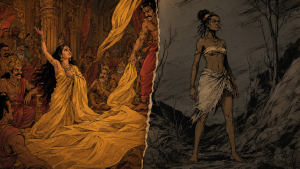
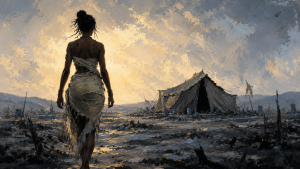
The next morning, Dopdi does something nobody expected. When ordered to be brought before Senanayak, she tears apart her clothing, refuses to cover herself, and walks toward him naked, wounded, bleeding, and laughing. She forces him to look at what his soldiers have done to her body. She confronts him. And for the first time in the story, the powerful military officer is afraid.
Why Does the Story Matter?
This might sound like a story about victimhood. It absolutely is not.
Think of it this way. Imagine someone being robbed of everything — their home, their dignity, their body — and then, in the final moment, turning to the robber and saying: “You can take all of this from me. But you cannot make me feel ashamed of it.” That reversal is at the heart of “Draupadi.”
Dopdi’s nakedness in the final scene is not a sign of defeat. It is a weapon. She weaponises the very violence that was done to her, holding it up as evidence, as accusation, as a challenge. The state wanted to destroy her will. Instead, her will is the only thing left standing.
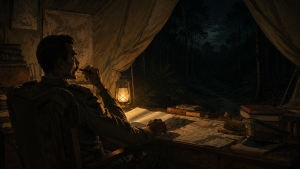
The story also matters because it forces us to ask uncomfortable questions. Who gets to write the official record of history? In the story, Senanayak keeps detailed files on insurgents, reads anthropological literature, and even plans to write about the Naxalites in the future. He is the one with access to archives and language. Dopdi, by contrast, sings songs in a tribal dialect that even the “specialists” cannot decipher. Her story only survives because Mahasveta Devi wrote it.
In 2021, Devi’s story was deleted from the English Honours syllabus of Delhi University on the grounds of “hurt sentiments” — which tells you something about just how alive and unsettling this text continues to be, nearly fifty years after it was written.
A Note on the Setting
To truly understand the story, it helps to know a little about the Naxalite movement. On May 25, 1967, a peasant rebellion began in Jote village in Naxalbari, West Bengal, with the slogan “land to the tiller.” This movement created an indigenous agrarian reform leadership led by the lower classes, including tribal cultivators.
The story is set against the backdrop of the Naxalite movement (1967–71), the Bangladesh Liberation War (1971), and the forests and villages of Birbhum, Bankura, and Jharkhani. The Indian government cracked down hard on the movement after 1971. Thousands of tribal fighters were killed, tortured, and “countered” — a coded military term for extra-judicial killing that the story uses with devastating irony.
Dopdi and Dulna are not just fictional characters. They represent the thousands of tribal people whose resistance was erased not just physically, but from the historical record itself.
Reading the Story for the First Time
When you first read “Draupadi,” you might notice its unusual style. The narrative keeps shifting — from a police dossier, to dry bureaucratic language, to Dopdi’s vivid interior thoughts, to a bitter mock-parliamentary question-and-answer session about how many rebels have been killed. Mahasveta Devi switches registers constantly, almost like she is showing you the same event through multiple lenses.
This is intentional. The story is asking you to notice how different people tell the same story differently. The state has its language. The army has its language. And Dopdi has hers — a language the army cannot even translate properly.
It is a short story, yes. But it is a story built like a maze. Every time you think you’ve found the exit, there is another turn, another question waiting for you.
Start here. Read it slowly. And be prepared for the ending.
This is the first in a series of four blog posts on Mahasveta Devi’s “Draupadi.” Subsequent posts explore the mythological parallels with the Mahabharata, the figure of Senanayak and the politics of knowledge, and the meaning of Dopdi’s final act of defiance.