
The Body as Battlefield: Dopdi’s Final Act and What It Means
On Resistance, Shame, and the Politics of the Female Body in “Draupadi”
Most stories about sexual violence end with the woman diminished — broken, silent, or dead. The violence is the ending. The woman becomes a symbol of what was lost, a wound in the narrative, a reason for the men in her life to seek revenge. Her own feelings after the event — if she survives — are rarely the point.
Mahasveta Devi’s “Draupadi” ends differently. Shockingly differently. It ends with the woman who has just been gang-raped walking, naked and bleeding, toward her attacker — laughing, speaking, pointing at her own wounds, and making him afraid. Not the other way around. The army officer with his guns and his authority and his theories is afraid of an unarmed, unclothed, wounded tribal woman.
How do we read this ending? What does it mean? And why has it unsettled readers — and apparently entire university curriculum committees — for nearly five decades?
What Actually Happens
Let’s be precise about the final sequence of events, because the details matter enormously.
Dopdi is captured and brought to the military camp. Senanayak’s dinner hour approaches, and without even looking up from his routine, he says: “Make her. Do the needful.” He leaves for dinner. The soldiers rape Dopdi through the night, tied to four posts, repeatedly. The narrative describes it in clinical yet shattering terms — counting the assailants, noting the passing of time in cosmic language (“a billion moons pass, a billion lunar years”), describing the physical injuries in detail.
The next morning, Dopdi is brought into the tent and given back her cloth. She is told to present herself before the “Burra Sahib” — the big boss, Senanayak. Here is where the story pivots.
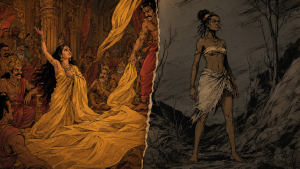
Dopdi pours water from a pot onto the ground (refusing to use it). She tears her cloth apart with her teeth. The guard, confused, runs to ask what to do with a prisoner who behaves “incomprehensibly.” When Senanayak comes out of his tent, Dopdi is walking toward him, naked, “with her head high.” She stands before him, laughs, and says: “The object of your search, Dopdi Mejhen. You asked them to make me up, don’t you want to see how they made me?”
She pushes him with her mangled breasts. She spits at his white bush shirt. And she says: “You can strip me, but how can you clothe me again? Are you a man? There isn’t a man here that I should be ashamed. I will not let you put my cloth on me. What more can you do? Come on, counter me — come on, counter me—?”
Senanayak is, for the first time in the story, terribly afraid.
Shame as a Weapon — Whose Weapon?
Shame is usually thought of as something that happens to the victim of sexual violence. She is the one who is supposed to feel it. She is the one expected to hide, to cover herself, to be silent. This is how patriarchal cultures manage the aftermath of sexual violence: by making the survivor carry the weight of what was done to her.
Dopdi refuses this completely.
Her nakedness, by the end of the story, is not a sign of shame. It is a mirror she holds up to Senanayak. She is, in effect, saying: look at what you ordered. Look at what your soldiers did. This is your work — not my failure, not my degradation, your crime. If anyone here should feel shame, it is you. And I am not going to help you forget what you did by covering up the evidence.
The cloth, in this reading, would be Senanayak’s escape route. If Dopdi put it back on, the visible record of the night’s violence would be hidden. The camp could return to its orderly routines. Nobody would have to look at what “make her” actually produced. By refusing the cloth, Dopdi refuses to let anyone look away.
“Counter Me” — Language as Weapon
One of the most powerful details in the ending is Dopdi’s use of the word “counter.”
Earlier in the story, we learn that “counter” is a piece of police-military slang, an abbreviation for “killed by police in an encounter” — the official euphemism for extra-judicial killing. It is the code the state uses when it wants to dispose of someone quietly, making the killing appear to be a legitimate response to aggression. You are “countered” when the state decides you need to disappear.
Dopdi, throughout the story, knows this word well. She has seen others “countered.” She has mentally prepared herself for being countered. When Mushai’s wife asks if she can run away, she says: “What will they do if they catch me? They will counter me. Let them.”
But in the final scene, she takes this word — the state’s word for erasure — and flings it back at Senanayak as a challenge. “Come on, counter me.” She is daring him to do it. She is saying: go ahead, kill me. That is the only move you have left, and we both know it. You have done everything else already.
The word also carries a double meaning that Spivak highlights: to counter someone is to meet them face to face, to encounter them, to reckon with them as an equal. Dopdi is demanding that Senanayak truly encounter her — not as a target, not as a file in his dossier, but as a person whose suffering he has to account for. It is a demand he cannot meet.
The Body That Cannot Be Recuperated
There is a theoretical term that appears in Spivak’s foreword — “recuperated.” When something is recuperated, it is brought back into the existing system, absorbed, neutralised. A radical idea gets recuperated when it becomes fashionable and loses its edge. A revolutionary gets recuperated when they are celebrated as a hero in museums and textbooks, safely dead and no longer threatening.
Dopdi, in her final act, makes herself impossible to recuperate.
She cannot be pitied, because she is not asking for pity. She cannot be dismissed, because she is standing right in front of Senanayak and cannot be avoided. She cannot be punished further, because she is already inviting further punishment. She cannot be covered up, because she is the one tearing the cover apart. Every move the system would normally make to manage her — to explain her, categorise her, neutralise her — she has already pre-empted.
This is what makes Senanayak afraid. He is a man who has spent his entire career being the one who knows what to do next. He has an answer for every situation, a theory for every event. Standing before Dopdi, he has nothing. He cannot even formulate the question properly — “What is this?” stays in his throat. She has put him in a position his entire worldview has not prepared him for.
Does the Subaltern Speak?
Spivak’s most famous question — “Can the subaltern speak?” — is asked in a later essay, but “Draupadi” is often read as one of the texts that frames that question.
The “subaltern” is a term for those at the bottom of social hierarchies — people who are so marginalised, so outside the structures of power and representation, that they have no real way of being heard by those in power. Their voices, when they speak, get translated, filtered, explained, or ignored. They are spoken about but never truly spoken to.
Dopdi is a subaltern in every sense. She is tribal, female, landless, illiterate, wanted by the state, and brutalised. She sings songs in a dialect that specialists cannot translate. Her story would never be heard if Mahasveta Devi had not written it.
And yet — at the end of the story, in her final confrontation, Dopdi speaks in a way that cannot be ignored. Not through language alone, but through her body, her refusal, her laughter, her wounds. Senanayak — who has built an entire career on understanding people like her — has no framework for this. She exceeds everything he knows.
The story seems to be suggesting that sometimes, the subaltern does speak — but that speaking requires giving up everything else first. Dopdi’s voice in the final scene is the loudest in the story. But it costs her everything.
Why the Ending Is Not Simple
It would be easy to read the ending as purely triumphant. Woman defies rapist. Villain is afraid. Resistance wins.
But Mahasveta Devi is too honest a writer to leave it there. Dopdi is still wounded. She is still a prisoner. The story ends with Senanayak being afraid, but Dopdi’s fate beyond that moment is unsaid. “Counter me,” she says. And we know what that means.
The ending is both a victory and a tragedy. Dopdi’s defiance is real and powerful. And it is happening at the very edge of her destruction. She has turned her suffering into a statement, her wounds into a weapon, her nakedness into an argument. But she is still naked, wounded, and surrounded.
This is the honesty that makes “Draupadi” so enduring. It doesn’t offer false comfort. It shows us what resistance can look like at its most extreme, most costly, most human. It shows us a woman who refuses to disappear quietly, who insists on being seen — not despite her suffering, but through it.
Dopdi Mejhen cannot be countered. She has already countered herself.
Reading the Story Today
In 2021, when Delhi University removed “Draupadi” from its syllabus due to “hurt sentiments,” many academics and students protested. The question was obvious: whose sentiments were hurt? Not those of the tribal communities the story represents. The story was removed precisely because it is too clear-eyed about what the Indian state has done — and continues to do — to its most marginalised people.
A story that can still be removed from a curriculum in 2021 for being too dangerous is a story that is still doing its work. Forty-six years after it was written, Dopdi Mejhen is still walking toward her captor. Still laughing. Still daring him to look.
This concludes our four-part series on Mahasveta Devi’s “Draupadi.” We hope these posts have made the story a little more accessible — but more importantly, we hope they have made you want to read it yourself.


One thought on “The Body as Battlefield: Dopdi’s Final Act and What It Means”
A fascinwting discusion iis definitely worth comment. I belisve tat
yoou ought too publish mkre on this issue, itt mayy nnot bbe a
tabhoo mtter butt geerally pewople don’t discuss
these subjects. To the next! Manyy thanks!!