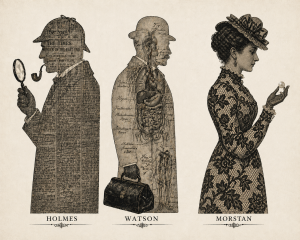
The Architecture of Mystery: Plot and Detective Fiction in The Sign of Four
How Conan Doyle built a genre — and what makes this novel tick as a story
The Sign of Four (1890) is Arthur Conan Doyle’s second Sherlock Holmes novel, and it remains one of the most carefully constructed detective narratives of the Victorian era. Before we analyse it as a cultural document — which it certainly is — it helps to understand it as a story: how its plot is shaped, how its genre works, and why its structure still feels satisfying more than a century later.
What kind of story is this?
Detective fiction as a genre was still relatively new when Conan Doyle published this novel. The form had been pioneered by Edgar Allan Poe in stories like “The Murders in the Rue Morgue” (1841), but Conan Doyle gave it a new energy. The detective novel typically begins with a disruption — a crime, a mystery, a secret — and moves forward through investigation toward resolution. The pleasure of the genre lies in that movement: the reader is invited to follow clues alongside the detective, building toward an explanation that makes the seemingly impossible feel inevitable.
“You have been in Afghanistan, I perceive.”— Sherlock Holmes, meeting Watson for the first time (recalled in The Sign of Four)
In The Sign of Four, the central mystery is layered. A young woman named Mary Morstan arrives at 221B Baker Street with a strange tale: her father disappeared years ago, and she has been receiving mysterious pearls. Holmes and Watson take on the case, which unravels into a story of hidden treasure, betrayal, and a murderous pact made in colonial India.
The double narrative structure
One of the most interesting features of the novel’s plot is what we might call its double narrative. The “present” story — Holmes investigating, the chase on the Thames, the capture of Jonathan Small — is interrupted by a long embedded narrative in Chapter 12, where Small himself recounts the story of the Agra treasure. This is a technique known as analepsis (or flashback): the reader is taken back in time to India to understand how the murder and the treasure came to be.
This structure does important work. It means the novel has two timelines: the colonial past and the Victorian present. The crimes of the past — including the original theft of the treasure — create the conditions for the crimes in the present. Doyle is not just telling a mystery; he is telling us that the past has consequences that travel across time and geography.
Pacing, suspense, and the chase
The novel’s pacing is also worth noting. After several slower chapters of investigation and discovery, Doyle accelerates dramatically in the boat chase on the River Thames. This is one of the earliest extended action sequences in detective fiction, and it shows Doyle’s skill at modulating pace. The genre convention of the climactic chase — villain flees, detective pursues — is here given genuine momentum and geographical specificity. The Thames itself becomes a character.
“The treasure is lost… but I have a higher claim, Watson, in the shape of the woman I love.”— Dr. Watson, The Sign of Four, final chapter
The novel ends on a deliberately domestic note: Watson declares his love for Mary Morstan, and Holmes retreats into cocaine and melancholy. This double ending — romantic resolution for Watson, existential emptiness for Holmes — is characteristic of detective fiction’s ambivalence. The mystery is solved, but something is lost.
Key conventions of detective fiction in this novel
As a first-year student, it is useful to recognise the genre conventions at work: the eccentric genius detective, the loyal narrator-companion, the use of physical clues and logical deduction, the criminal who is given a voice and explanation, and the restoration of social order at the end. The Sign of Four uses all of these, but it also complicates them — particularly around questions of justice, which we will explore in later posts.
Key Terms
Detective fiction: A genre centred on the investigation and solution of a crime, typically through rational deduction.
Analepsis: A literary term for flashback — narrating events that occurred before the main story’s timeline.
Narrative structure: The way a story is organised in time and sequence; how beginning, middle, and end are arranged.
Genre convention: A recognisable feature or pattern that readers expect within a particular type of literature.
Pacing: The speed at which a narrative moves; how tension is built and released through the arrangement of events.
Discussion Questions
- How does the double narrative structure (present investigation + Small’s flashback) affect your experience as a reader? What does the flashback add to your understanding of the mystery?
- Compare the ending of the novel for Watson and for Holmes. What does each man’s conclusion suggest about the costs and rewards of solving crime?
- What makes a mystery satisfying? Using The Sign of Four as your example, identify the elements that create suspense and then release it.