Sriram of Malgudi: The Unlikely Hero Who Changed India
Understanding the Novel’s Protagonist and the Comedy of Good Intentions
At the start of R.K. Narayan’s Waiting for the Mahatma (1955), we meet Sriram: twenty years old, financially comfortable, and doing absolutely nothing with his life. He lives on Kabir Street in the fictional town of Malgudi, looked after by his doting grandmother. He has money sitting in a bank he rarely visits. He spends his days pleasantly but aimlessly. He is, in short, the last person you would expect to become a foot soldier of India’s independence movement.
And yet, by the novel’s end, Sriram has been shaped by Gandhi’s philosophy, imprisoned by the British, separated from the woman he loves, and is present at Gandhi’s assassination. How does an idle young man from a small fictional town find himself at the centre of one of history’s greatest political moments?
That is the central question of Waiting for the Mahatma — and the answer is both funnier and more moving than it might sound.
The Man Who Fell into History (for the Wrong Reasons)
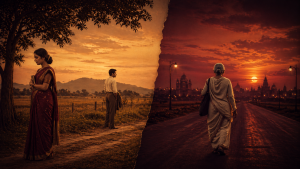
Let’s be honest about Sriram. He doesn’t join Gandhi’s movement because he burns with anti-colonial fire. He joins because he is hopelessly attracted to Bharati, a young woman who works as one of Gandhi’s most devoted disciples.
“His mother, who died delivering him, and his father, who was killed in Mesopotamia, might have been figures in a legend as far as Sriram was concerned.”
Narayan establishes Sriram’s character with quiet efficiency right from the opening pages. He is an orphan — both parents gone before he could know them — raised by a grandmother who loves him fiercely but perhaps too protectively. He is educated but unfocused. There is a famous detail early in the novel: Sriram is more attracted to a framed photograph of a ‘European queen’ in a local shop than to the actual photograph of his own mother. It’s a moment of gentle comedy, but it’s also Narayan’s first hint at a deeper point: Sriram’s desires have been shaped by colonialism in ways he doesn’t fully understand.
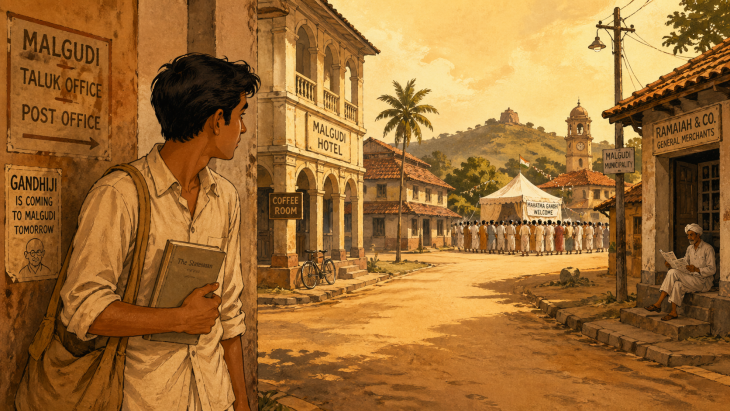
When Gandhi arrives to camp among the untouchable community at Nallappa’s Grove outside Malgudi, the whole town is stirred up. Sriram goes along with the crowd and, in the crowd, sees Bharati. What follows is one of the most charming and quietly comic scenes in Indian English fiction: Sriram inventing reasons to stay near Gandhi’s camp, Gandhi seeing through him immediately, and yet accepting him anyway.
The Picaresque Hero: A Rogue with a Heart
Scholars call Sriram a “picaresque hero” — a term worth understanding. The picaresque is an old literary form (it began in sixteenth-century Spain) featuring a roguish, low-born protagonist who stumbles through a series of misadventures. He is not a hero in the classical sense. He does not plan. He improvises, makes mistakes, gets into trouble, and somehow muddles through.
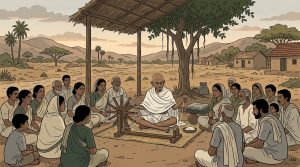
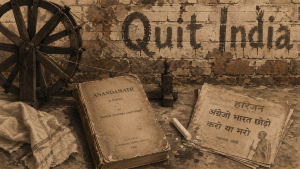
Sriram fits this mould almost perfectly. He blunders into politics. He makes a mess of learning to spin khadi on the charkha (the spinning wheel Gandhi uses as both a practical tool and a powerful symbol). He goes on a mission to write “Quit India” on village walls and finds that most villagers are either indifferent or confused. He falls in with a violent underground cell and participates in railway sabotage — a direct betrayal of the Gandhian non-violence he is supposed to embody.
But here is what makes Narayan’s use of the picaresque interesting: Sriram is not just a comic figure to laugh at. He is also transformed by his experiences. Cynthia Vanden Driesen, writing the first major scholarly essay on the novel, argues that Sriram’s story follows a pattern from the Bhagavad Gita: the sin of anger being gradually subdued through suffering and love. That is a rather grand description of a fairly bumbling young man, but it captures something real.
Granny: The Person He Leaves Behind
No discussion of Sriram is complete without his grandmother, who is arguably the novel’s most emotionally affecting character. Granny represents the domestic world that Sriram must leave in order to enter history. She does not understand the independence movement. She does not understand Bharati (whom she suspects, with some jealousy). She understands Sriram, the pension money, and the rhythms of Kabir Street.
Sriram’s departure is not cruel — he loves Granny — but it is a form of abandonment. And the novel records the cost. Granny deteriorates in his absence. She nearly dies and is taken to a burning ghat. In one of the novel’s most devastating scenes, Sriram encounters her there but cannot acknowledge her because he is a fugitive from the police. She survives the pyre, only to be considered ‘dead’ by her community (a person who returns from the threshold of death is considered an ill omen in traditional belief) and is forced to exile herself to Varanasi, the holy city. She goes to die in the holiest place in India — and Sriram never truly comes back for her.
Narayan never moralises about this. He simply shows it. The political story and the domestic tragedy run in parallel, and the reader is left to draw the connection.
What Sriram’s Story Means
By the novel’s end, Sriram has been genuinely changed. He is not the same person who first attended Gandhi’s prayer meeting out of romantic interest. He has suffered, been imprisoned, been separated from the people he loves, and learned — imperfectly — what it means to wait, to endure, and to commit. Gandhi gives him and Bharati his blessing for marriage. That is his reward.
But the reward arrives in the shadow of Gandhi’s assassination. The novel’s final scene takes place at Gandhi’s prayer meeting in Delhi, where Sriram and Bharati are waiting in the crowd. And then the shots ring out.
Narayan’s choice to make his protagonist a confused, self-interested, comic everyman is not a limitation — it is his argument. History is not made only by idealists and saints. It is made by people like Sriram, who stumble into it for the wrong reasons and are slowly, painfully shaped by it.
Key Terms
| Term | Definition |
| Picaresque | A literary mode featuring a roguish, episodic protagonist whose misadventures expose society’s failings. Think of it as the novel’s ancestor to the modern antihero. |
| Khadi | Hand-spun, hand-woven cloth promoted by Gandhi as a symbol of Indian economic self-reliance and resistance to British imports. |
| Charkha | The spinning wheel — Gandhi’s most potent symbol, representing disciplined labour, self-sufficiency, and the subordination of the ego to the collective good. |
| Picaresque hero | A protagonist who is not born noble or destined for greatness, but who is shaped by experience, error, and encounter. Sriram is Narayan’s version. |
| Nallappa’s Grove | The marginalised area outside Malgudi where the untouchable community lives. Gandhi’s deliberate choice to camp here is a political and moral statement. |
Discussion Questions
| 1. | Sriram joins the independence movement because of his attraction to Bharati, not because of political conviction. Does this make him a hypocrite, or does it make his story more realistic? |
| 2. | How does Granny’s storyline comment on the personal costs of political commitment? What does Narayan suggest about the price ordinary people pay for ‘national history’? |
| 3. | Narayan never directly condemns Sriram for his many failures. How does this narrative restraint shape your response to the character? |
| 4. | By the end of the novel, has Sriram genuinely changed? What evidence would you use to support your argument either way? |