Love, Sacrifice, and the Spinning Wheel: Major Themes in Waiting for the Mahatma
From Private Desire to Public Commitment — Narayan’s Most Complex Novel
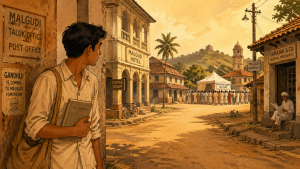
One of the first things readers notice about Waiting for the Mahatma is that Sriram is not a typical political hero. He doesn’t join Gandhi’s movement because he burns with ideological conviction. He joins because he has fallen for Bharati. This is stated openly in the novel, and Narayan makes no attempt to hide it.
This is the central irony — and the central theme — of the novel: can a person enter politics for the wrong reasons and still be genuinely transformed by the experience? Narayan’s answer is yes. But the transformation is not easy, not complete, and not free.
This post explores the major thematic threads of the novel, showing how each one is woven into the others.
Theme 1: Private Desire and Political Commitment
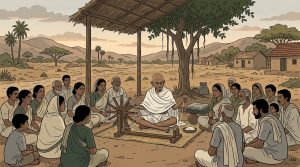
Sriram’s attraction to Bharati is the engine of the novel. Without it, he never goes to Gandhi’s camp. Without it, he never learns to spin, never goes on the Quit India mission, never faces arrest. And yet, paradoxically, this impure motivation is what puts him in the path of genuine transformation.
“Sriram’s story is a skilful interplay between individual desires and nationalistic fervour.” — Jose Matheikal
The novel asks a genuinely interesting philosophical question: does it matter why you do the right thing, as long as you do it? Narayan’s answer seems to be: yes and no. Sriram’s motives are transparent, sometimes embarrassing, often comic. But his experience of the independence movement — the marches, the imprisonments, the underground, the separations from Bharati — does eventually produce something real in him. By the end, his love for Bharati and his love for the Gandhian ideal have become inseparable.
This is confirmed, symbolically, by Gandhi’s decision to bless their marriage. Gandhi, who has always known Sriram’s real motivations, ultimately sanctions the union — not because Sriram has become perfect, but because he has genuinely tried.
Theme 2: Non-Violence and Its Limits
Part Three of the novel is its moral darkest. Separated from Bharati and increasingly purposeless, Sriram falls under the influence of Jagadish, a photographer who runs an underground cell engaged in sabotage against the British. Sriram participates in activities that culminate in the sabotage of a railway line — a derailment that causes unspecified casualties.
This is Sriram’s most serious betrayal of Gandhian principles. And the novel is careful not to let him off the hook. A fellow prisoner later tells Sriram: ‘You call yourself the Mahatma’s disciple, and you have derived no good from it.’ That observation stings because it is accurate.
Against Sriram’s moral collapse, Narayan places Bharati’s principled clarity. Rather than join the underground, Bharati surrenders herself to the police. Her logic is simple: Gandhian satyagraha requires accepting imprisonment rather than inflicting violence, even on your oppressors. For Bharati, surrender is not defeat. It is integrity.
The contrast between Sriram and Bharati here is one of the novel’s sharpest moral statements: both are tested by the same historical moment, and only one passes.
Theme 3: The Common Person and History
One of Narayan’s most distinctive achievements in this novel is his insistence on depicting history through an ordinary, confused person’s eyes. Think about how the independence movement appears to most of the people Sriram encounters in the villages.
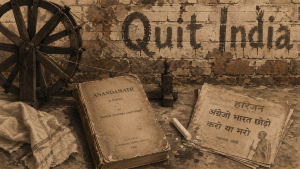
“Sriram taught the children to say ‘Quit India’ repeatedly. They chanted it cheerfully, not caring what it meant.”
There is the teacher who wants to change the slogan ‘Quit India’ to ‘Quiet India’ because he is afraid of trouble. There are the shopkeepers who shrug and go back to their accounts. There are the schoolchildren who learn the slogan as a song, without understanding it as a political demand.
This is not Narayan being cynical about the independence movement. It is Narayan being honest about the gap between nationalist ideology and popular consciousness. History’s big moments do not sweep everyone up equally. They are received differently by different people — with indifference, with fear, with partial understanding, with reluctant participation.
Compare this with Raja Rao’s Kanthapura (1938), the other great novel about the Gandhian movement in South India. In Kanthapura, the village is transformed collectively, swept up in a near-mystical experience of national awakening. In Narayan’s Malgudi, the same movement produces confusion, comedy, and contingency. Neither version is false. Together, they give us a more complete picture.
Theme 4: Domesticity Against National Life
Running parallel to Sriram’s political education is Granny’s domestic tragedy. As Sriram enters history, Granny deteriorates. As he gains political purpose, she loses her world.
The burning ghat scene is the novel’s most powerful expression of this theme. Granny is nearly cremated alive — taken to the pyre because the community believes she is dead. She survives, but the community refuses to take her back: in traditional belief, a person who returns from the threshold of death is an ill omen. She is forced to go to Varanasi, the city where Hindus go to die.
What makes this so devastating is that Sriram is present at the burning ghat but cannot acknowledge her. He is a fugitive. He has traded the most intimate human relationship for an abstract political commitment. And the novel does not excuse him for this.
Narayan is making a feminist and humanist point embedded within the nationalist narrative: the cost of national history is paid at the domestic scale, by ordinary people left behind, separated, and displaced. Granny’s story is not sentimental. It is an indictment.
Theme 5: Independence Achieved, Ideals Betrayed
By the time India achieves independence in 1947, the novel’s tone has shifted considerably. Independence has arrived — but it has brought Partition, communal massacre, Gandhi fasting against his own people’s violence, and finally, Gandhi’s assassination at the hands of a Hindu nationalist.
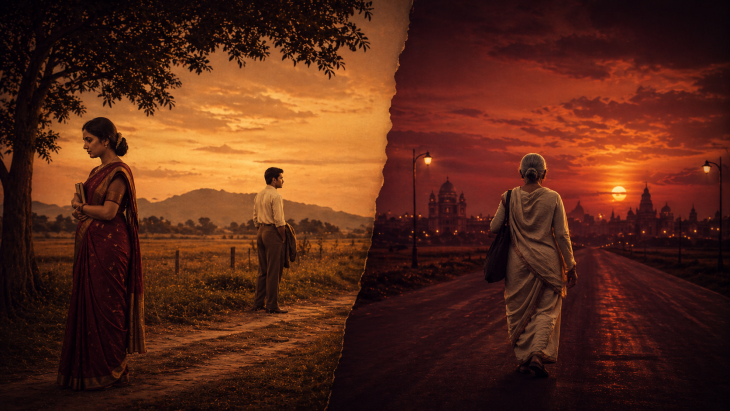
The political liberation that Sriram and Bharati worked and suffered for has been achieved. But it has not produced the India Gandhi imagined. The Gandhian ideal — of a nation built on ahimsa, communal harmony, and self-reliance — appears to have been defeated even as political independence was won.
This is the novel’s most profound irony, and its most serious historical claim. Narayan does not write this with bitterness. He writes it with the same controlled understatement that characterises the whole novel. But the reader cannot miss the point.
Key Terms
| Term | Definition |
| Ahimsa | Non-violence — Gandhi’s foundational ethical principle. In the novel, it distinguishes Bharati’s choice (surrender) from Sriram’s (sabotage). |
| Satyagraha | Soul-force or truth-force — Gandhi’s method of non-violent resistance. Bharati’s surrender to the police is an act of satyagraha. |
| Kanthapura | Raja Rao’s 1938 novel about the Gandhian movement in a South Indian village. Often compared to Narayan’s novel; represents a more mythic, collective vision of Independence. |
| Underground resistance | The secret network of activists who continued the struggle against the British after Gandhi’s arrest in 1942, sometimes using sabotage. Jagadish represents this strand. |
| Allegorical | Having a symbolic meaning beneath the literal surface. Bharati is allegorical — her name means ‘India,’ and she represents the nation’s ideals. |
| Communal violence | Violence between religious communities, especially between Hindus and Muslims. It accompanied Partition in 1947 and forms the background of the novel’s final section. |
Discussion Questions
| 1. | Is Sriram’s transformation at the end of the novel genuine? What specific events or moments would you point to as evidence of real change? |
| 2. | How does Bharati’s decision to surrender herself to the police compare with Sriram’s decision to join Jagadish’s underground cell? What does this contrast tell us about the novel’s moral framework? |
| 3. | What is Narayan suggesting by showing that the independence Sriram and Bharati worked for arrives alongside Partition and communal violence? Does the novel end in hope or despair? |
| 4. | Granny never understood the independence movement, but she paid a severe price for Sriram’s involvement in it. Is the novel critical of the independence movement itself, or of something else? |